 EveryMemory
What Is Déjà Vu? A Memory Glitch Explained
That eerie 'I've been here before' feeling has a surprisingly tidy scientific explanation - and it says something reassuring about how your brain checks its own work.
Part of the guide: Understanding Memory Loss and Forgetfulness: A Calm, Reassuring Guide →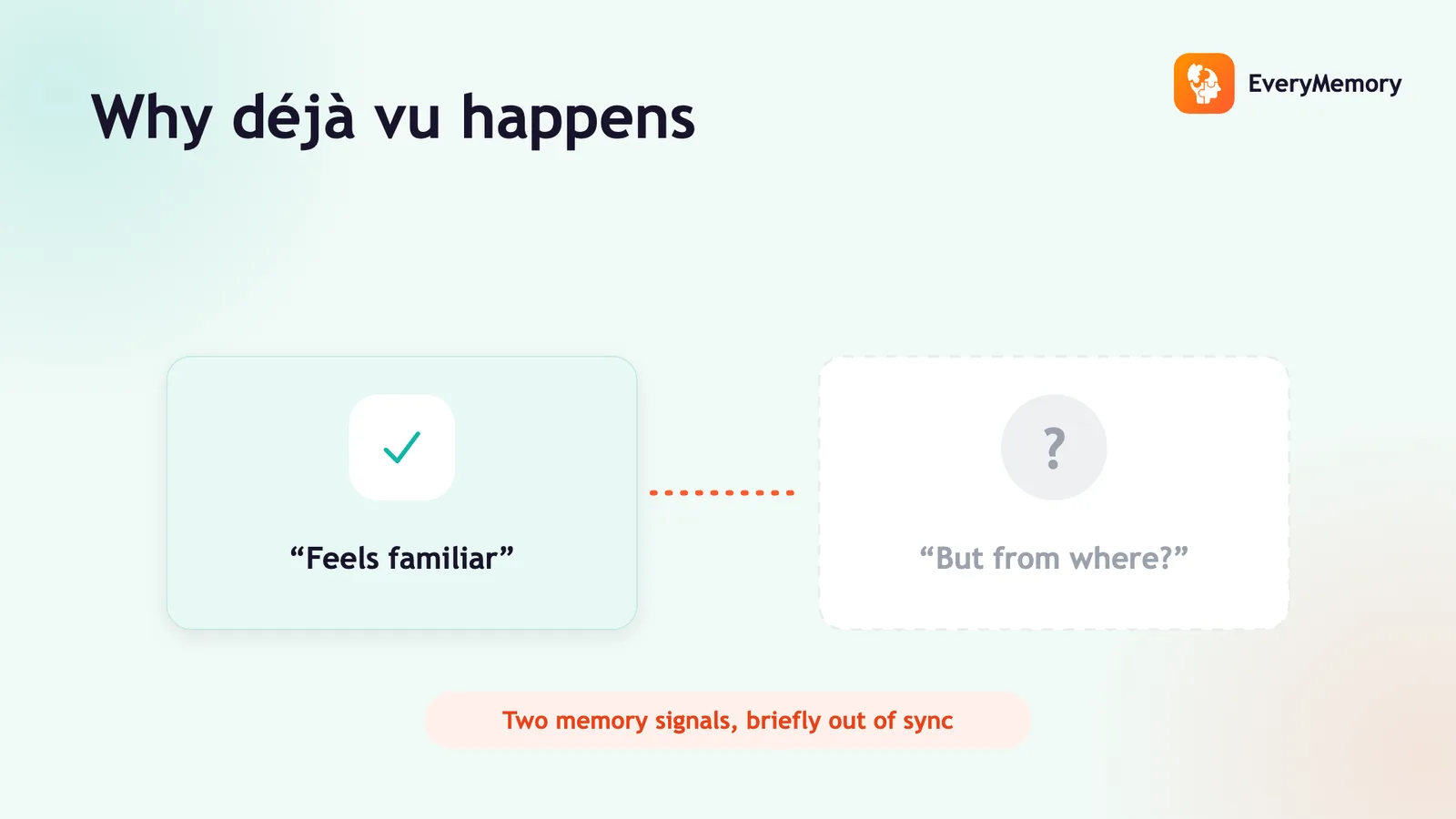
⚡ Quick answer
Déjà vu is a brief mismatch between two parts of your memory system: the familiarity signal fires without a matching recollection to explain it, so a new experience feels strangely familiar. It is extremely common, typically harmless, and reflects the brain actively checking its own memory for errors. Most people experience it a handful of times a year, and it tends to become less frequent as they get older.
Key takeaways
- Déjà vu is a brief mismatch between the brain's familiarity signal and its recollection system - common, harmless, and typically over in seconds.
- It may reflect the brain's conflict-detection system catching and correcting a memory error, which means it can be a sign your monitoring system is working.
- Episodes are most frequent in young adults (15–25) and tend to decline with age as frontal monitoring activity decreases.
- Occasional déjà vu is normal; frequent, prolonged, or symptom-accompanied episodes are worth mentioning to a healthcare professional.
You walk into a coffee shop you have never visited - or so you believe - and a wave of certainty washes over you: you have been here. You recognise the layout, the light, perhaps even what is about to happen next. Then the feeling evaporates, leaving nothing behind except mild bafflement.
That sensation is déjà vu - French for 'already seen' - and it is one of the brain's most reliably puzzling productions. It is also, reassuringly, one of the most common: surveys suggest 60 to 90 percent of people experience it at least once. Far from being mysterious or worrying, déjà vu is increasingly well understood, and what scientists have found is rather elegant.
Two memory systems, one glitch
Understanding how memory works reveals that recognition is not one seamless process - it involves two distinct systems running in parallel: familiarity (a fast, general signal that something feels known) and recollection (the slower retrieval of who, what, when, and where).
Familiarity is handled largely by a region called the rhinal cortex; detailed recollection relies more heavily on the hippocampus. In ordinary remembering, the two sync up seamlessly. Déjà vu happens when they slip out of step. The leading explanation - sometimes called the temporal processing mismatch - holds that if the familiarity signal fires just a fraction before the rest of the experience reaches conscious awareness, your brain briefly tags the scene as 'already known' before realising it hasn't. The result is that split-second conviction of recognition, dissolving almost as quickly as it arrives.
- The familiarity signal fires before the recollection system can find a matching memory.
- The brain detects the conflict and begins to correct it - which is why déjà vu feels so fleeting.
- The sense of knowing what will happen next is an illusion, not genuine foresight.
Your brain catching itself in an error
Here is perhaps the most reassuring reframe: déjà vu may actually be a sign that your memory-monitoring system is working well. Brain imaging studies show that the experience activates not only memory regions but also frontal lobe areas linked to conflict detection - the same circuits that flag when something does not add up.
The brain is not just misfiring; it is catching the misfire. That brief, unsettling quality is the moment the frontal cortex overrides the false familiarity signal and reinstates reality. Once the conflict-detection system flags the discrepancy, the feeling fades and ordinary perception resumes - which is why the whole episode typically lasts only a few seconds.
Why it happens more when you're young - and less as you age
Déjà vu is most common in people between about 15 and 25, and its frequency tends to decline through middle age and beyond. Older brains have more accumulated memories - so why would they produce fewer episodes?
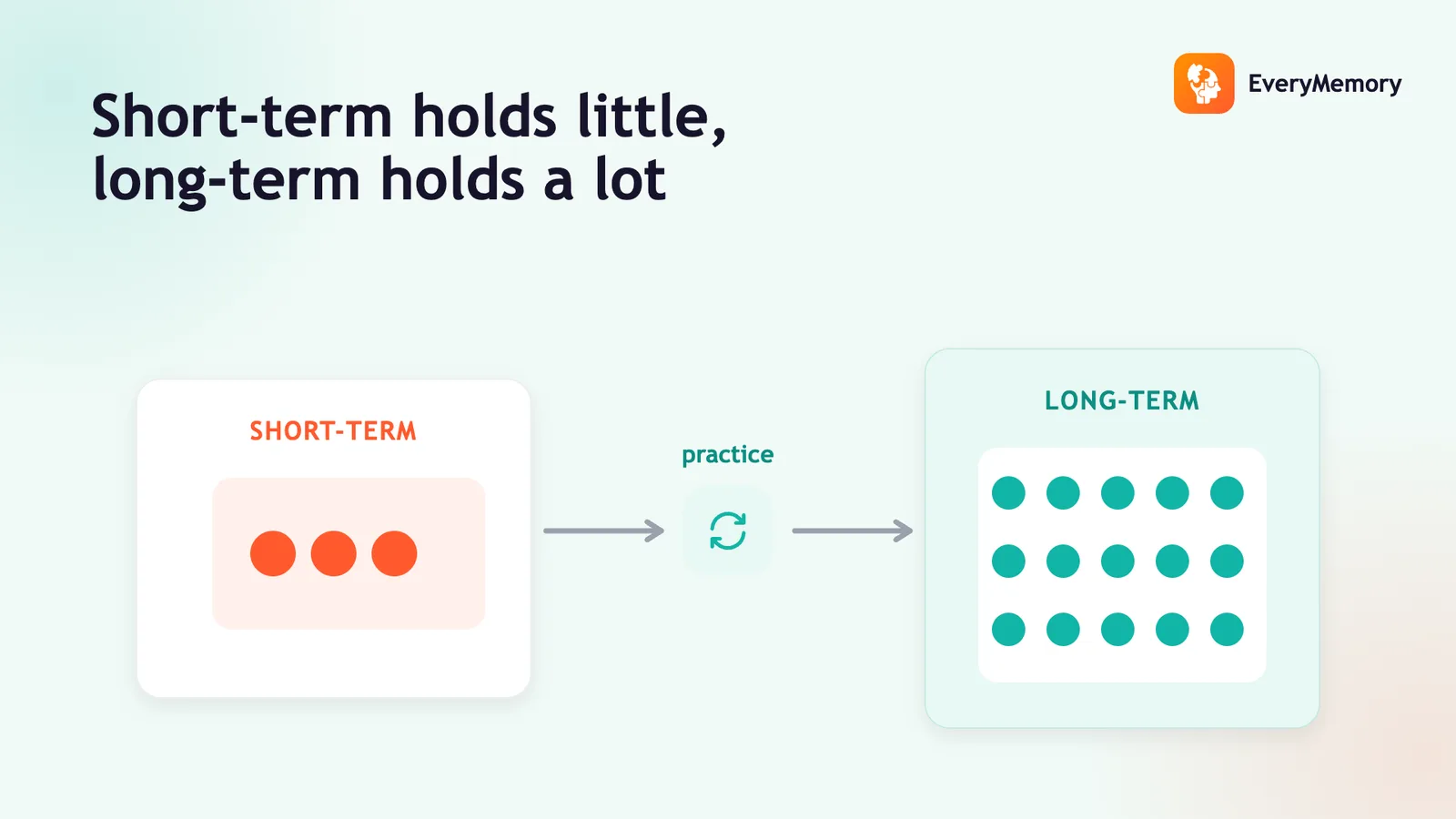
The answer lies in conflict detection. Experiencing déjà vu requires the brain to both generate the false familiarity signal and notice that something is off. Younger brains have higher excitatory neural activity, which makes both steps more likely - they are, in effect, running memory checks more vigorously. As we age, the frontal monitoring systems that flag these mismatches become less sensitive, so fewer slip-ups reach conscious awareness. For a deeper look at how these memory systems shift over time, our piece on short-term vs. long-term memory provides useful context.
Fatigue, stress, and information overload all increase the likelihood of déjà vu - conditions where the two memory pathways are more prone to falling out of step.
The tip-of-the-tongue cousin
Déjà vu is not the only moment when your memory's internal systems slip out of sync. The tip-of-the-tongue state - when a word sits frustratingly just beyond reach - is another example of the familiarity and recollection systems diverging. You know the word exists (familiarity), but the precise label will not load (recollection). Our article on why words get stuck on the tip of your tongue covers the mechanics in full.
Both are normal, common, and harmless - brief moments when the usually seamless machinery of memory runs slightly out of step.
Is déjà vu ever worth mentioning to a doctor?
For the vast majority of people, déjà vu is entirely benign - a brief curiosity, not a concern. A typical healthy adult might notice it a few times a year, lasting only seconds, with nothing else accompanying it.
In rare cases, frequent or prolonged episodes can be associated with temporal lobe activity and occasionally appear as a precursor to certain focal seizures. The key distinction is frequency, duration, and accompaniments. Episodes that are very frequent, last more than a few seconds, or arrive alongside other sensations - a racing heart, a dreamlike feeling, automatic repeated movements - are worth discussing with a healthcare professional.
- A few brief episodes per year, lasting seconds: normal and very common.
- Frequent, prolonged, or intensifying episodes: worth mentioning to a doctor.
- Episodes with other physical or sensory symptoms: see a healthcare professional promptly.
What déjà vu tells us about memory
Déjà vu offers a rare window into memory's normally invisible machinery. Because it is a glitch - a moment when the system briefly misfires - it reveals the distinct moving parts that ordinary remembering keeps perfectly hidden. Familiarity and recollection can come apart, even momentarily, confirming that memory is not a single recording played back unchanged. It is an active, multi-step construction.
The occasional mismatch is not a sign that something is failing - it is evidence of a monitoring system doing its job. For a broader grounding in how these systems fit together, our overview of how memory works is a useful starting point.
✅ Try this today - Notice your next déjà vu
Turn your next episode into a brief moment of self-observation rather than just a passing oddity.
- When déjà vu strikes, pause and name it: 'This is my familiarity system firing without a matching recollection.' Just labelling the experience shifts it from eerie to interesting.
- Notice how long it lasts. Time it if you can. Most episodes dissolve in under five seconds once your conflict-detection system kicks in - observing this in real time makes the mechanism tangible.
- Check the context: Were you tired, stressed, or overwhelmed when it happened? Déjà vu is more common in those states. Tracking this over a few episodes can reveal your personal pattern.
- If the feeling feels unusually prolonged or comes with any other odd sensation, jot down a brief note - date, duration, what accompanied it. A short log is useful context if you ever decide to mention it to a doctor.
⚠ When to talk to a professional
Occasional, brief déjà vu is a common, harmless experience. If you notice episodes that are becoming more frequent, lasting unusually long, or occurring alongside other physical or sensory symptoms, it is worth speaking with a qualified healthcare professional to rule out any underlying cause.