 EveryMemory
How Memory Works: A Simple Guide
Memory isn't a single system - it's a layered process of encoding, storage, and retrieval. Understanding how it works makes forgetting far less worrying.
Part of the guide: Understanding Memory Loss and Forgetfulness: A Calm, Reassuring Guide →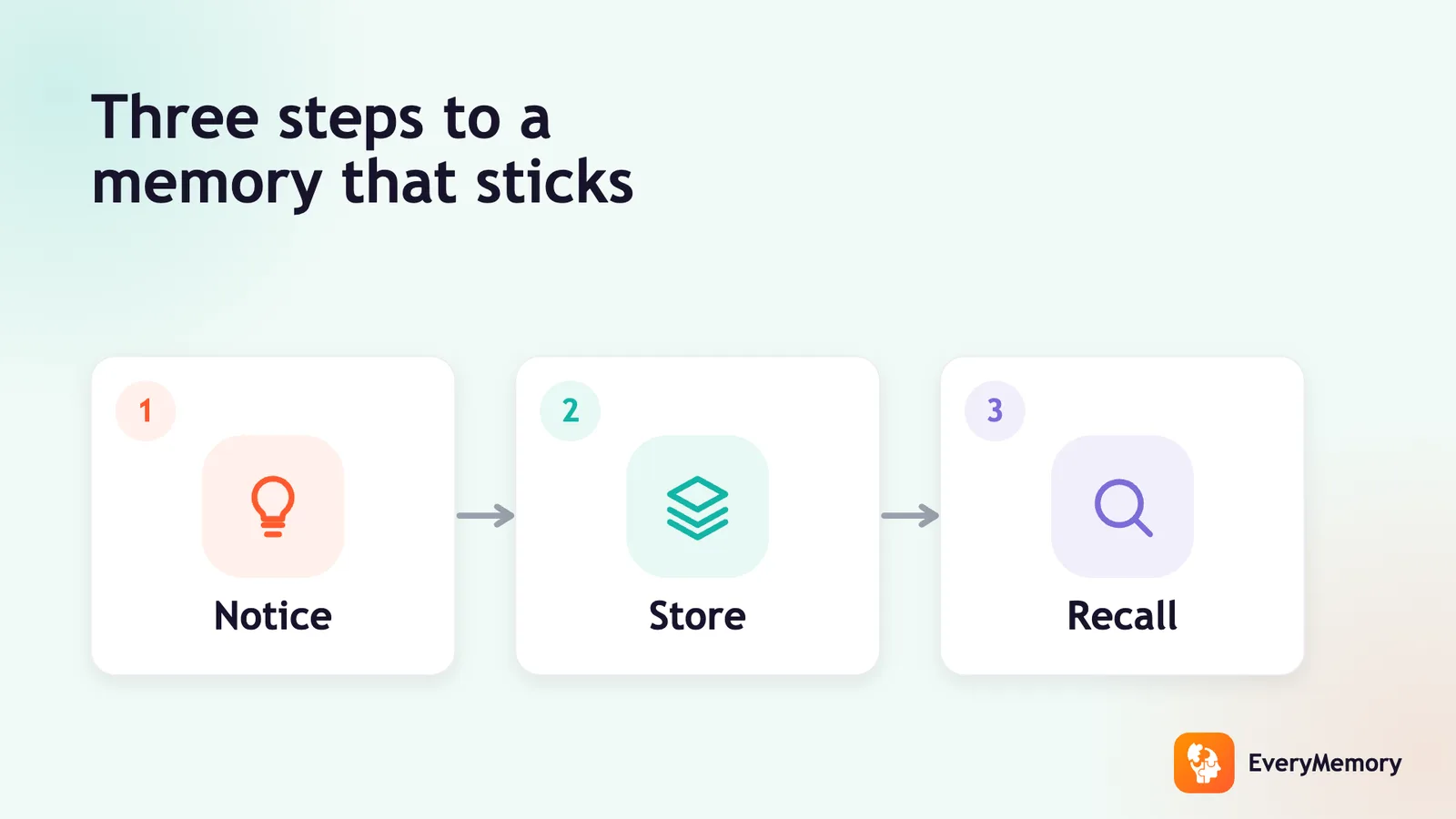
⚡ Quick answer
Memory works in three stages: encoding (taking information in), storage (holding it over time), and retrieval (calling it back when you need it). Each stage can be disrupted by factors like distraction, stress, fatigue, or simply not paying close enough attention in the first place. Most everyday forgetting happens at the encoding stage, not because something is wrong with your brain.
Key takeaways
- Memory has three stages - encoding, storage, and retrieval - and a failure at any one stage produces what feels like a memory lapse, even when the overall system is working well.
- Most everyday forgetting happens at the encoding stage: if attention was split or absent when something occurred, there was never much to store.
- Forgetting is a feature the brain uses constantly to stay usable; what gets retained is what receives attention, emotional weight, or repeated use.
- Sleep plays a central role in consolidation - much of the work of moving information from working memory into lasting storage happens during deep sleep overnight.
Memory is one of those things we rely on every single day without really thinking about how it works - until it seems to let us down. A missed name, a forgotten errand, a word that sits just out of reach. When these moments happen, they can feel alarming. But they usually aren't.
Understanding how memory actually functions makes it easier to put those moments into perspective. It also gives you a clearer sense of what you can do to support your recall through daily habits. This guide walks through the essentials in plain language - no textbook required.
Three stages that work together
Think of memory less like a filing cabinet and more like a series of steps. Information doesn't just land in your brain and stay there - it has to be processed at each stage to become a stable memory.
The three stages are encoding (the moment you take something in), storage (the process of consolidating and holding it), and retrieval (calling it back when you want it). A failure at any one of these stages can produce what feels like a "memory problem" - even if the overall system is working perfectly well.
Most everyday forgetting happens at encoding. If you were distracted, tired, or simply not paying full attention when something occurred, there wasn't much to store in the first place. That's why so many "memory lapses" are actually attention lapses.
| Stage | What it does | Everyday example |
|---|---|---|
| Sensory memory | A brief first impression of what you see or hear | The fleeting image of a face in a crowd |
| Working memory | A mental notepad that holds a few items for seconds | Keeping a phone number in mind long enough to dial |
| Long-term memory | Where information settles for the long haul | Remembering a friend's name for years |
| Retrieval | Finding and bringing back what you stored | Recalling where you left your glasses |
Sensory memory: the brief first impression
Before anything reaches your awareness, your brain takes in a fleeting snapshot of what you're experiencing through your senses - sights, sounds, smells, sensations. This is called sensory memory, and it lasts only a fraction of a second.
Most of that raw input is discarded almost immediately. Only the things that capture your attention get passed along to the next stage. You can influence what gets through by reducing distractions: turning off background noise, making eye contact during a conversation, or pausing before putting something down are all ways of giving the next stage clearer material to work with.
Working memory: the mental notepad
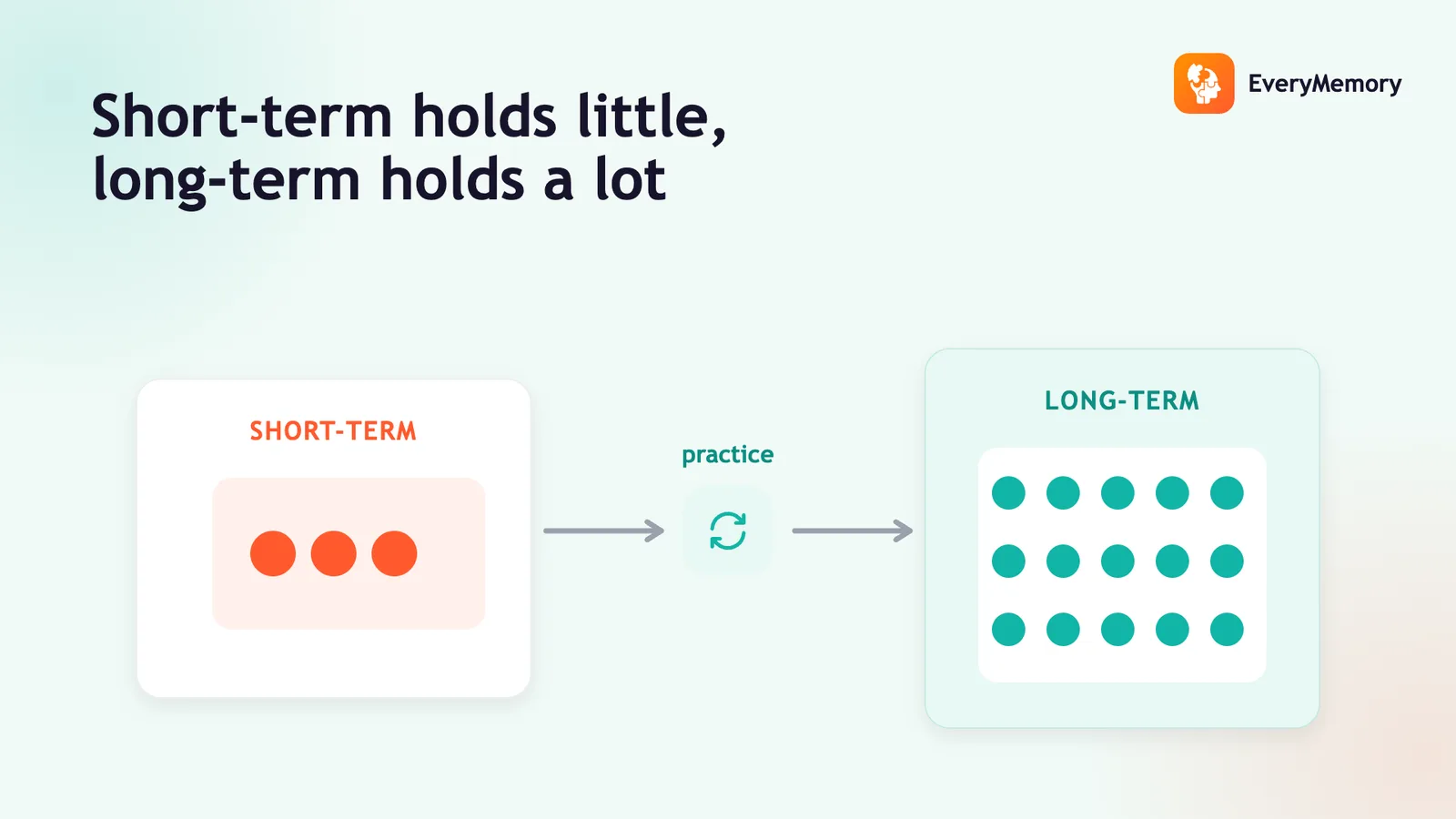
Once something passes through the sensory gateway, it enters what researchers call working memory - or what most people think of as short-term memory. This is your mental notepad: the space where you hold a phone number while you dial it, or keep track of the beginning of a sentence while you're reading the end.
Working memory is genuinely limited. It can hold roughly four to seven distinct pieces of information at once, and it fades quickly - often within 20 to 30 seconds - unless you actively do something with the information.
That limitation is not a flaw. It's a feature that lets your brain stay nimble and focused rather than overwhelmed. The challenge is that when working memory is overloaded - too many things at once, too many interruptions - errors and lapses become more likely. This is explored further in our article on common short-term memory problems.
- Repeating information aloud or mentally helps hold it in working memory longer.
- Breaking information into smaller chunks makes it easier to manage.
- Multitasking directly competes with working memory capacity.
- Stress and fatigue reduce the effective capacity of working memory noticeably.
Long-term memory: where things actually stick
For something to become a lasting memory, it has to move from working memory into long-term storage. This happens through a process called consolidation, which involves the brain strengthening and organising the connections associated with a new piece of information.
Sleep is especially important here - much of memory consolidation happens during deep sleep, which is one reason that a poor night's rest often leaves yesterday's events feeling hazy. Long-term memory itself has different compartments: semantic memory (facts and general knowledge), episodic memory (personal experiences and events), and procedural memory (how to do things, like riding a bike).
Episodic memory - the kind that lets you recall what you had for breakfast or where you put your keys - is the type people most often notice slipping as they get older. Understanding why that happens, and how often it's normal, is the focus of our piece on memory loss versus normal aging.
Retrieval: finding what you stored
Even a well-stored memory doesn't always come back on demand. Retrieval can be blocked by stress, distraction, or the absence of the right mental cue. The classic "tip of the tongue" experience - knowing that you know something, but being unable to bring it to mind - is a retrieval difficulty, not a storage failure.
The memory usually surfaces later when you encounter a related thought or context. You rarely remember things in a vacuum; recall is triggered by connection. Actively testing your recall - trying to remember something before looking it up - strengthens this process over time. That's the core idea behind spaced repetition.
Why forgetting is a feature, not just a flaw
Forgetting has a bad reputation, but your brain forgets constantly and for good reason. If every sensory impression, passing thought, and overheard conversation stayed in memory equally, your brain would be buried under noise. Forgetting is how it stays usable.
What gets retained is what gets repeated, emotionally tagged, or meaningfully connected to something you already know. A name heard once in a noisy room was never fully encoded - that is not memory failure, it's normal.
The forgetting that warrants attention is sudden, worsening over time, or affecting daily life concretely. Our piece on why we forget why we entered a room offers a reassuring look at one of the most common memory moments people worry about.
What this means for everyday life
Once you understand the three-stage process, a few practical principles become obvious. Pay closer attention at the encoding stage - slow down, reduce distractions, and give new information a chance to actually register. Reinforce storage by revisiting important information rather than assuming one exposure is enough. Support retrieval by building cues: write things down, keep objects in consistent places, and use association to connect new information to something familiar.
Memory is also a skill that responds to practice. Using association to remember more is one of the most accessible techniques, and it works with the way your brain naturally stores information - through connection, not through repetition alone.
✅ Try this today - The encode-and-check exercise
Try this with any new piece of information today - a name, an appointment, a grocery item:
- When you hear or read the information, stop for two seconds and say it back to yourself in your own words. Don't move on immediately.
- A few minutes later - before you write it down or look it up - try to recall it from memory. Just attempt it. The effort itself strengthens storage.
- Notice whether you remembered it. If not, don't worry - the act of trying (and then checking) is what builds the habit of active encoding over time.
⚠ When to talk to a professional
This article contains general, non-medical information about how memory works. If you notice sudden, rapid, or significant changes in your memory - or changes that are affecting your daily life - it's worth speaking with a qualified healthcare professional. Occasional, mild forgetfulness is very common and is not usually a cause for concern.