 EveryMemory
Sleep and Memory: What's the Connection?
Sleep is when your brain does most of its memory work - and even mild, regular sleep loss can make recall noticeably worse.
Part of the guide: How to Keep Your Brain Healthy: A Complete Lifestyle Guide →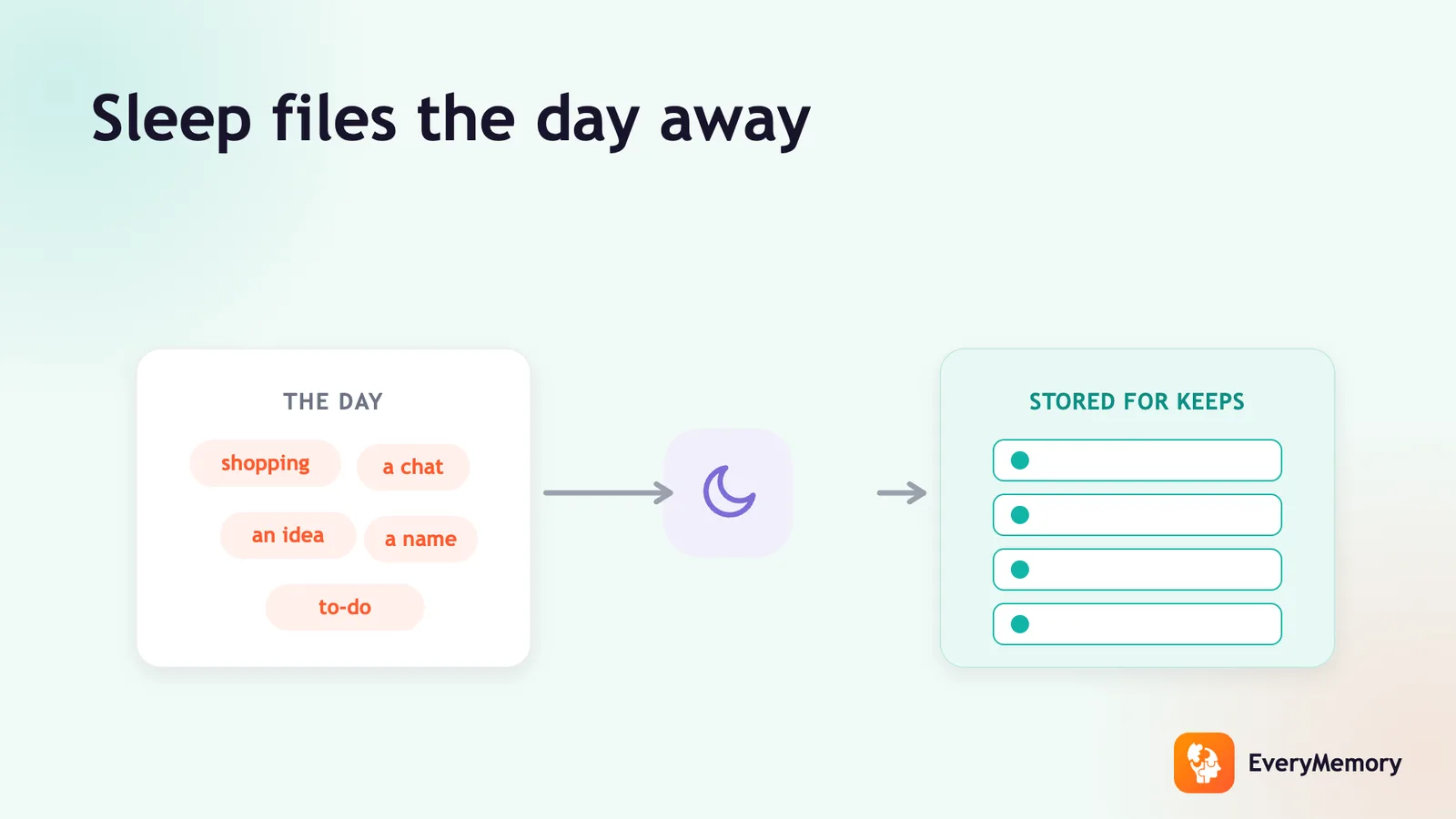
⚡ Quick answer
Sleep is when your brain transfers memories from short-term storage into more stable long-term memory - a process called consolidation. Without enough quality sleep, new memories don't get properly stored, and retrieval of existing ones becomes harder. Consistently poor sleep is one of the most common and most reversible causes of everyday forgetfulness.
Key takeaways
- Sleep is when new memories are transferred from short-term storage into more stable long-term memory, a process called consolidation.
- Deep slow-wave sleep (first half of the night) handles factual memories; REM sleep (second half) handles skill-based and emotional ones - skipping either half costs you something different.
- Older adults spend less time in deep sleep naturally, but many factors that worsen sleep quality - screen use, irregular schedules, worry - are changeable.
- A consistent wake time, morning light, and a screen-free wind-down hour are the habits most consistently linked with better sleep quality.
You stayed up late, slept badly, and today everything feels just a little harder to hold onto. Names slip, you re-read the same paragraph twice, you walk into a room and immediately forget why. This is not your imagination. Sleep and memory are so tightly connected that even a single night of poor sleep measurably reduces recall the following day.
For older adults, this connection matters even more - sleep patterns change with age in ways that affect memory consolidation, and understanding those changes makes it much easier to do something about them.
What your brain does with memories while you sleep
During the day, new experiences are held in a temporary, fragile form - stored in the hippocampus, the brain's short-term intake area. Sleep is when those memories are replayed, reorganised, and transferred into longer-term storage across the broader cortex. This process, called memory consolidation, happens primarily during deep slow-wave sleep and during REM sleep.
Deep slow-wave sleep, which dominates the first half of the night, handles most of the transfer of factual and event-based memories - things you learned, conversations you had, where you put something. REM sleep, dominant in the second half, is particularly important for skill-based and emotional memories. Skip either half of the night and you lose a different part of the process.
This is also why "I'll remember it in the morning" almost never works if the morning follows a short or disrupted night. The filing system only runs during sleep.
| Sleep stage | What it does for memory |
|---|---|
| Deep (slow-wave) sleep | Helps consolidate facts and new information |
| REM (dreaming) sleep | Linked with skills, emotion and creative connections |
| Light sleep | Bridges the stages and supports overall rest |
| Too little of any | Memories are less likely to settle the next day |
How sleep changes with age - and what that means for memory
Sleep architecture changes naturally with age. Older adults tend to spend less time in deep slow-wave sleep, wake more often during the night, and have an earlier natural sleep-wake cycle. None of this is abnormal - it is a well-documented shift. But it does mean that the memory consolidation that happens in deep sleep is compressed.
This is not an irreversible decline. Many of the factors that worsen sleep quality in later life - pain, medication timing, inconsistent schedules, screen use before bed, worrying - are changeable. Improving sleep quality, even without increasing total sleep time, tends to produce a noticeable improvement in next-day recall and mental clarity.
If stress is making you more forgetful, poor sleep is often part of the same loop - stress impairs sleep, and impaired sleep raises stress hormones. Addressing one almost always helps the other.
Signs that sleep may be behind your forgetfulness
Sleep-related forgetfulness tends to be worst in the morning or after a string of poor nights, and better after a good stretch of sleep. It affects recent, everyday information - what was just said, what you were about to do - rather than older, established memories.
- More likely sleep-related: difficulty retaining conversations from the day before, trouble concentrating in the morning, forgetting where you put something hours after putting it there, mental fatigue by mid-afternoon.
- Less likely to be just sleep: memory changes that are progressive and steady regardless of how well you slept, confusion about familiar people or places, or rapid worsening over weeks.
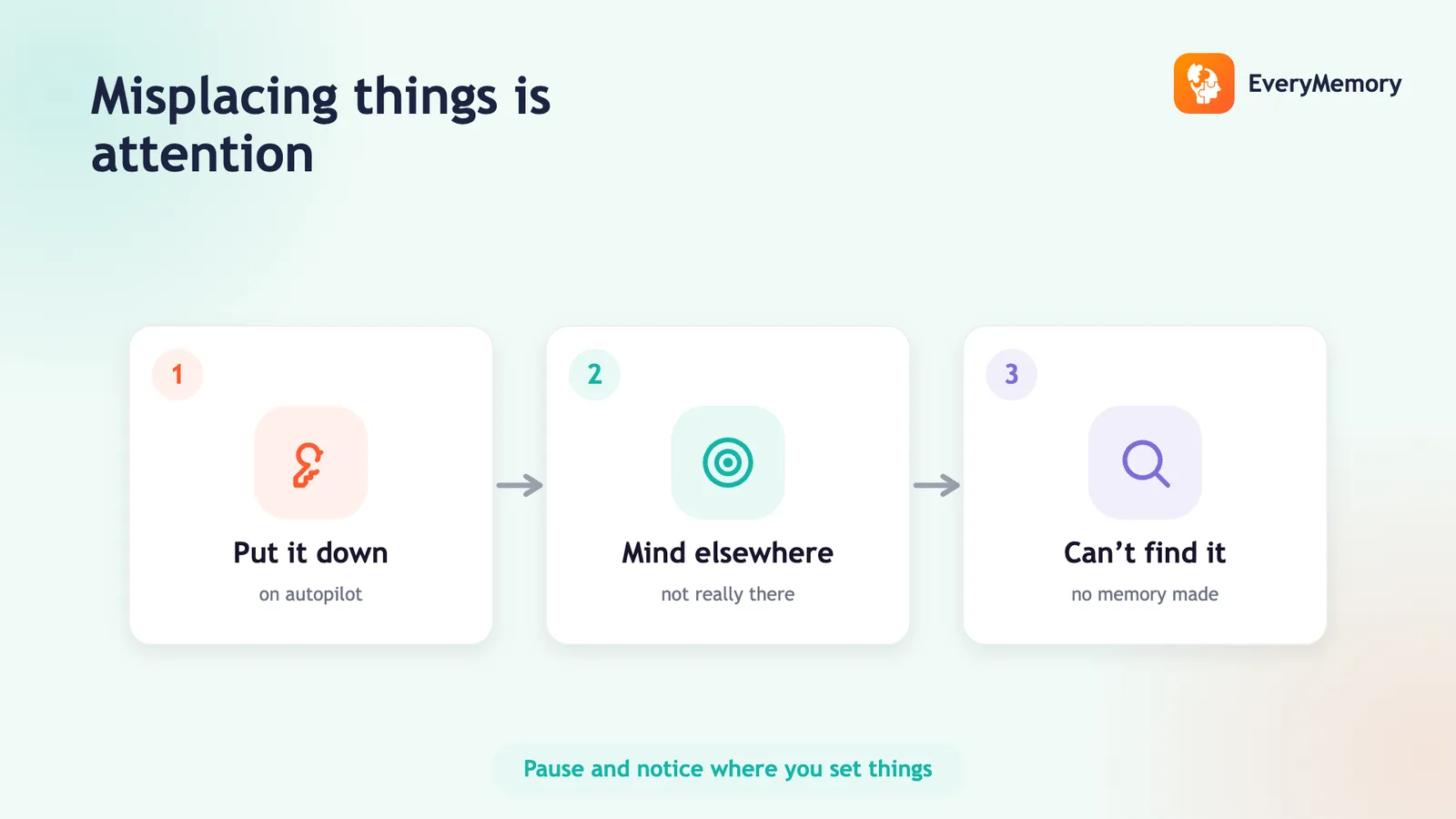
If you also find yourself misplacing things more than usual, ask honestly whether your sleep has been worse lately - the correlation is often very clear.
What genuinely supports sleep quality
The habits that most consistently improve sleep quality in older adults are not complicated, but they do require consistency:
- A fixed wake time, even at weekends. The wake time anchors the whole circadian rhythm more than bedtime does. A consistent wake time steadies the system within two to three weeks.
- Morning light. Fifteen minutes of daylight within an hour of waking sets the internal clock and makes it easier to feel sleepy at the right time in the evening.
- A wind-down buffer. An hour before bed without bright screens or stimulating content gives the brain time to begin the transition to sleep. Gentle reading, light stretching, or conversation work well.
- A cool, dark, quiet room. Core body temperature needs to drop slightly for deep sleep to begin - a cool room helps this happen faster.
- Avoiding long naps. A short nap (20 minutes) in the early afternoon is restorative; a long or late nap can reduce deep sleep pressure at night, worsening the cycle.
Better sleep also reinforces better memory practice. A focus and attention workout is far more effective when done after a good night's sleep - tired attention is weak attention.
Building sleep into a memory-supporting routine
The most durable way to improve sleep-related forgetfulness is to treat sleep as a non-negotiable part of your memory routine, not an optional extra. This means protecting sleep time, taking sleep quality seriously, and noticing patterns in how your memory feels on well-slept versus poorly-slept days.
A simple daily memory routine that includes both deliberate memory practice and a consistent sleep schedule will outperform either alone. And if you want to see how your sleep habits are affecting your recall over time, tracking it through a non-medical memory check can make the connection visible in a surprisingly short time.
✅ Try this today - The consistent wake-time experiment
Try this for two weeks and notice how your morning sharpness changes:
- Choose a wake time you can keep every day including weekends - and set a single alarm for that time.
- Get outside or sit near a window within the first hour of waking to get natural light.
- Each morning, take 30 seconds to recall three things from the previous day before you check your phone.
- At the end of two weeks, note whether morning recall and mental clarity feel different.
⚠ When to talk to a professional
Most sleep-related forgetfulness is common and improves with better sleep habits. If you are experiencing significant or worsening memory difficulties regardless of sleep, or if you suspect a sleep disorder such as sleep apnea, it is worth discussing this with a qualified healthcare professional. This article is general information only.