 EveryMemory
Why Your Memory Isn't a Video Recording
Memory reconstructs the past rather than replaying it - which is why two people recall the same event differently, details shift over time, and a vivid memory can still be imperfect.
Part of the guide: Understanding Memory Loss and Forgetfulness: A Calm, Reassuring Guide →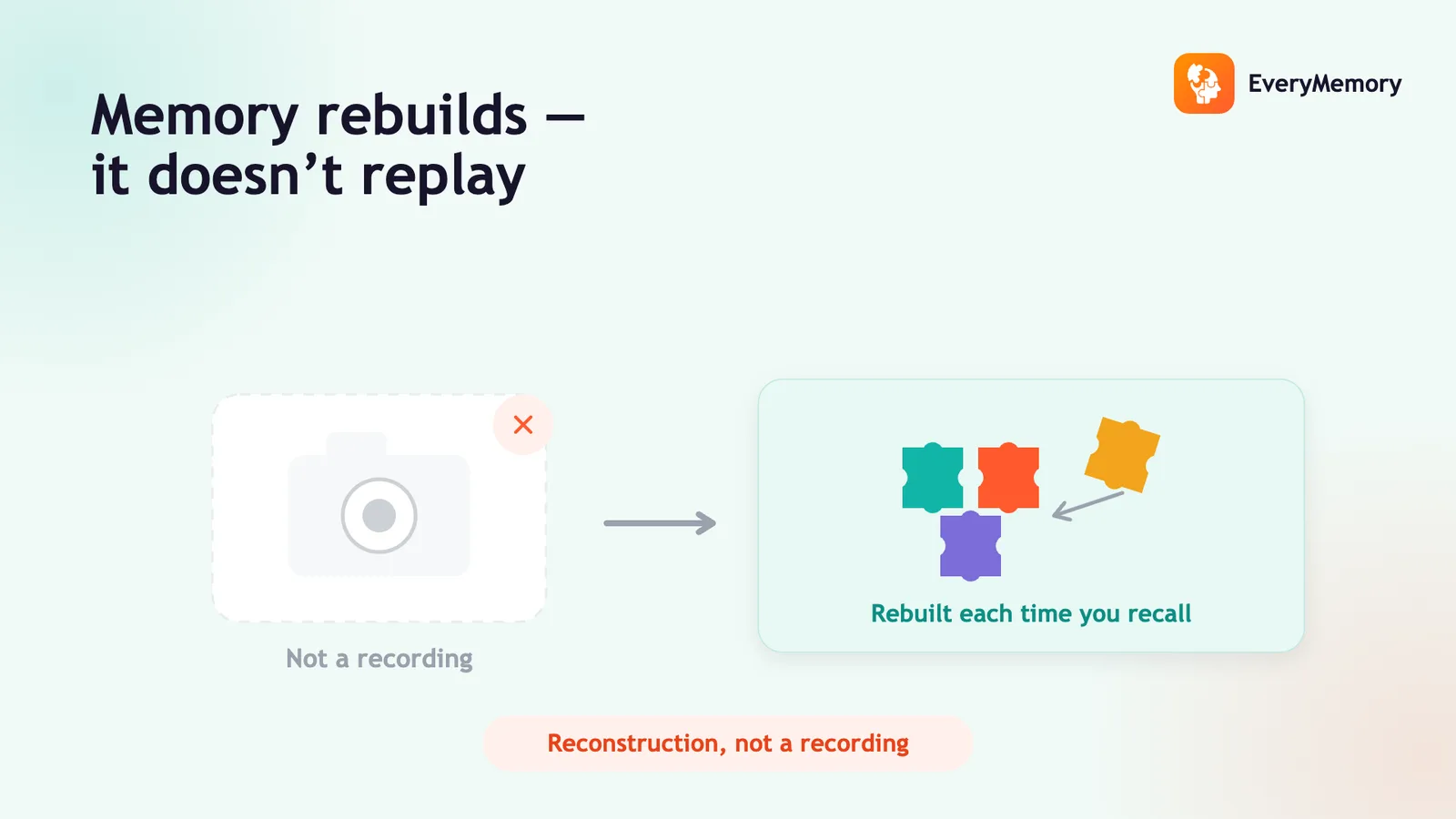
⚡ Quick answer
Memory does not store and replay events like a recording. Each time you remember something, your brain actively rebuilds the experience from fragments - filling gaps with logic, emotions, and what you know now. This is why two people can recall the same event differently, why details shift with retellings, and why a vivid, confident memory may not be perfectly accurate. It is not a flaw; it is how memory is built.
Key takeaways
- Memory reconstructs past events from fragments rather than replaying a stored recording.
- Two people can hold genuinely different memories of the same event - both are honest, normal reconstructions.
- Each time a memory is recalled it can absorb small updates, which is why details drift over years.
- Confidence in a memory does not guarantee accuracy on every peripheral detail, and this is universal, not age-related.
Two siblings sit at the same kitchen table retelling a family holiday from thirty years ago - and they might as well be describing two different trips. One remembers sunshine and laughter; the other remembers the argument on day three. Neither is lying. Neither is losing their mind. They are both doing exactly what memory is designed to do.
The popular image of memory as a mental video camera - faithfully filming life and storing footage for later replay - is one of the most misleading ideas in everyday psychology. Research spanning nearly a century tells a different story: memory is a reconstruction, not a reproduction. Understanding that difference can dissolve a great deal of unnecessary worry about why your memories sometimes surprise you.
Memory as a Builder, Not a Player
In the 1930s, psychologist Frederic Bartlett asked participants to retell an unfamiliar folk story across multiple sessions. The story changed with each retelling - not randomly, but in a predictable direction. Unfamiliar details shifted toward familiar ones; strange elements were smoothed out; the narrative grew tidier. Bartlett called this "effort after meaning" - the brain's drive to make new experience fit what it already knows.
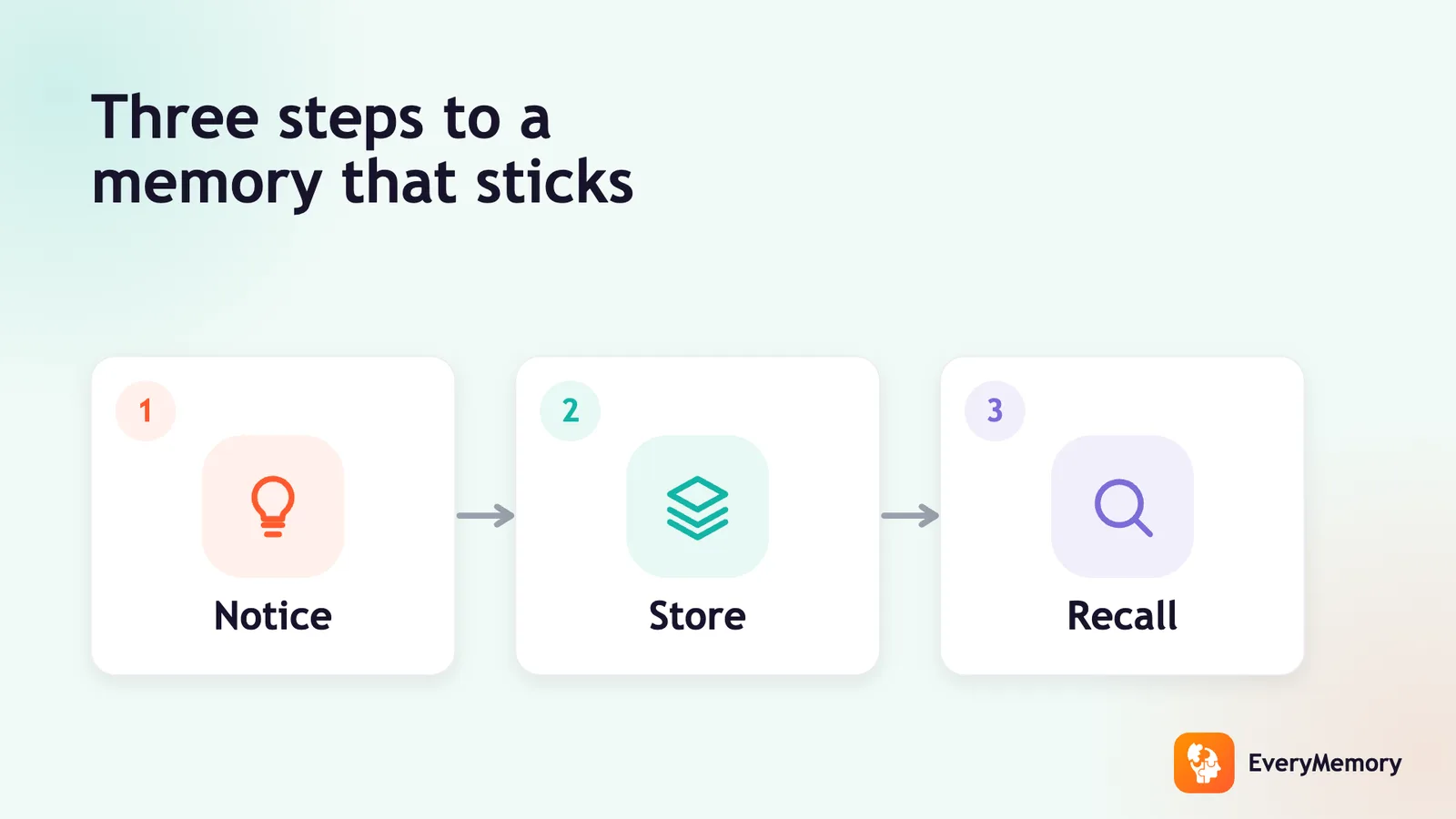
The brain does not file a complete recording of an event; it stores fragments - a dominant emotion, a handful of vivid details, the rough shape of what happened - and reassembles them at retrieval. Gaps are filled automatically using general knowledge and whatever you have experienced since. For a deeper look at the mechanics, how memory works walks through encoding, storage, and retrieval in plain language.
| A camera / recording | Your memory | |
|---|---|---|
| How it stores | An exact, unchanging copy | A reconstruction, rebuilt each time |
| Over time | Stays identical | Details can shift and update |
| Two people | See the same footage | Often remember it differently |
| Confidence | Doesn't change the file | Can feel certain yet be inaccurate |
Why Two People Remember the Same Thing Differently
Reconstruction draws on each person's unique combination of attention, prior knowledge, and emotional state - so two witnesses to the same event build different memories, even when both are trying to be accurate. We cannot record everything at once, so the brain selects: someone anxious about the weather registers the grey sky; someone excited about the food barely notices it.
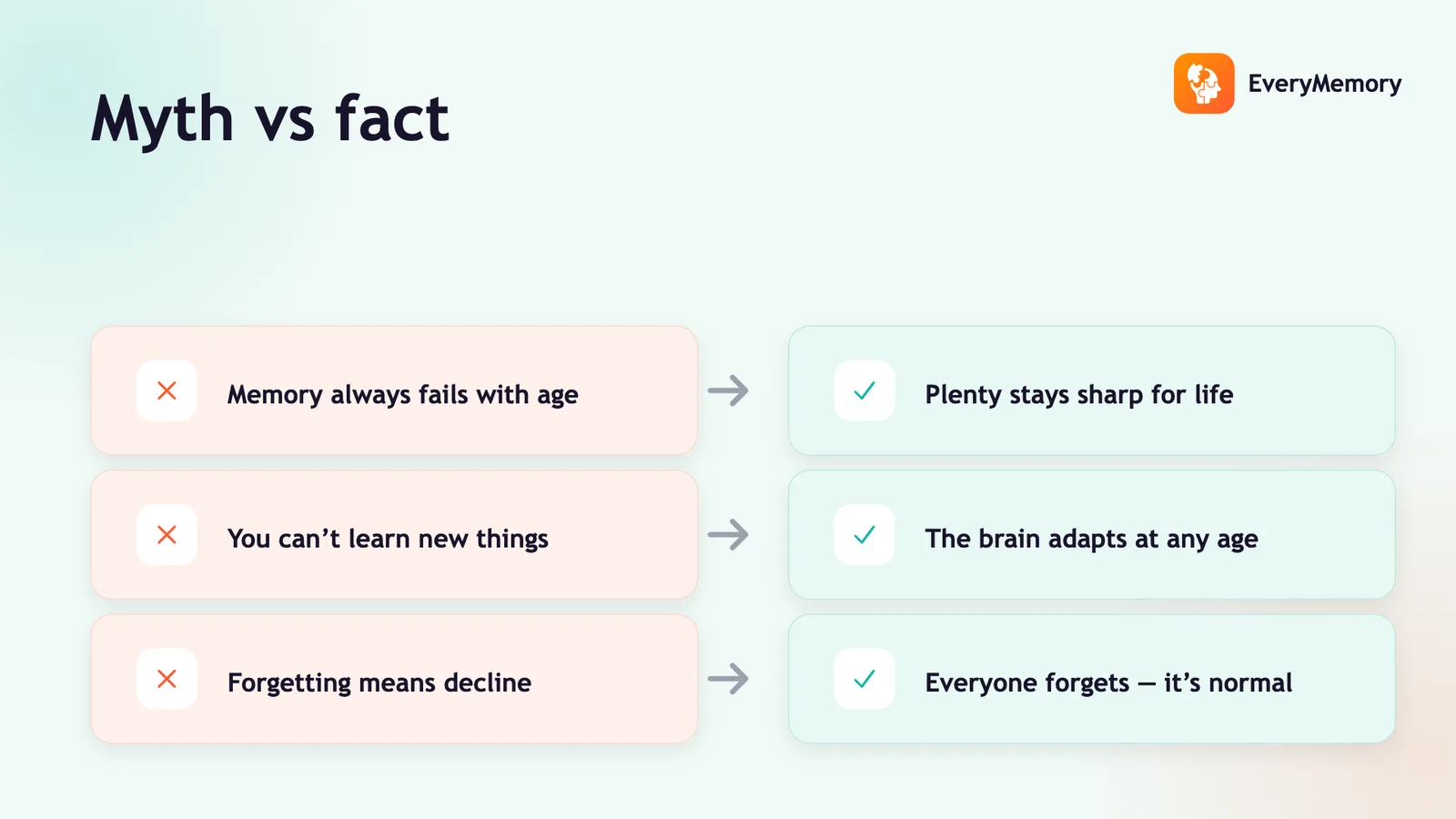
The same ambiguous remark can register as warm to one person and cutting to another. That interpretation - not a neutral transcript - is what gets stored. By retrieval, each person is replaying their own version, and both feel completely real from the inside. Divergent memories between family members are not a sign that someone's recall is failing. They are one of the most common myths about memory and aging worth setting straight.
How Details Shift Over Time
A memory is not frozen at the moment it forms. Research on memory reconsolidation shows that each time you recall an event, it briefly becomes malleable - open to small edits - before being stored again. New information, the mood you are in, what someone else said about the same event, even a photograph you glanced at can quietly weave into the stored version. A memory recalled dozens of times across the years may have drifted in ways you cannot detect.
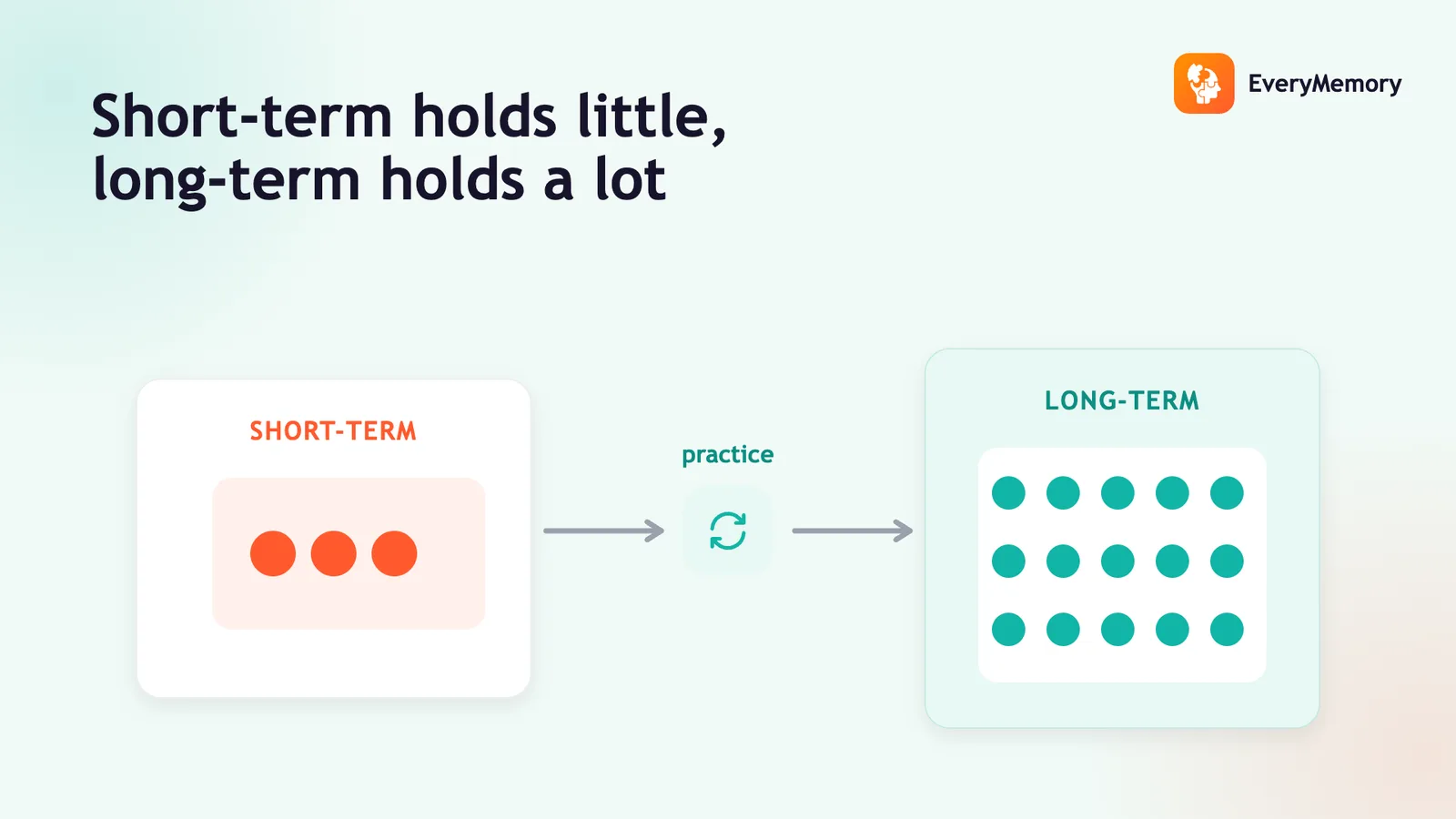
Understanding this pattern sits at the heart of how short-term and long-term memory differ - long-term memories in particular are shaped by every subsequent encounter with the material. We tend to remember the emotional core of charged events with high confidence, but peripheral details - what colour shirt someone wore, exactly what was said - are no more reliable than details from an ordinary Tuesday.
When a Confident Memory Is Still Wrong
Confidence and accuracy do not always travel together. Researcher Elizabeth Loftus demonstrated what she called the misinformation effect: when people receive misleading information about an event they witnessed, a significant proportion later incorporate that misinformation into their recollection - and report it with complete conviction. In one classic experiment, participants who saw a car accident at a stop sign, but were later asked about a yield sign, subsequently remembered seeing a yield sign - one that was never there.
In everyday life this is usually harmless. Misremembering a conversation from last month, or placing a missing item in the wrong room, is the normal background noise of a reconstructive system - not a sign of decline. For a plain guide on what changes are worth paying attention to, see understanding memory loss and forgetfulness.
This Design Has Real Benefits
If memory can drift, fill gaps, and be confidently wrong - what is it good for? Quite a lot. A perfectly literal recording of every experience would be overwhelming and mostly useless. What you need is meaning: the lesson from a relationship, the gist of a conversation, the feel of a familiar place. Reconstruction delivers that - it compresses and generalises, keeping memories flexible enough to apply to new situations.
The mental frameworks Bartlett identified let you walk into a new restaurant and know how to behave because your memory extracted the pattern from dozens of prior restaurants. Reconstructive memory is not a bug in an otherwise perfect system. It is the system, designed for a living, social, ever-changing world.
- Memory stores the essence and emotion of events, not a frame-by-frame record.
- Gaps are filled automatically using knowledge and context - usually correctly.
- Each retrieval is a fresh reconstruction, which keeps memories adaptable and useful.
- Two honest people can hold genuinely different memories of the same event.
What This Means for Everyday Memory Worries
When your memory of a cherished holiday differs from a sibling's, curiosity beats alarm. Both are real reconstructions shaped by different attention, emotion, and subsequent experience. When a detail you were sure about turns out to be slightly off, that is not deterioration - it is memory doing the job it evolved to do.
Small inaccuracies in peripheral details are universal and lifelong. Where it is worth paying attention is when changes are sudden, rapid, or affect well-established information rather than peripheral details. That distinction is explored further at common myths about memory and aging.
✅ Try this today - Test Your Own Reconstruction
This short exercise makes the reconstructive nature of memory concrete and usually produces a reassuring surprise.
- Choose a clear memory from the past year - a meal, a walk, a gathering. Without checking any record of it, write down five specific details: who was there, what was said, what you saw, what you felt, what the surroundings looked like.
- Now check: look at a photo, ask someone who was there, or re-read a message from that day. Notice which details match, which are slightly different, and which surprised you.
- Treat any mismatches as data, not failure - this is reconstruction at work. The emotional core is almost certainly accurate; peripheral details drift. That calm observation tends to ease the worry that your memory is uniquely unreliable.
⚠ When to talk to a professional
The occasional detail that shifts or the memory that turns out to differ from someone else's is a normal feature of how memory works at every age. If you notice sudden, rapid, or significant changes in recalling familiar information or managing everyday tasks, speak with a qualified healthcare professional.