 EveryMemory
Can Stress Make You More Forgetful?
Stress is one of the most common and overlooked causes of forgetfulness - and understanding the link gives you a practical way to do something about it.
Part of the guide: How to Keep Your Brain Healthy: A Complete Lifestyle Guide →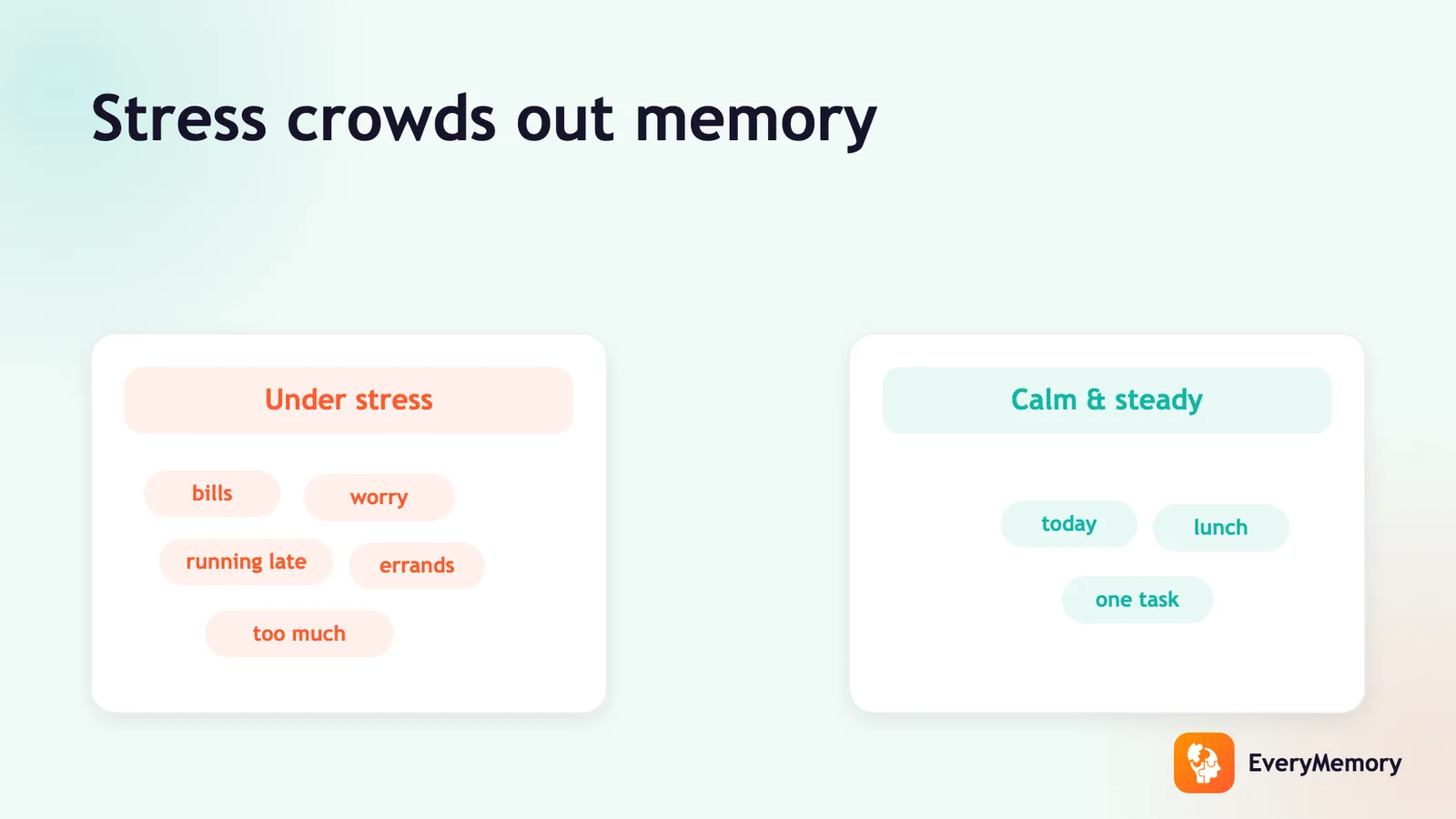
⚡ Quick answer
Yes. Stress affects memory in two main ways: it raises cortisol, a hormone that interferes with memory formation and retrieval, and it occupies working memory with worry, leaving less mental space for everyday tasks. The good news is that much of this forgetfulness reverses when the stress eases or is managed better.
Key takeaways
- Chronic stress raises cortisol, which interferes with the hippocampus - the brain region most directly involved in forming and retrieving memories.
- Worry and rumination occupy working memory, leaving less mental space for everyday tasks like holding a name or following directions.
- Stress-linked forgetfulness tends to worsen during stressful periods and ease when stress eases, and typically affects recent information rather than older established memories.
- A 20-minute walk, protected sleep, and writing things down rather than holding them in your head are among the most reliable ways to reduce its effect.
You have been under pressure for weeks - deadlines, family concerns, a difficult decision to make - and you notice that your memory seems to have gone fuzzy. You forget appointments, lose track of sentences, put things down and have no idea where. Is the stress doing this, or is something else going on?
The answer is almost certainly: yes, the stress is doing at least part of it. The relationship between stress and memory is one of the most well-established in cognitive science, and it works through several direct, measurable pathways.
How stress gets into your memory
When you experience stress, your body releases cortisol and adrenaline as part of a normal protective response. In short bursts this is actually helpful - a moderate spike in cortisol improves attention and can sharpen recall of important events.
The problem is chronic, low-grade stress. When cortisol stays elevated for days or weeks, it begins to interfere with the hippocampus - the brain region most directly involved in forming new memories and retrieving them. High cortisol makes it harder to store new information, harder to access what is already there, and harder to concentrate on any one thing long enough to encode it properly.
Stress also simply takes up space. Worry, rumination, and mental rehearsal of problems all live in working memory - the same scratchpad you use to hold a name, follow directions, or remember why you walked into a room. When a significant portion of that space is occupied with anxious thoughts, there is less room left for everything else.
Recognising stress-related forgetfulness
Stress-related forgetfulness tends to have a few distinctive features. It often appears or worsens alongside a stressful period and eases when the stress resolves. It tends to affect recent, everyday information - what you were just doing, what someone just said - rather than older, established memories. And it usually comes packaged with other signs: difficulty concentrating, trouble sleeping, irritability.
- Often stress-related: forgetting appointments during a busy or anxious period, losing the thread of a sentence when your mind is elsewhere, misplacing things more than usual.
- Less likely to be just stress: memory changes that started without a clear stressful event, changes that are rapid and progressive, confusion about familiar people or places.
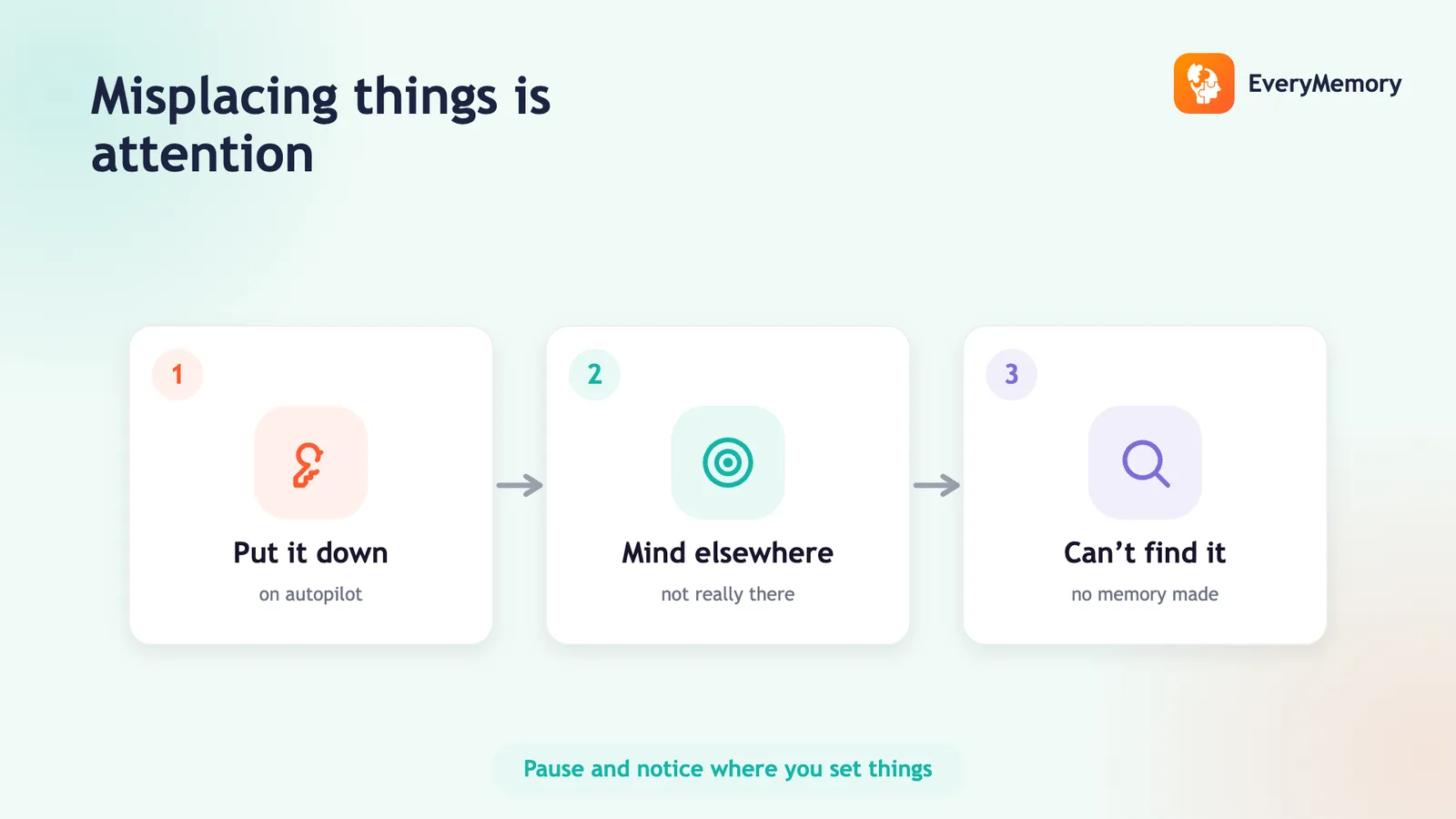
If you are also noticing that you keep misplacing things more than usual, it is worth asking honestly whether your stress level has been higher lately - the two are closely connected.
What actually helps
The most effective approach combines reducing the stress itself with protecting the cognitive habits that stress erodes:
- Physical movement. Even a 20-minute walk lowers cortisol and improves blood flow to the memory areas of the brain. It is one of the most reliable, fastest-acting tools available. The effects on attention and recall are well-documented - more at walking and brain health.
- Sleep protection. Stress and poor sleep create a vicious cycle - stress makes sleep worse, and poor sleep raises stress hormones further. Breaking the cycle, even partially, helps both problems. See sleep and memory for practical strategies.
- Structured breathing. Slow, deliberate breathing - four counts in, hold briefly, six counts out - activates the parasympathetic nervous system and lowers cortisol within minutes. It can be done anywhere.
- Reducing cognitive load. When you are stressed, write things down rather than trying to hold them in your head. External memory systems - lists, reminders, a consistent place for important objects - free your working memory for what actually matters.
- Social connection. Talking through a problem, even briefly, reduces the mental rehearsal loop that occupies working memory.
Rebuilding the attention habit
Stress gradually erodes the habit of paying full attention - you become scattered, reactive, and less able to deliberately focus. This makes it harder to encode new information even during calmer moments.
A short, consistent practice of directed focus helps rebuild this. A focus and attention brain workout does not need to be long - ten minutes a day, done consistently, is enough to start restoring the quality of attention that good memory depends on. Weaving this into a simple daily memory routine means it actually happens rather than being one more thing you intend to do.
When to check in with a professional
If forgetfulness is clearly tied to a stressful period, eases with rest, and doesn't come with confusion about familiar people or places, it is very likely stress-related and manageable. However, stress does not fully explain every pattern of forgetfulness, and the two things - stress and another underlying change - can co-exist.
If your forgetfulness feels disproportionate to your stress level, is worsening steadily rather than fluctuating, or is starting to disrupt daily tasks, it is worth having a conversation with a qualified healthcare professional. It may still be nothing serious, but getting a clear picture is always better than wondering.
✅ Try this today - The 5-4-6 cortisol reset
When you notice your mind going foggy or scattered, try this:
- Sit or stand still and breathe in slowly through your nose for a count of five.
- Hold gently at the top for a count of four.
- Breathe out fully through your mouth for a count of six.
- Repeat four times. Then write down the one next thing you need to do - just one.
⚠ When to talk to a professional
Occasional stress-related forgetfulness is common and usually resolves as stress eases. If you notice memory changes that are rapid, persistent, or disrupting your ability to manage daily tasks, please speak with a qualified healthcare professional. This article is general information only.