 EveryMemory
Digital Amnesia: Is Your Phone Weakening Your Memory?
The 'Google effect' shows we remember less when we expect to look things up. Here is what that means for everyday life, where AI raises the stakes, and how to keep your own memory in the loop.
Part of the guide: How to Keep Your Brain Healthy: A Complete Lifestyle Guide →
⚡ Quick answer
"Digital amnesia" and the Google effect refer to the well-documented tendency to remember less when we know a device can recall it for us. This is mostly normal cognitive offloading, the same thing humans have always done with notebooks and calendars, but when we do it unconsciously for everything, we practise active recall less often, and that practice matters. The good news is that small, deliberate habits can rebalance the equation.
You reach for your phone to look up something you are fairly sure you already know. A few seconds later you have the answer, but you could not have recalled it cold. This happens dozens of times a day for most people, and researchers have given the pattern a name: the Google effect.
A popular non-clinical phrase that has grown up around this idea is "digital amnesia", the feeling that our memories are leaking into our devices. It is not a medical diagnosis, and it does not mean your brain is damaged. It describes something more ordinary: when you know a tool will remember something for you, your brain often decides not to bother.
The question worth asking in 2026 is whether that trade-off is always a good one, especially now that AI assistants are extending the same logic from remembering facts to doing our thinking and writing for us.
What 'digital amnesia' and the Google effect mean
In 2011, psychologist Betsy Sparrow and her colleagues at Columbia University published a study in Science showing that people were less likely to remember information they expected to be able to look up later, and more likely to remember where to find it than what it actually said. They called this the "Google effect," and it replicated reliably across several experiments.
The everyday version is familiar: most people today cannot recall the mobile numbers of close family members they call regularly, even though those same people had a dozen numbers memorised before smartphones arrived. The information did not become less important; the brain simply stopped treating it as worth the storage cost once an external system took over reliably.
This is not a new phenomenon in principle. Humans have always used external memory aids, clay tablets, written lists, printed directories. What is new is the speed, scale, and invisibility of the offloading. The phone is always in your pocket, the answer arrives in under two seconds, and there is no conscious decision to delegate; it just happens.
Cognitive offloading is not all bad
Before treating every search as a warning sign, it helps to remember why cognitive offloading exists in the first place. Working memory, the mental scratch-pad you use to hold and manipulate information in the moment, has a limited capacity. When you write a shopping list, set a calendar reminder, or save a route in Maps, you free up that capacity for tasks that genuinely need focused attention.
Researchers sometimes call this "extended cognition": the idea that tools, notebooks, and now devices are a legitimate part of the cognitive system, not a cheat. Using them sensibly is not laziness; it is good mental organisation.
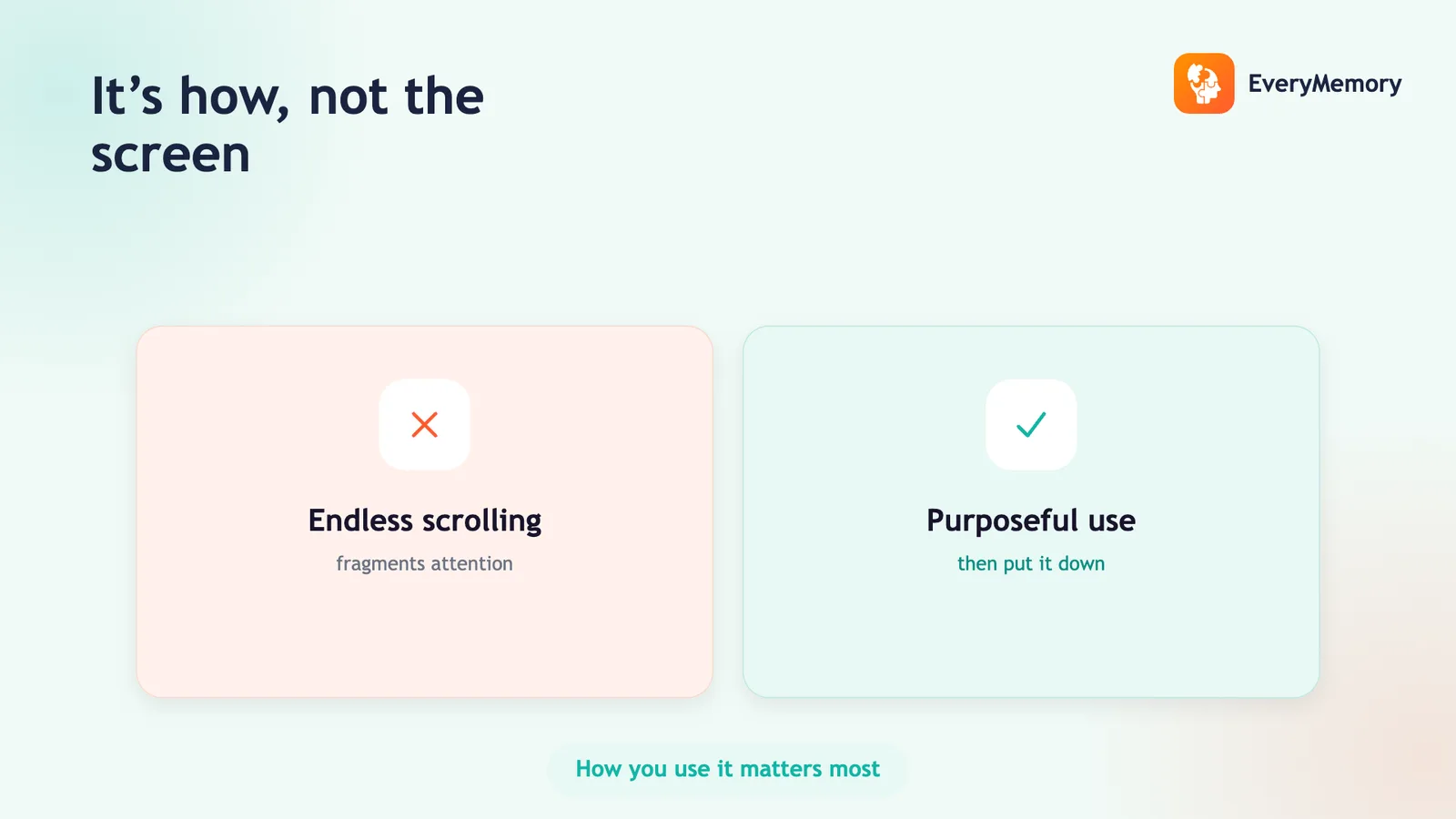
The issue is not offloading itself. The issue is doing it unconsciously for everything, including things that would benefit from being held in your own memory. Reaching for your phone before you have even attempted to recall something means you never get the retrieval practice that keeps memory pathways active. Over time, less practice means less fluency, not brain damage, but a skill that gets less exercise than it could.
Where AI raises the stakes
Smartphones moved fact-recall outside the skull. AI assistants are starting to move reasoning and writing there too. Ask a large language model to draft your email, summarise an article, or weigh up your options, and you are offloading not just storage but processing.
Concerns raised in 2025 by researchers studying student AI use suggest that heavy reliance on AI tools may correlate with less independent critical-thinking effort, though this remains an area of active study rather than settled science, and causation is not established. The direction of the concern is worth noting: if you rarely practise forming your own arguments or composing your own sentences, those skills may get less rehearsal. This is the same logic as the Google effect, extended one level up.
None of this means AI tools are harmful. The same concerns were raised about calculators and word processors, and those tools largely freed people to do more interesting work. The key question is whether you are using the tool to extend what you can do, or to replace effort you would benefit from making. For more on how distraction patterns affect memory encoding, see our piece on how multitasking affects memory and our overview of screen time and memory.
Signs you are over-relying on your devices
Over-reliance tends to show up gradually. A few patterns worth noticing:
- You reach for your phone before you have spent even a few seconds trying to recall something yourself.
- You cannot remember basic information, a colleague's name, a familiar address, a common word, without looking it up, even when you knew it well a year ago.
- You finish reading an article or chapter and retain almost nothing because you assumed you could re-find it later.
- You rarely navigate anywhere without turn-by-turn directions, even on routes you have driven many times.
- You feel a mild anxiety when your phone is not available, not because of emergencies, but because you rely on it to remember things for you.
- You habitually use AI tools to write or think through problems you once handled independently, without any conscious decision to do so.
One or two of these occasionally is normal. Several of them regularly is a cue that the balance may have shifted further than you intended.
How to keep your own memory in the loop
The goal is not to stop using your phone or AI tools. It is to stay in practice. Small deliberate habits make a real difference because memory, like most cognitive skills, responds to use.
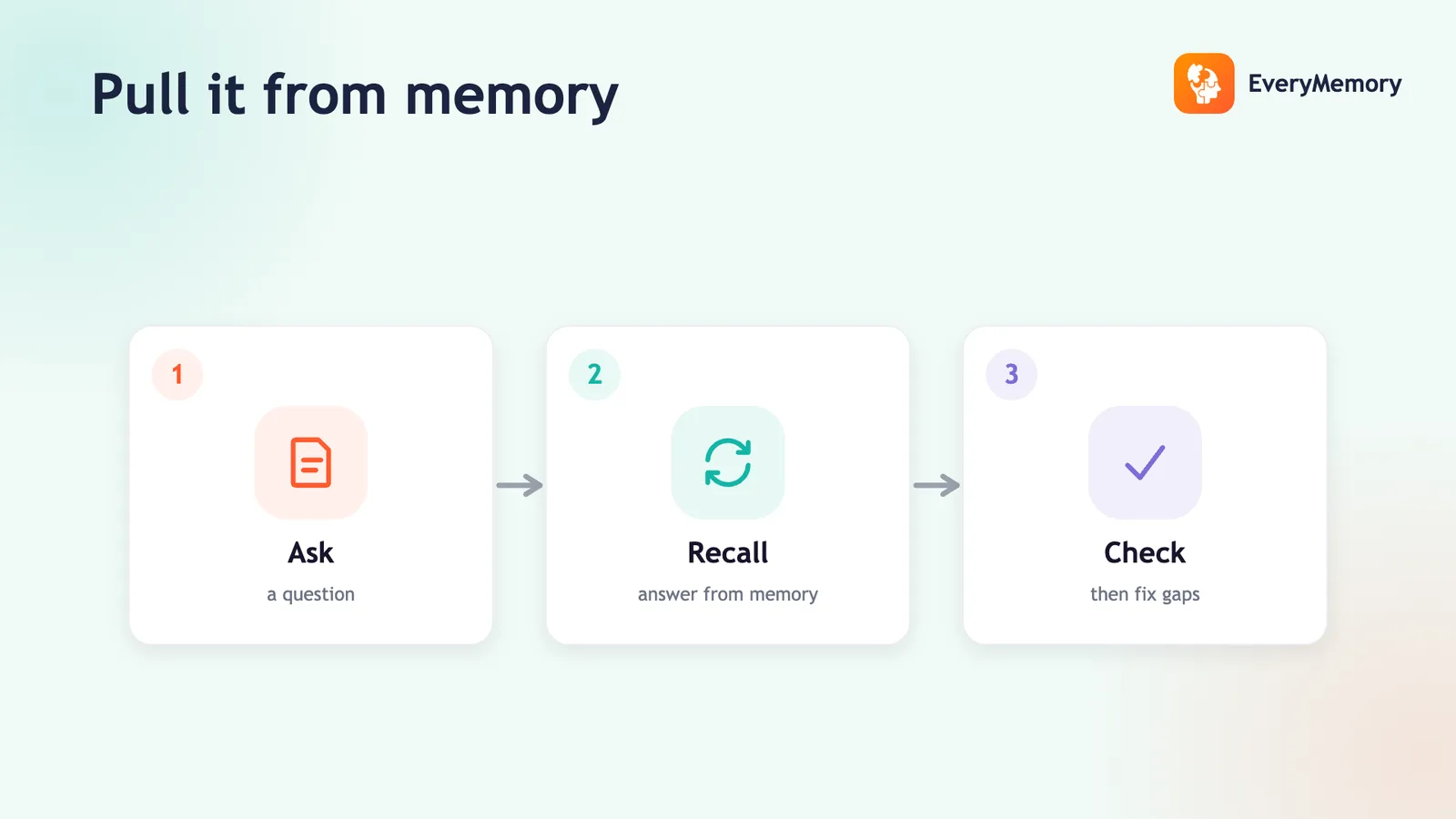
- Recall before you search. When you need a fact, pause for 10-20 seconds and try to retrieve it yourself first. Even a failed attempt strengthens the memory trace slightly and tells you what you actually know. This is the core of active recall, one of the most evidence-backed memory techniques available.
- Memorise a few key things on purpose. Pick a small category, phone numbers of people you care about, a poem, a list of items you need regularly, and commit them to memory without any aid. The content matters less than the practice of intentional encoding.
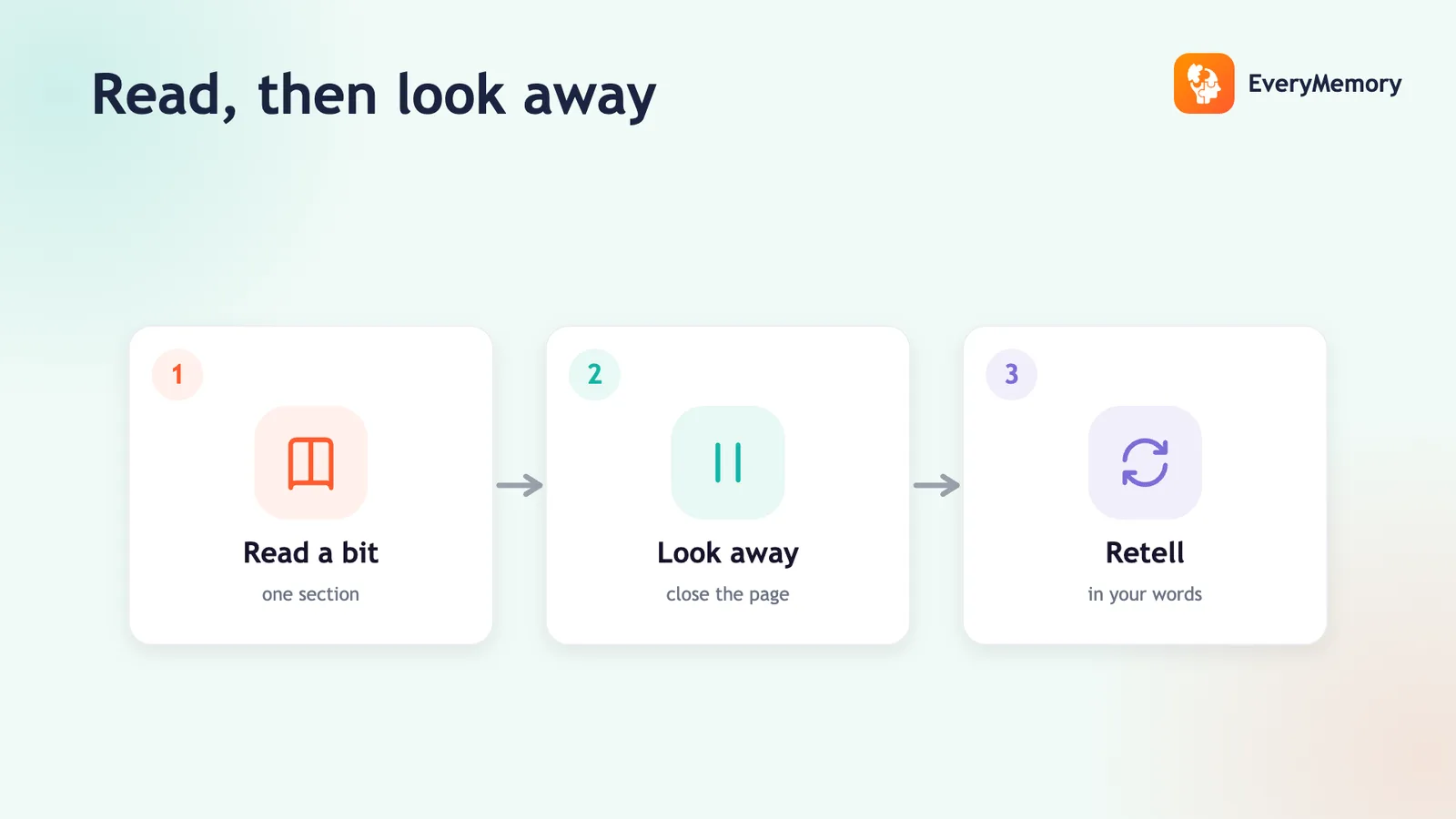
- Single-task and read deeply. Skimming with the implicit assumption you can re-find the source later is a form of offloading comprehension. Try reading one piece per day without switching tabs, summarising it in your own words at the end. Our guide to remembering more of what you read covers this in detail.
- Use spaced repetition for things that matter. Rather than looking the same thing up repeatedly, learn it once properly using a flashcard system or a simple review schedule.
- Take short breaks from auto-pilot navigation. Drive or walk a familiar route without GPS occasionally. Spatial navigation is one of the richer memory exercises available, and it is easy to let it atrophy entirely.
The underlying principle across all of these is the same: retrieval practice builds the retrieval pathway. Every time you remember something yourself, you make it easier to remember next time. Every time a device does it for you, that practice does not happen. Neither is always wrong; the balance is what you are managing.
✅ Try this today - The recall-before-you-Google habit
Try this for one week. Before reaching for your phone or asking an AI, give yourself a short retrieval window first. It takes under a minute and builds real practice.
- When you need to remember something, stop and set a 20-second mental timer. Try to bring it up on your own, a name, a fact, a route, anything.
- If you get it, great. Say it out loud or write it down before you verify. If you cannot get it after 20 seconds, look it up, but notice the gap and try to read the answer actively rather than skim.
- At the end of each day, pick one thing you looked up and try to recall it from memory without checking. That single retrieval attempt is enough to strengthen the trace meaningfully over a week.
⚠ When to talk to a professional
This is general, non-medical information about everyday tech habits, not a diagnosis of any condition.