 EveryMemory
Learning a Language and Memory: What the Science Says
Picking up a new language as an adult does far more than teach you words - it exercises the very memory and attention systems that matter most as you age.
Part of the guide: How to Keep Your Brain Healthy: A Complete Lifestyle Guide →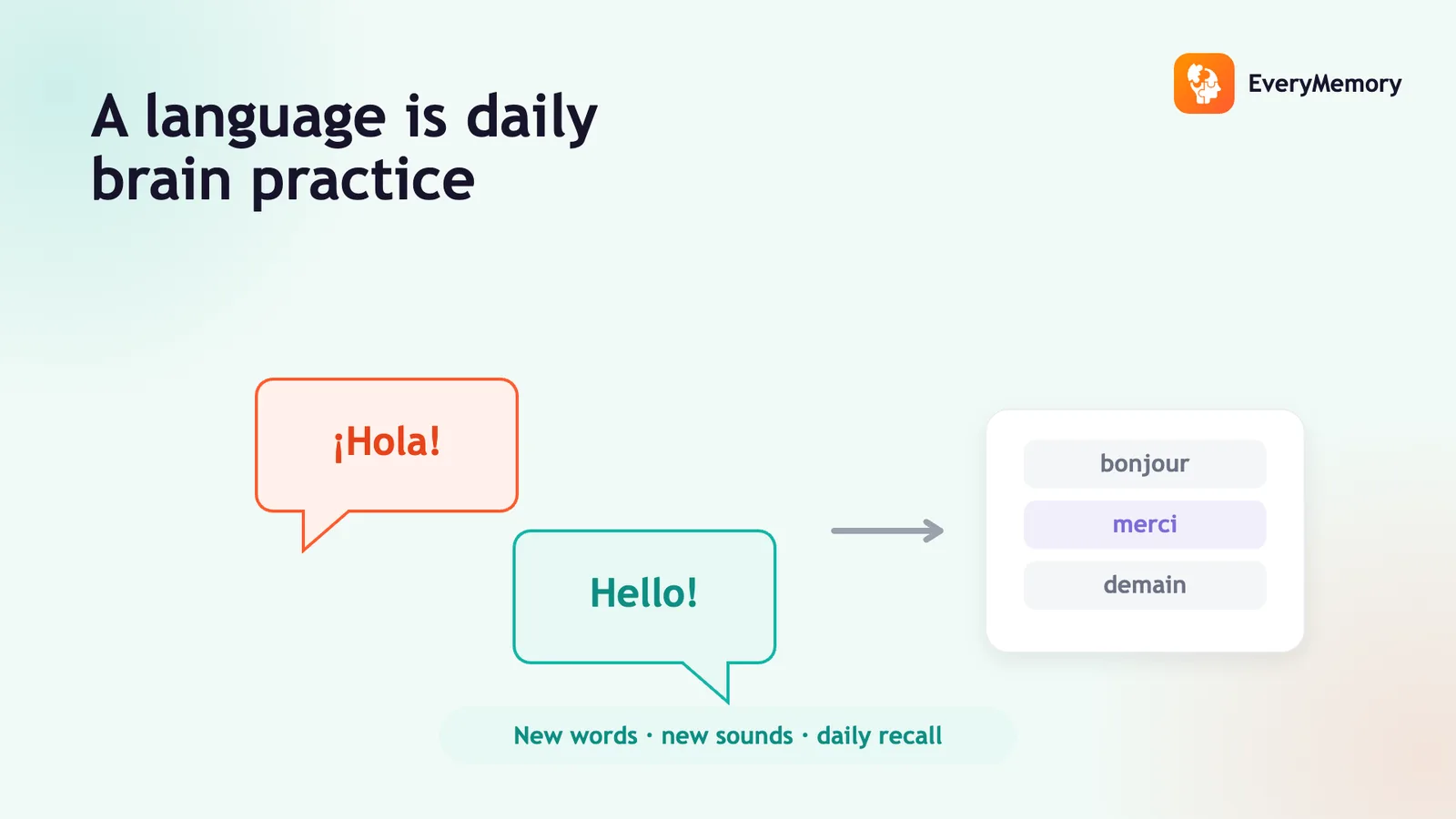
⚡ Quick answer
Learning a language appears to support memory through several overlapping routes: it provides daily recall practice through vocabulary, it exercises attention and working memory continuously, and it may contribute to cognitive reserve - the brain's accumulated resilience. Research on bilingualism suggests that actively managing two languages offers meaningful mental exercise. Starting in your 50s or 60s still appears worthwhile, and even modest, consistent effort seems to provide real engagement for the brain.
Key takeaways
- Vocabulary learning is daily retrieval practice - exactly the kind of memory exercise that strengthens recall over time.
- Language learning builds cognitive reserve by exercising attention, working memory, and executive control simultaneously.
- Bilingualism research links managing two languages with greater brain resilience, though the evidence is still developing.
- Starting in your 50s or 60s is not too late - even a few years of consistent practice provides meaningful cognitive engagement.
There is something pleasantly demanding about learning a new language. You have to hold new words in mind while remembering grammar rules, listen carefully to unfamiliar sounds, and retrieve vocabulary under mild pressure - all at once. That particular combination of effort turns out to be one of the most memory-friendly activities an older adult can take on.
This article looks specifically at the language angle: why vocabulary learning is essentially daily recall practice, how picking up a new language links to the brain's long-term resilience, and what the bilingualism research actually says - framed honestly, without overclaiming. If you are curious about the broader picture of learning new things and brain health, our article on learning new skills and brain health covers that territory in depth. This piece goes narrower and deeper on language specifically.
Why language learning is unusually good brain exercise
Most cognitive activities favour one type of mental demand. A crossword puzzle stretches vocabulary retrieval. A sudoku puzzle exercises logical reasoning. Language learning does something less common - it stacks multiple demands at once and forces them to work together.
To use a new word correctly, you need to recall its meaning (long-term memory), hold the sentence structure you are building in mind while you select it (working memory), and monitor whether what you just said matched your intention (attention and monitoring). All of this happens in real time, especially in conversation. The brain is not passively absorbing content; it is actively retrieving, assembling, and checking.
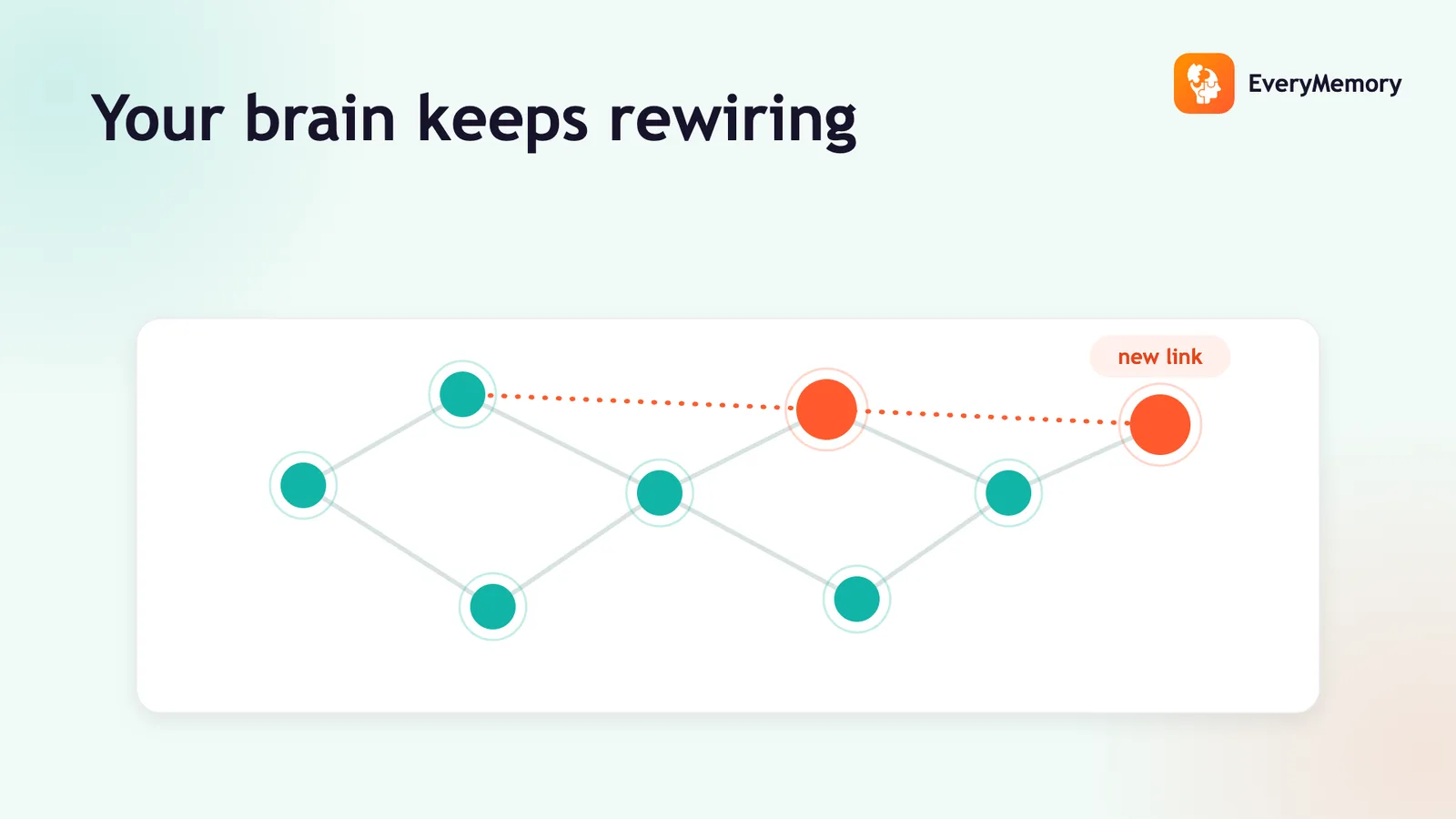
This is precisely the kind of challenge that neuroplasticity responds to - the brain's capacity to form and strengthen connections in response to use. Challenge and novelty together appear to stimulate this process more reliably than activities that are mentally familiar, however enjoyable those are.
Vocabulary learning as daily recall practice
One of the most underrated aspects of language study is that it turns memory practice into a natural, purposeful activity rather than an abstract exercise. When you review a set of new words, you are practising the same retrieval mechanisms used in everyday memory - but with a clear goal (understand and be understood) that makes the effort feel meaningful rather than clinical.
Research published in the journal Frontiers in Human Neuroscience found that older adults learning a foreign language successfully encode new vocabulary through structural brain changes that mirror plasticity seen in younger learners. The semantic memory system - the part of long-term memory that stores word meanings and world knowledge - tends to remain relatively robust in older adults, which may actually give them an advantage: the brain has a strong scaffold to hang new vocabulary onto.
Practically, this means that even a few minutes a day with a vocabulary app or a set of flashcards is not a trivial exercise. It is structured retrieval practice - the same principle behind spaced repetition for everyday memory - applied in a context that inherently requires it.
The cognitive reserve connection
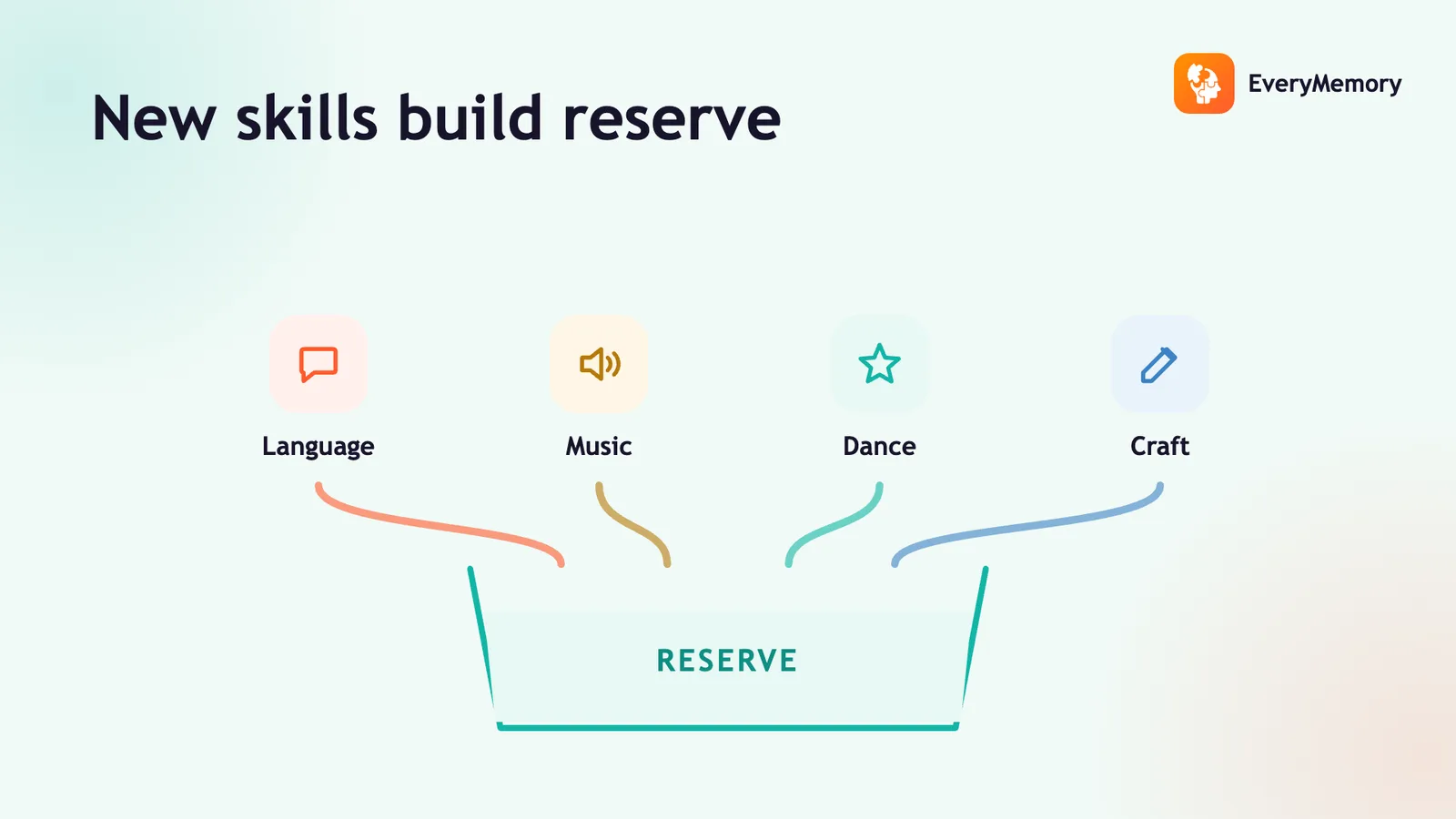
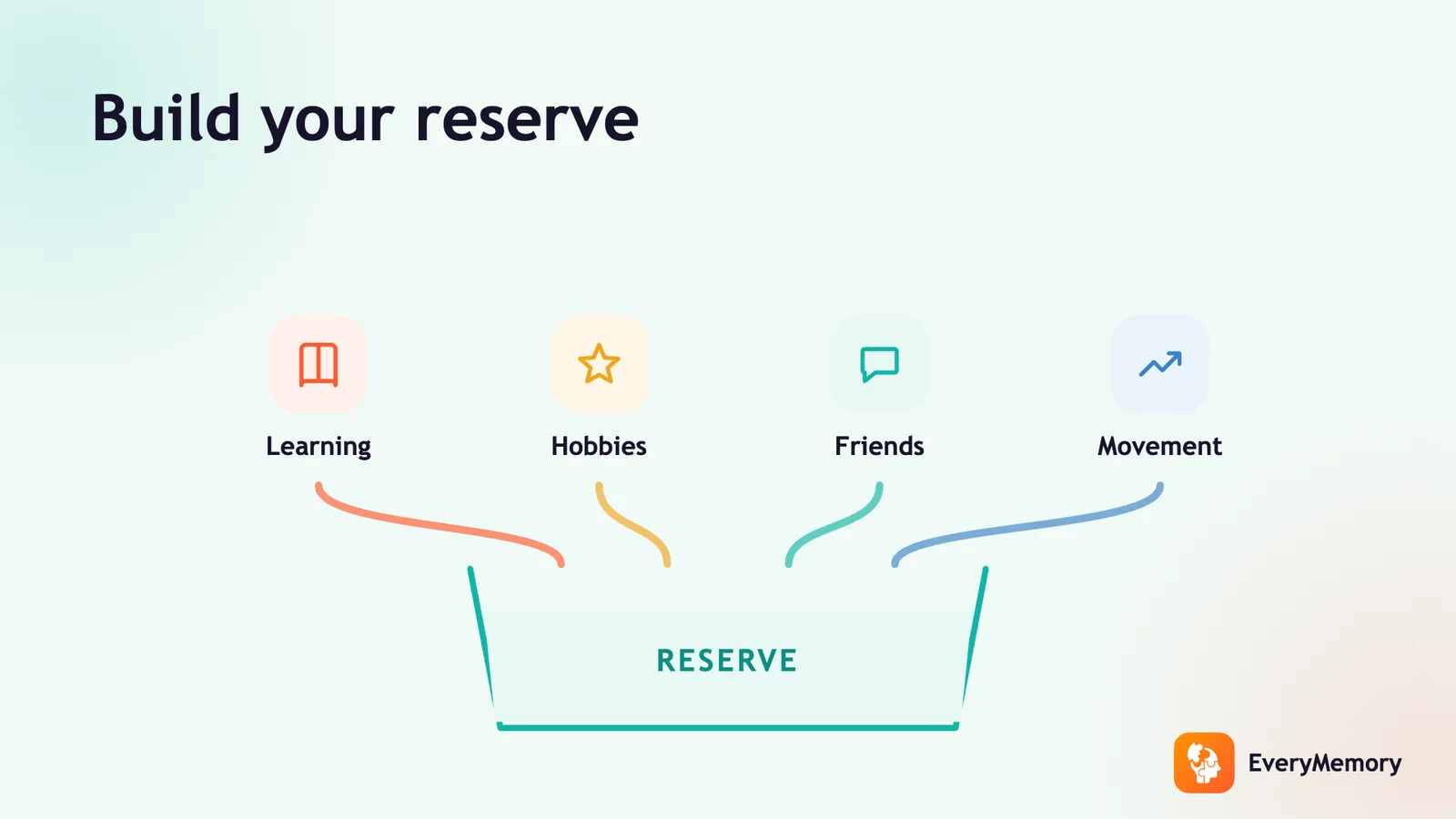
Researchers use the term cognitive reserve to describe the brain's accumulated resilience - its capacity to keep functioning well even as natural changes occur with age. Reserve is built up over a lifetime through education, mentally stimulating work, ongoing learning, and activities that require sustained cognitive effort. It is not a fixed property but something that responds to how the brain is used over years.
Language learning - whether you reach fluency or not - is one of the activities most consistently linked with building reserve. It demands effort across multiple cognitive domains simultaneously: attention, memory encoding, retrieval, executive control (for managing two vocabularies and grammar systems), and often social engagement when you practise with others.
Crucially, the evidence suggests that this kind of mental investment does not need to begin in childhood to be meaningful. Studies have found that adults who pick up intensive language study later in life still show brain structure changes consistent with increased engagement - including in regions associated with memory and language processing. For a deeper exploration of how reserve accumulates over time and why it matters, see our guide to what cognitive reserve actually is and the relevant research in our Library.
What the bilingualism research says - and what it doesn't
Much of the excitement in this area comes from bilingualism research - studies of people who have spoken two languages throughout their lives. A 2024 community-based study in Alzheimer's & Dementia found that lifelong bilinguals showed superior baseline cognitive performance compared with monolingual peers, even after adjusting for education, occupation, and other social factors. Other neuroimaging work has found that bilingual older adults appear to use their brains differently on executive-function tasks - achieving similar performance while showing more efficient neural patterns.
The proposed mechanism is that constantly managing two languages - selecting words from one while suppressing the other - provides lifelong exercise for the brain's attentional control systems. Over decades, this may contribute to greater neural efficiency and reserve.
It is important to be honest about the limits here: the research is not uniformly settled. Studies vary in methodology, and some critics have questioned whether the bilingual advantage holds across all populations and settings. What the evidence does consistently show is that sustained, active engagement with a second language - at whatever level - provides real cognitive exercise. You do not need to be a lifelong bilingual for the activity to be worthwhile. Starting language study in your 50s or 60s still means years of meaningful brain engagement ahead of you.
Language learning also frequently overlaps with social activity - joining a conversation class, finding a language exchange partner, or simply watching films with the sound on in a foreign language - adding another evidence-backed ingredient to the cognitive benefit.
How adults 55+ can start without being overwhelmed
The biggest obstacle for most adults considering a new language is the mental image of school-style memorisation, grammar tables, and homework. Modern language learning looks quite different, and that matters - because enjoyment and manageability determine whether you stick with it long enough to get the cognitive benefit.
A few approaches that work particularly well for older beginners:
- Start with 10–15 minutes a day, not a set number of lessons per week. Short, daily sessions are more effective for vocabulary retention than longer, infrequent ones - and they fit into an existing routine without feeling burdensome.
- Choose a language that connects to something you care about - a place you want to visit, a cultural tradition, a family heritage. Motivation tied to genuine interest tends to outlast willpower.
- Use apps as a starting point, not a ceiling. Free apps like Duolingo or Babbel are genuinely good for building a vocabulary base and daily habit, but adding a real conversation - even brief - makes the practice meaningfully more demanding and rewarding.
- Prioritise listening and speaking early, not just reading. Listening to unfamiliar sounds and forming spoken words exercises auditory processing and memory encoding together.
- Accept imperfection from the start. The goal is not fluency in six months - it is consistent engagement over years. Progress, not performance, is what builds the cognitive benefit.
Community classes, conversation groups at local libraries, and language exchange apps that pair you with a native speaker of your target language are all accessible starting points for adults who prefer more human contact than solo app work.
How language learning compares to other brain activities
It is worth putting language learning in context alongside other popular approaches to staying mentally active. Purpose-built brain-training games have the narrowest transfer - they reliably improve your score on the game itself, but the evidence for broad cognitive effects is limited. Learning a musical instrument, taking up drawing, or studying a complex topic have broader effects because they require multi-domain engagement over time.
Language learning sits near the top of this spectrum because it naturally combines retrieval practice, attentional control, novelty, social engagement, and listening - and it scales: as you improve, the challenge evolves rather than disappearing. A crossword becomes familiar; a language continues to offer new territory for years.
That does not mean it is the only activity worth doing, or that it replaces sleep, movement, and diet as foundations of brain health. It is one of the most cognitively rich activities available to adults who want to keep their minds actively engaged - and one that happens to be accessible, low-cost, and intrinsically enjoyable for many people.
✅ Try this today - Your 10-minute language starter
Try this today - no prior experience or app download required:
- Pick a language. Any one you have a genuine reason to be curious about. It can be a language spoken by family members, connected to a travel interest, or simply one whose sound you have always liked.
- Write down ten words you would actually use: hello, thank you, excuse me, how much, the name of a food you like, a colour. These are your first ten. Look up their pronunciation on a free site like Forvo and say each one aloud twice.
- Set a 10-minute daily reminder on your phone labelled with the language name. Commit to just ten minutes. Even on busy days, ten minutes spent recalling and practising vocabulary is meaningful retrieval practice - and the habit, once established, often grows naturally.
⚠ When to talk to a professional
This article contains general information only and is not a substitute for medical advice. If you experience sudden, rapid, or noticeably worsening changes in memory, language use, or thinking - such as forgetting familiar words more than occasionally, or confusion in familiar settings - please speak with a qualified healthcare professional rather than attributing the changes to normal ageing.