 EveryMemory
How to Remember to Take Medication on Time
Practical, non-medical strategies - pill organizers, habit-stacking, visible placement, reminder apps, and a simple tick chart - to make staying on your medication schedule easier.
Part of the guide: How to Improve Your Memory: The Complete Beginner's Guide →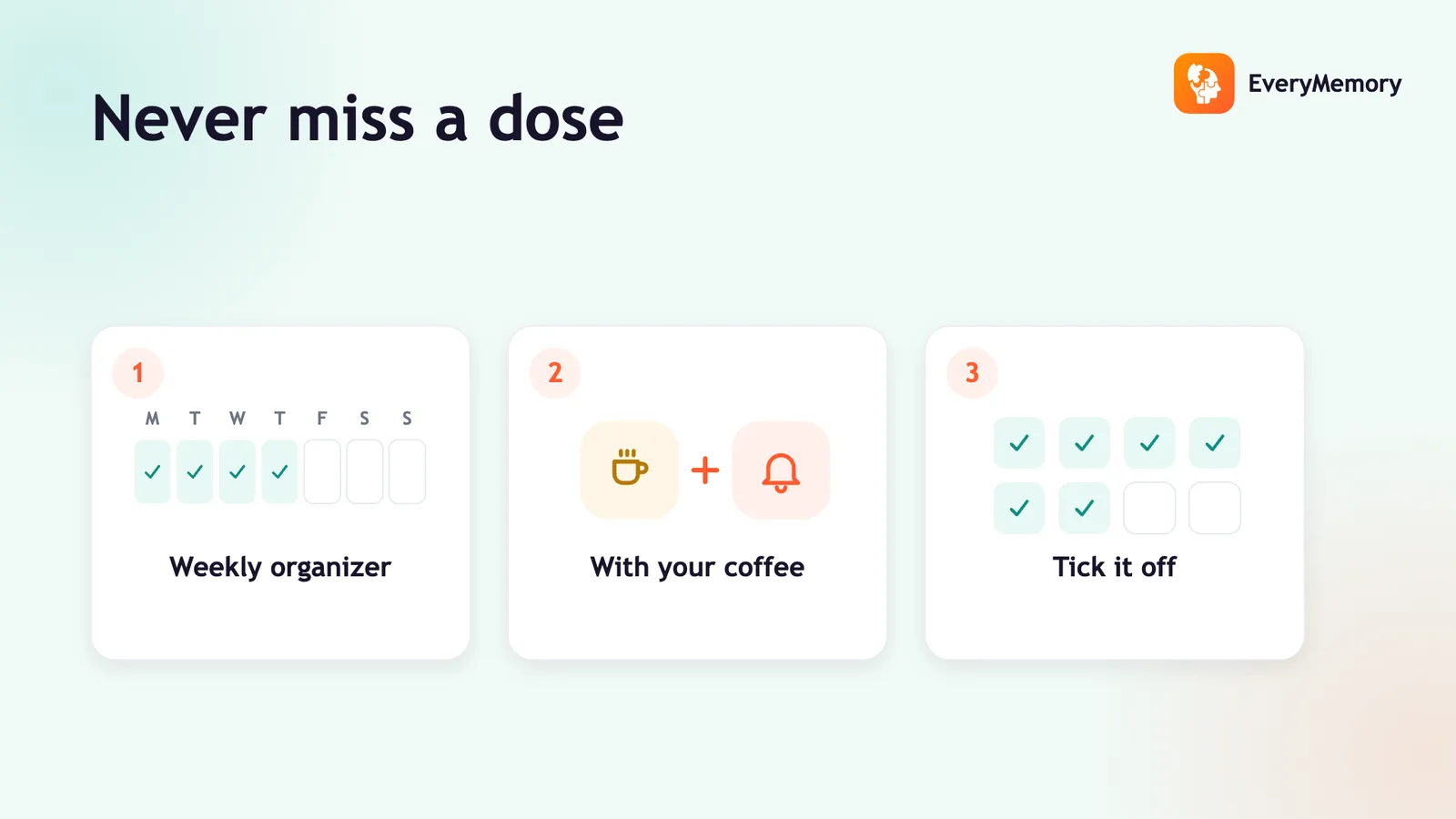
⚡ Quick answer
The most reliable way to remember medication is to combine three things: a weekly pill organizer (so you can see at a glance whether today's dose has been taken), habit-stacking onto a fixed daily anchor like a meal or tooth-brushing, and a persistent alarm or reminder app as a backup. A simple tick chart adds a visual record that removes any doubt. Used together, these strategies dramatically reduce missed doses without requiring any unusual feat of memory.
Key takeaways
- A weekly pill organizer makes it instantly visible whether today's dose has been taken, removing all doubt.
- Habit-stacking - tying medication to a fixed anchor like a meal or tooth-brushing - turns intention into automatic behavior.
- A phone alarm set five minutes before your anchor moment acts as a reliable backup for disrupted days.
- A simple tick chart provides a written record that benefits both you and anyone helping you stay on track.
Remembering to take medication consistently is a memory and habit challenge - not a willpower problem. Most missed doses happen for the same handful of reasons: the pill bottle is out of sight, there is no fixed time attached to the dose, or the day gets busy and the usual cue gets skipped. These are predictable features of how human memory works, not character flaws.
A well-placed organizer, a strong anchor to something you already do, and a simple record-keeping system can turn a fragile intention into a near-automatic routine. This article covers each tool in practical detail. Always follow your prescriber's or pharmacist's instructions on which medications to take, when, and how - this guide covers only the memory and habit side of the equation.
Why we forget medication - and why it is not a memory failure
Taking a pill looks the same every day and carries no immediate consequence if delayed an hour, so the brain does not flag it as a priority. Research on adherence consistently shows that omission errors - simply not doing something - are the most common mistake, and they are most likely when there is no reliable environmental prompt. The solution is not to try harder to remember; it is to redesign the environment so the cue is impossible to miss.
If you have been missing doses, it almost certainly reflects a gap in your system, not a gap in your cognition. The strategies below are about building that system. For more on why daily structure supports this kind of habit, see why routine matters for focus.
Pill organizers: the single most useful tool
A weekly pill organizer with separate AM and PM compartments solves a problem many people do not realise they have: uncertainty about whether they actually took a dose. Without one, it is easy to wonder mid-morning whether you took your tablet or only thought about it. With an organizer, the answer is visible and physical - the compartment is empty or it is not.
- Weekly organizers are the most practical starting point. Fill the whole week on Sunday so the daily task is just opening a compartment, not thinking.
- AM/PM versions are worth it if you have doses at different times of day - they prevent opening the wrong section by feel alone.
- Blister-pack dispensing is offered by many pharmacies: pre-sorted packets labeled by day and time remove the filling step entirely. Ask your pharmacist.
- Automated dispensers with built-in alarms release the correct compartment at the set time and beep until opened - a more hands-off option.
Habit-stacking: tying medication to a fixed daily anchor
Habit-stacking means attaching a new behavior to an existing, automatic one - borrowing the reliability of a habit you already have. For medication, the anchor needs to be something that happens at a consistent time every single day. The strongest options are:
- Morning meals. Breakfast works well for once-daily doses. Put the organizer on the kitchen table or next to the kettle.
- Evening meals. Natural for evening doses and easy to sustain because the routine is already structured.
- Tooth-brushing. Fixed times, fixed location (the bathroom counter) - reliable for twice-daily regimens.
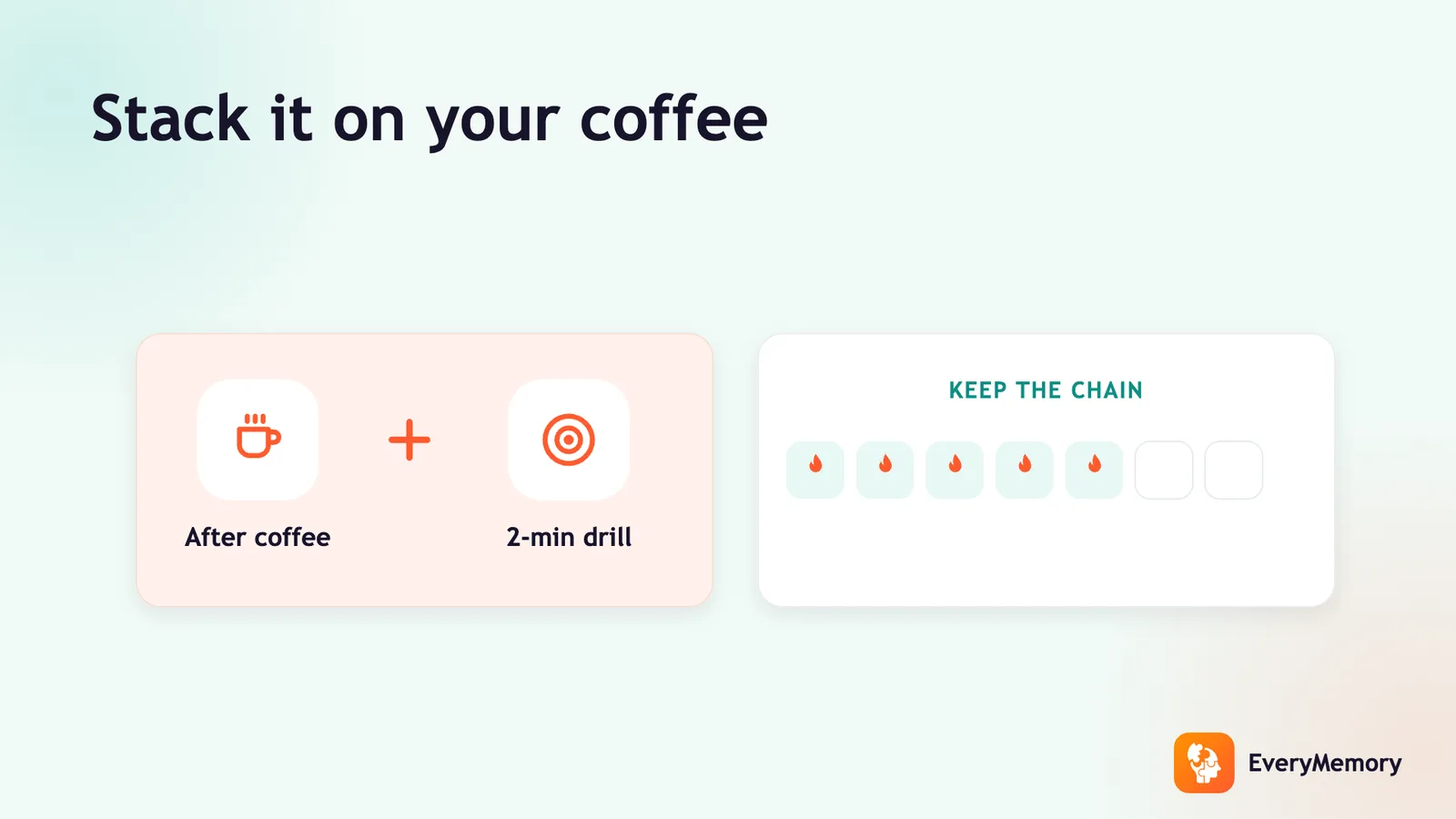
- Coffee or tea preparation. The kettle boiling creates a consistent two-minute pause at the same time each day.
The key rule is specificity: decide exactly which moment triggers the dose - not "with breakfast" but "right after I sit down with my coffee." Vague anchors produce vague behavior. For more on building this kind of daily structure, see how to build a memory training habit.
Visible placement: out of sight, out of mind
Even the best anchor fails if the organizer is tucked inside a cabinet. Keeping it visible acts as a passive prompt throughout the morning or evening, priming the behavior before the cue even fires.
- On the kitchen counter next to the coffee maker or kettle.
- On the bathroom shelf beside the toothbrush.
- On the dining table, already out from the night before.
- On the bedside table for a bedtime dose - visible from the pillow, not just reachable.
If medication needs to be stored away from heat or children, keep a sticky note or labeled card at the anchor point itself. The goal is a cue you genuinely cannot overlook. The same visible-cue logic applies to other reminders - see how to remember appointments.
Reminder alarms and apps: the backup layer
A phone alarm is the safety net for days when the anchor habit is disrupted - travel, an unusual schedule, or a morning that runs late. Think of it as the backup, not the primary system.
- Set it to fire five minutes before your anchor moment, giving you a small window to get to the organizer.
- Use a distinct ringtone reserved only for this alarm so it does not blend into ordinary notifications.
- Label it clearly - "Morning tablet" or "Evening pill" - so there is no ambiguity.
- Dedicated medication apps (many are free) log each dose as taken and flag missed ones. A two-second tap creates a record without extra effort.
A basic kitchen timer or wristwatch alarm set to repeat daily works just as well if you prefer a low-tech backup. Reliability matters more than the technology used.
A simple tick chart: the written record that removes all doubt
A tick chart is especially useful when managing more than one medication or more than one time of day. It takes two minutes to set up and eliminates the "did I or didn't I?" question entirely.
- Tape a small card inside a kitchen cupboard or bathroom cabinet - somewhere you open daily.
- Write the days of the week across the top and list each medication and time of day down the left side.
- Each time you take a dose, put a tick in the corresponding box.
- At the end of the week, replace the card with a fresh one.
A tick chart also makes oversight easier if a family member helps manage medications - the record is visible and shared without any need for a daily conversation. See how to help an aging parent with memory concerns for broader guidance.
✅ Try this today - Set up your system today
Three steps, all doable before tonight.
- Name your anchor: write one specific sentence - "I take my tablet right after I pour my morning coffee." Vague intentions do not stick; a named moment does.
- Place your organizer (or a reminder card, if pills must be stored away) at that exact spot. Fill it for the full week right now.
- Set a recurring phone alarm five minutes before your anchor, labeled with the medication name. Tape a simple tick chart - seven columns, one row per medication - inside a nearby cupboard. Your three-layer system is ready.
⚠ When to talk to a professional
If you notice sudden confusion about which medications you have taken, unexpected changes in how you feel after taking medication, or any rapid or worsening memory changes that affect daily life, speak with your prescriber or pharmacist promptly - they are the right people to help.