 EveryMemory
Monthly Memory Check-In: What to Notice
A gentle monthly check-in routine for noticing memory patterns over time - what to look for, what's normal variation, and what's worth writing down.
Part of the guide: Understanding Memory Loss and Forgetfulness: A Calm, Reassuring Guide →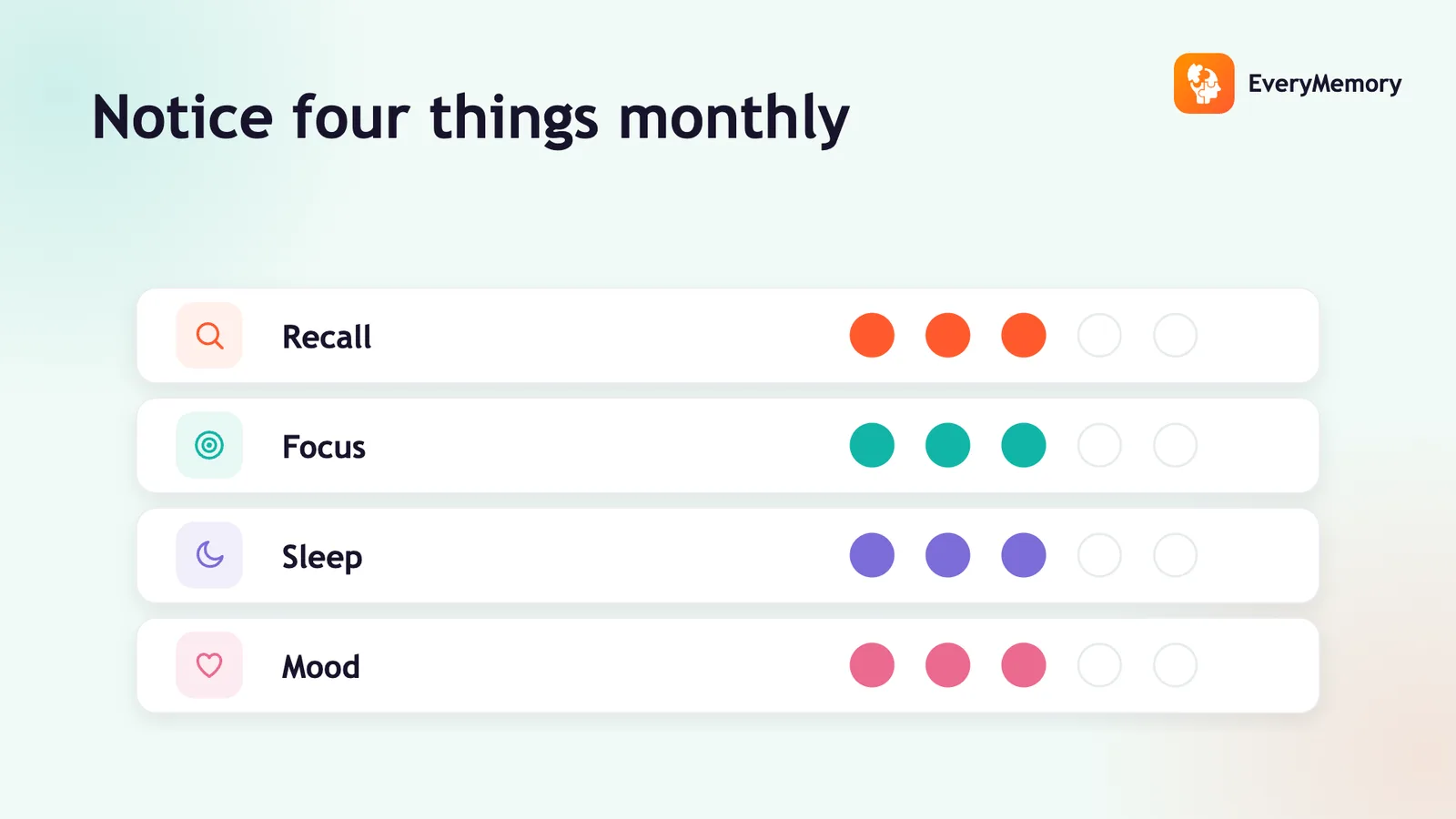
⚡ Quick answer
Once a month, ask yourself: how often did I have frustrating memory slips this month, roughly? What seemed to make recall worse (poor sleep, busy days, stress)? Did anything genuinely interfere with daily life? Write brief answers down. Review them every three months to spot whether things are stable, improving, or shifting.
Key takeaways
- A monthly check-in takes about ten minutes and asks five honest questions covering slips, context, and comparison to last month.
- Natural variation is expected - months with poor sleep or high stress will almost always feel different from calmer ones.
- After three months of notes, you can see whether your pattern is stable, improving, or gradually shifting.
- If something feels sudden rather than gradual - or a family member notices a change - talk to a healthcare professional promptly rather than waiting for month-end.
Once a month, spend ten quiet minutes checking in with yourself about how memory and attention have felt lately. Not a test, not a diagnosis - just an honest look at the patterns you've been living with.
This kind of regular self-check is more useful than it might sound. Most people notice memory only when something goes wrong. A monthly check-in builds a different habit: noticing the ordinary, the subtle shifts, and the things that reliably make recall better or worse. Over several months, that awareness becomes genuinely valuable.
Why a Monthly Check-In Beats a One-Off Test
Memory on any given day is shaped by sleep the night before, stress levels, hydration, physical health, and a dozen other factors. A single test score or self-rating tells you how you were doing that day - not whether anything has changed over time.
A monthly check-in, done consistently, gives you something much more useful: a record of your own baseline and how it fluctuates. Over three to six months, you can see whether recall is broadly stable, whether it reliably dips under certain conditions, or whether there's a gradual change happening that would otherwise be easy to miss.
This is a non-medical self-awareness tool. It can help you notice your own patterns - it cannot tell you whether any change is medically significant. For that, you need a healthcare professional.
What to Notice During the Month
You don't need to monitor yourself anxiously. Instead, build a loose habit of noticing three categories of experience as they happen, so your monthly review draws on real memories rather than guesswork:
- Recall slips: forgetting a name mid-conversation, losing a word, retracing steps to remember why you came into a room, repeating a question you'd already asked
- Recall wins: remembering something you expected to forget, navigating somewhere new without getting confused, following a complex conversation easily
- Daily-life impact: did any memory moment actually interrupt something you were trying to do - not just a momentary blip, but a genuine disruption?
If you're curious about what counts as a normal slip vs. something worth watching, memory loss vs. normal aging gives a clear, calm overview.
Your Monthly Check-In: Five Questions
Sit down with a notebook or the Printable Memory Tracker and answer these five questions honestly. Aim for one or two sentences each - not an essay.
- How often did I notice memory slips this month - rarely, occasionally, or frequently?
- Were there any specific types of slips I noticed more than usual (names, words, where I put things, conversations)?
- What conditions seemed to make recall worse? (Poor sleep, high stress, illness, busy days?)
- Did any memory moments genuinely interrupt daily life - not just frustrate me, but actually stop me doing something?
- Compared to last month's notes, does this month feel broadly the same, a bit better, or a bit worse?
The last question is the one that builds in value over time. In the first month you have no comparison. By month three, you're starting to see a pattern.
What Counts as Normal Variation
Expect variation. The months when you're sleeping well, exercising regularly, and life is calm will almost certainly feel sharper than months packed with stress, disrupted sleep, or illness. That fluctuation is normal - it reflects the reality that the brain and body are connected.
What you're looking for is the shape underneath the variation: is the overall pattern stable, or is something consistently different now compared to six months ago? Day-to-day and week-to-week fluctuations are not the signal. The multi-month trend is.
Can stress make you more forgetful? explains in practical terms why high-pressure periods affect recall so reliably - useful context when reading your own notes.
What to Do With Three Months of Notes
Read back through three months of check-ins and look for three things: Is the overall tone steady, improving, or declining? Do the difficult months correspond to identifiable causes? Are there any new kinds of slips appearing that weren't in the earlier notes?
If things look broadly stable with variation that tracks to circumstances, that's reassuring. If you notice a clear downward shift - especially one that doesn't correspond to any obvious cause - that's worth discussing with a healthcare professional. Bring your notes. A three-month written record is far more useful to a doctor than "I think my memory has got a bit worse."
The guide on what to track before talking to a doctor walks through exactly how to prepare for that conversation.
When to Act Without Waiting for the Monthly Review
Monthly check-ins are for tracking gradual patterns. If something feels sudden or sharp - a noticeable change over a few days, confusion about familiar places or people, difficulty with tasks that were routine - don't wait for month-end. Speak with a healthcare professional promptly.
The same applies if a family member or close friend mentions that they've noticed a change. People around us sometimes see shifts before we do. Take that feedback seriously and bring it, along with any notes you have, to a qualified professional.
For family members supporting an older parent, how to help an aging parent with memory concerns offers practical, compassionate guidance on navigating these conversations.
✅ Try this today - Do Your First Check-In Now
You don't need to wait until the end of the month. Answer these three questions about the past four weeks:
- How often did memory slip-ups bother you this month? Rarely, sometimes, or often? Write the word down with today's date.
- Name one type of forgetting you noticed most (names, words, objects, conversations) and one thing that seemed to make it worse.
- Write one sentence: compared to this time three months ago, memory feels roughly the same / a bit better / a bit worse. That's your baseline.
⚠ When to talk to a professional
Memory fluctuates naturally with sleep, stress, and physical health - check-ins will reflect this, and variation is normal. This monthly check-in is a non-medical self-awareness tool and cannot diagnose any condition. If you notice sudden, rapid, or severe changes, or changes that are disrupting everyday life, please speak with a qualified healthcare professional rather than tracking them alone.