 EveryMemory
Why Multitasking Makes You Forgetful
Multitasking doesn't split your attention evenly - it switches it rapidly, and each switch leaves information too shallow to stick. Here's what's happening and how to fix it.
Part of the guide: Understanding Memory Loss and Forgetfulness: A Calm, Reassuring Guide →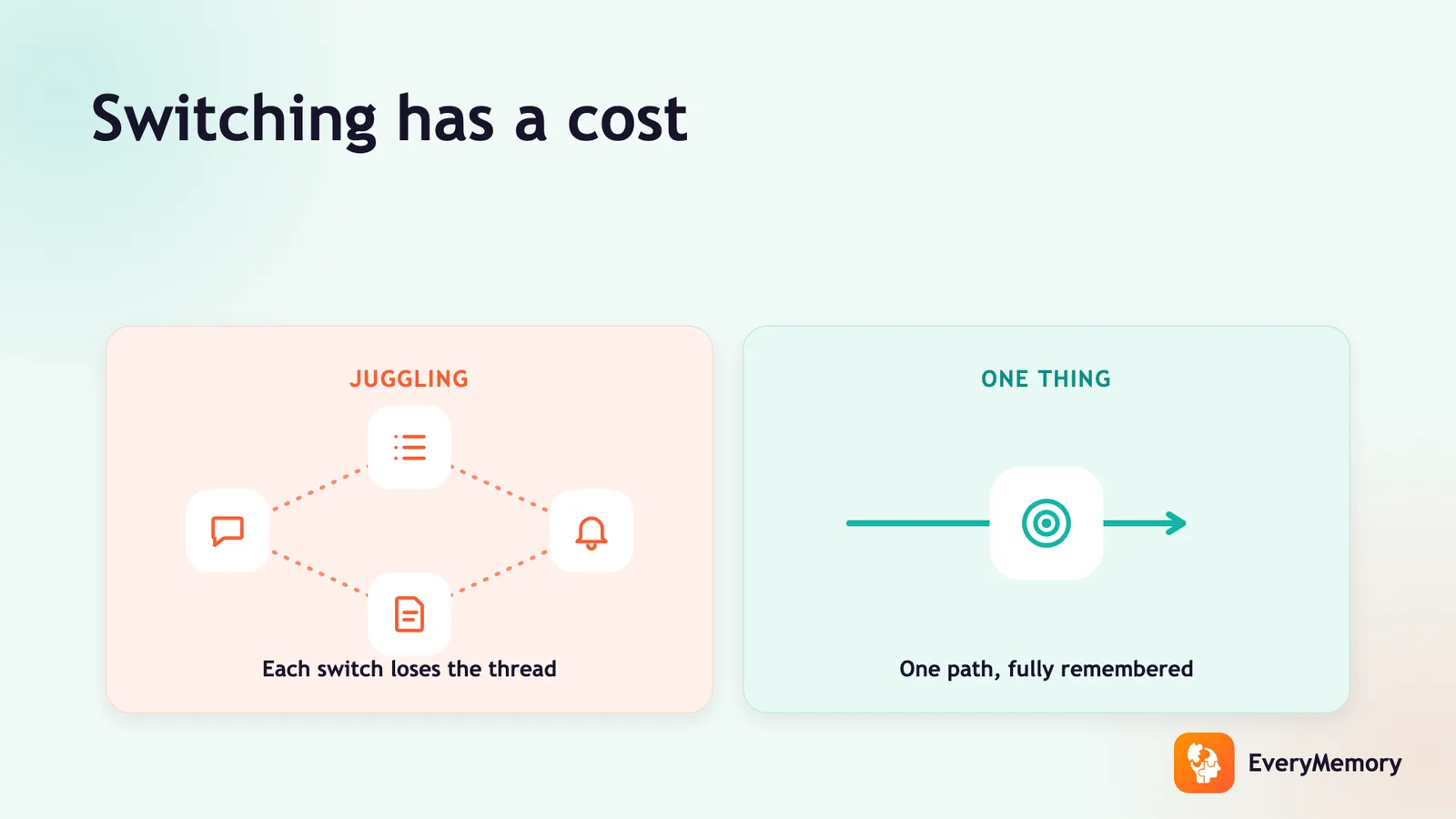
⚡ Quick answer
Multitasking causes forgetfulness because the brain doesn't truly do two things at once - it switches rapidly between tasks, and each switch is costly. Divided attention means information is processed too shallowly to be properly encoded, so there's nothing solid to recall later. It's not a broken memory; it's an attention problem. Deliberate single-tasking at key moments is one of the most direct ways to remember more.
Key takeaways
- The brain switches between tasks rather than truly multitasking, and each switch costs accuracy, speed, and memory depth.
- Divided attention disrupts encoding - so information never forms a strong memory in the first place, rather than slipping away later.
- Multitasking-related forgetfulness is an attention problem, not a sign that memory is breaking down.
- Deliberate single-tasking at key moments - introductions, instructions, important conversations - is one of the most direct ways to remember more.
You were on the phone while unloading the dishwasher - and now you have no idea where you put the car keys. You half-listened to plans while scrolling through an article, and an hour later you can't recall a single detail of either. Sound familiar? The temptation is to worry that something is wrong with your memory. The more accurate explanation is that your attention was somewhere else.
Multitasking and forgetfulness are more directly connected than most people realise. The problem isn't that information passed through your brain and slipped away. It's that it never truly landed in the first place.
The brain switches, it doesn't split
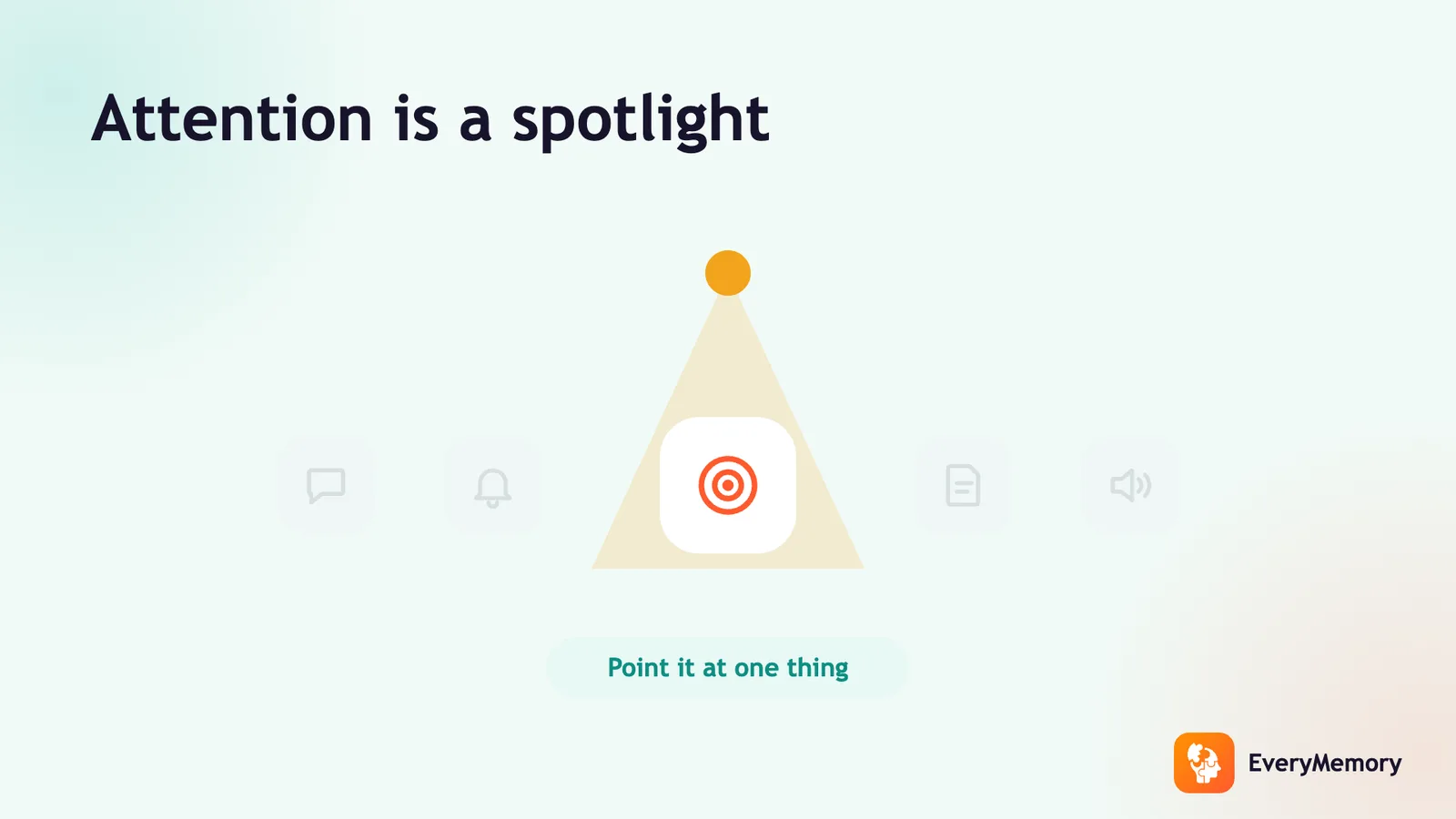
The phrase "multitasking" implies doing several things at once, but that's not what the brain actually does. When you appear to be juggling two tasks simultaneously, you are almost always switching rapidly back and forth between them - sometimes many times per minute. The feeling of doing both at once is an illusion produced by how fast the switching happens.
This matters because each switch carries a cost. Researchers call it the switch cost: a measurable drop in speed and accuracy each time the brain disengages from one task and re-engages with another. For memory, the switch cost isn't just about productivity - it's about depth of processing. A memory is only as strong as the attention given to the moment it formed. Switch during that moment, and encoding becomes shallow or incomplete. Our piece on how attention works and why it matters for memory explains the mechanics in detail.
| Single-tasking | Multitasking (task-switching) | |
|---|---|---|
| Attention | Fully on one thing | Split and constantly switching |
| Memory / encoding | Information gets encoded, so you can recall it | Often never encoded - nothing to recall later |
| Errors | Fewer | More slips and missed details |
| Time | Usually faster overall | Slower, because of switching costs |
| How it feels | Calmer and more in control | Busier but more scattered |
Divided attention and the encoding problem
Memory encoding is the stage at which experience becomes a retrievable record. It depends on the hippocampus - a brain structure that needs adequate attentional resources to do its job. When attention is divided, encoding becomes shallow, and shallow encoding produces memories that are hard to retrieve or simply absent.
This is why so many experiences that feel like memory failure are actually attention failure. A name heard during a noisy introduction, with your mind still half on a previous conversation - that name was never encoded with enough depth to stick. The memory didn't slip away. It was never formed clearly.
- Divided attention disrupts encoding, not just recall.
- Information processed shallowly produces weak, less retrievable memories.
- Single-tasking at key moments directly improves what gets retained.
Attention residue: the hidden cost that lingers
Beyond the immediate switch cost, there's a second mechanism worth understanding: attention residue. When you leave one task to start another, part of your cognitive attention remains occupied with the first. You are physically present with the new task, but mentally still partly engaged with what you left behind.
Organisational psychologist Sophie Leroy identified this phenomenon in research showing that people perform significantly worse on a new task when the previous one was left unfinished. The residue doesn't reset between tasks - it accumulates. A day filled with constant switching can leave you progressively less able to encode anything clearly, which explains why you can feel sharp in the morning and strangely foggy by afternoon.
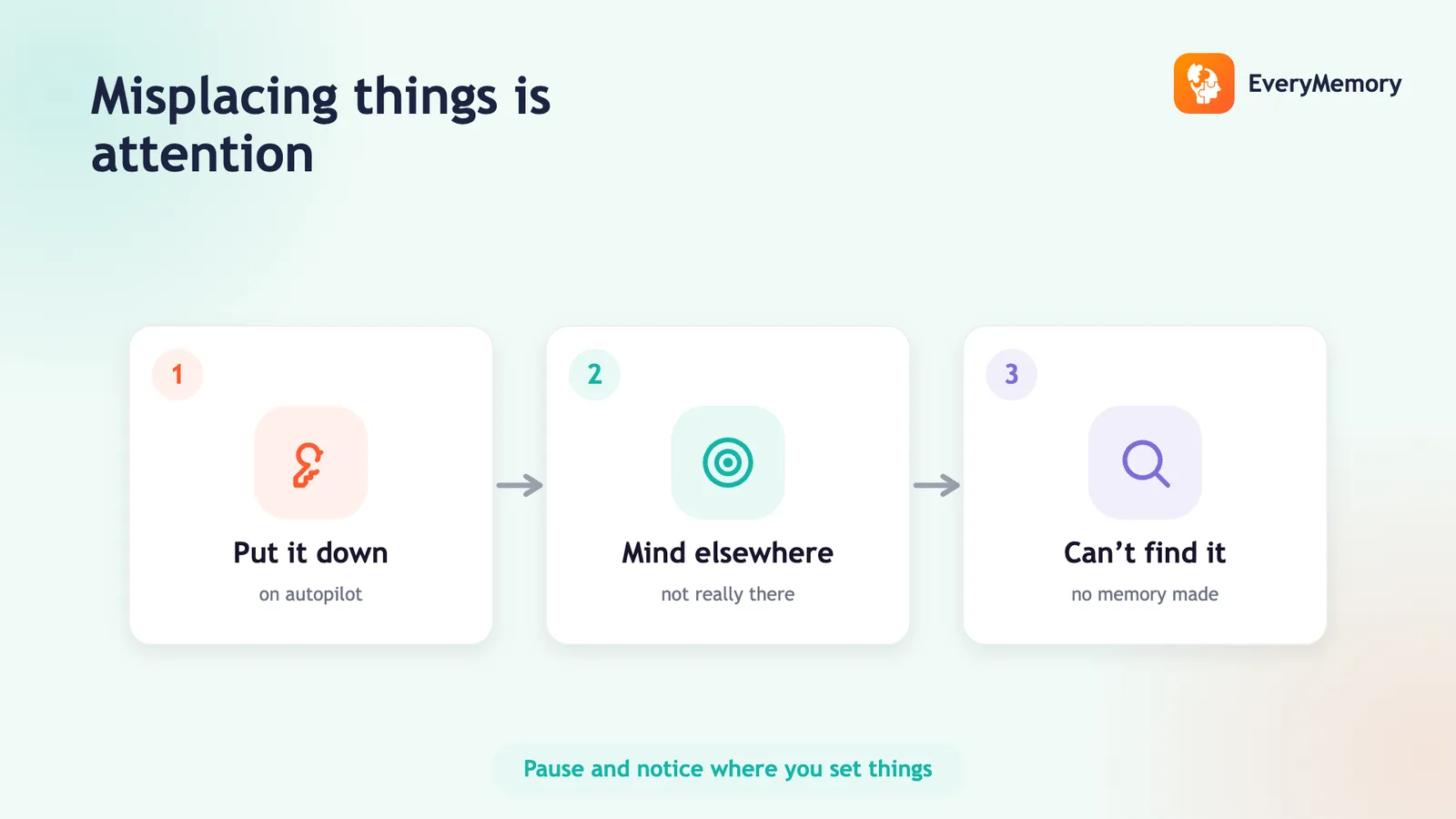
Misplacing objects is a textbook example: you put your glasses down while your mind was already on the next thing, leaving the act entirely unattended and unencoded.
This is an attention problem, not a memory problem
There is one genuinely reassuring thing to take from all of this: the forgetting that follows divided attention is not evidence of a deteriorating memory. The memory system is working as designed. What has been disrupted is the input - not the machinery.
A camera with a smudged lens produces blurry photographs. The camera isn't broken; the problem is upstream. If the encoding stage is interrupted by task-switching, the retrieval stage has nothing sharp to work with. That is not memory failure - it is a predictable consequence of how encoding works. Our overview of why you forget why you walked into a room explores another common version of this same dynamic.
Practical single-tasking strategies
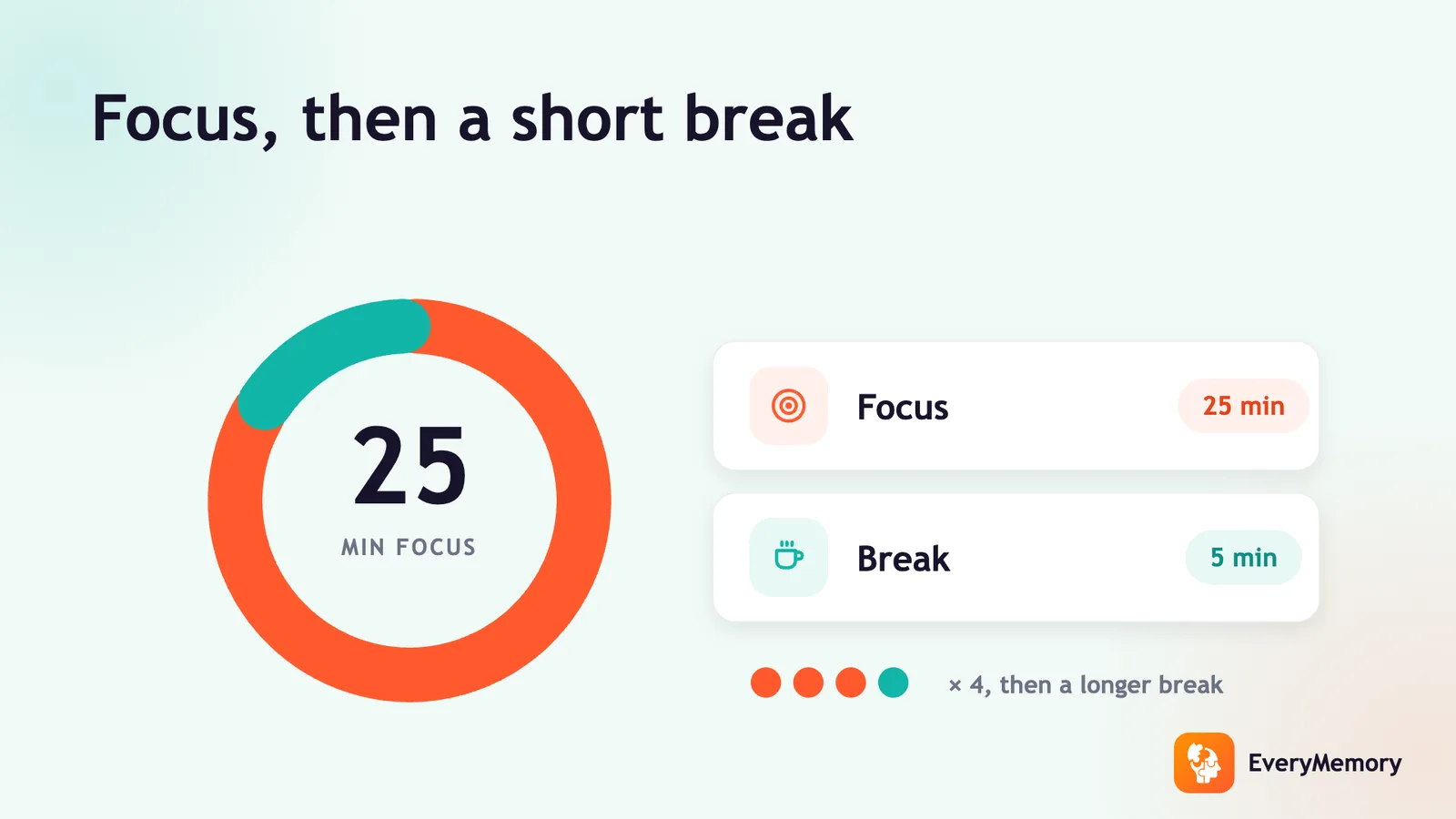
The most effective response to multitasking-driven forgetfulness is not a memory trick - it's protecting attention at the moment encoding needs to happen. The Pomodoro technique - working in focused 25-minute blocks with short breaks - gives this a concrete structure many people find easy to sustain. Before switching tasks, spend 30 seconds jotting down where you left off; this simple act reduces attention residue on whatever comes next.
- At key moments - introductions, instructions, important conversations - put down everything else and give full attention.
- Use physical cues when putting something down: say aloud where you're placing it, or glance deliberately at the spot.
- When switching tasks, note your stopping point before you move on.
- Keep your phone out of reach during meals or conversations that matter.
Building a gentler, more focused daily rhythm
The goal isn't a life of rigid single-tasking - that's neither realistic nor necessary. It's identifying the moments when full attention matters for memory and protecting those specifically. Making breakfast while the radio plays is fine. Trying to follow important instructions while texting is not.
Think of attention as a finite resource that replenishes with rest. Early in the day, when mental energy is fresh, is usually the best time for tasks requiring sustained focus and memory encoding. As the day fragments, written reminders and consistent object placement fill the gaps without demanding more from attention. Even one 20-minute period of genuine single-tasking each day - for something that matters - is enough to notice a real difference in what sticks.
✅ Try this today - The one-thing-at-a-time experiment
Pick one routine moment today where you normally split your attention - a mealtime, a phone call, reading the mail - and try it differently:
- Before you begin, put away or silence any unrelated screens or devices. You're not banning them forever - just for this one block.
- Do only the one thing. If your mind wanders to another task, notice that it did, and bring it back - without judgment. That noticing-and-returning is itself the practice.
- Afterwards, try to recall two or three details from what you just experienced. Compare this with how much you'd normally remember from the same activity. That difference is encoding depth in action.
⚠ When to talk to a professional
This article is general, non-medical information about attention and memory. If you are noticing memory or concentration changes that feel sudden, are getting noticeably worse over time, or are beginning to affect your daily life in concrete ways, it's worth speaking with a qualified healthcare professional.