 EveryMemory
Short-Term Memory Problems: What Can Affect Them?
Short-term memory problems in older adults have many causes - most of them common and changeable, a few worth discussing with a professional.
Part of the guide: Understanding Memory Loss and Forgetfulness: A Calm, Reassuring Guide →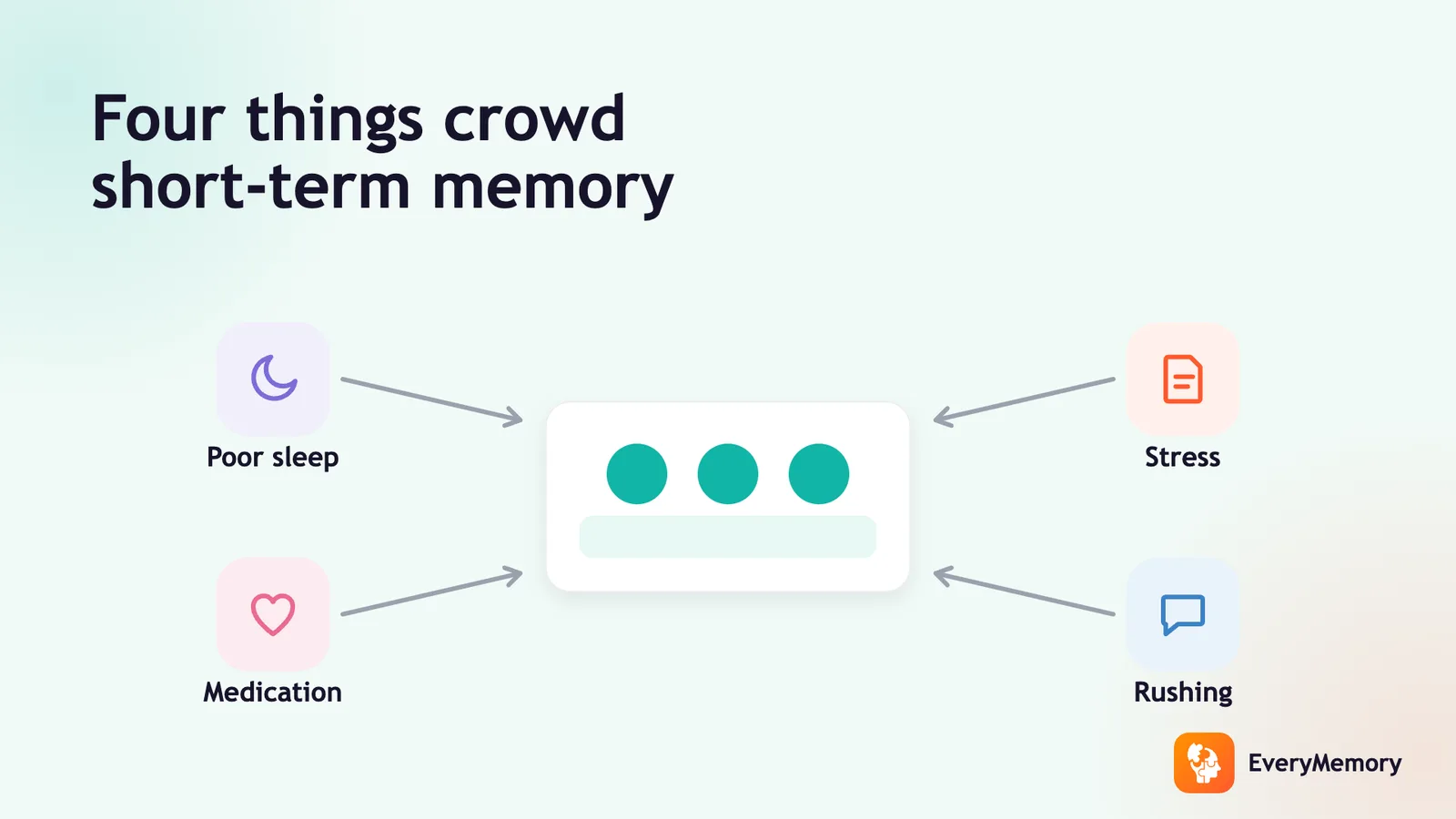
⚡ Quick answer
Short-term memory can be affected by sleep quality, stress, medication side effects, hydration, hearing changes, and normal age-related slowing. Most occasional forgetfulness in healthy older adults falls into these everyday categories. Rapid, worsening, or daily-life-disrupting changes are worth discussing with a qualified healthcare professional rather than explaining away.
Key takeaways
- Short-term memory holds roughly four to seven items for under a minute and fades quickly - its limitations are normal features, not a sign anything is wrong.
- Sleep, stress, certain medications, mild dehydration, and uncorrected hearing or vision changes are among the most common everyday causes of short-term memory hiccups.
- Most of these factors are changeable, and addressing them - especially sleep quality - often leads to noticeable improvement in day-to-day recall.
- Keeping a simple log of what you notice over two to four weeks turns a vague worry into concrete information that is genuinely useful if you later speak with a professional.
Misplacing your keys again, walking into a room and blanking, starting a sentence and losing the thread halfway through - short-term memory hiccups are one of the most common concerns people bring up after fifty. And one of the most understandably worrying.
The reassuring reality is that most short-term memory difficulties have identifiable, everyday causes that have nothing to do with a serious condition. Understanding those causes is both calming and genuinely useful - because many of them are changeable.
What short-term memory actually does
Short-term memory - sometimes called working memory - is the mental scratchpad you use to hold information for a few seconds or minutes while you work with it. It's what lets you remember a phone number long enough to dial it, follow a conversation, or hold the start of a sentence in mind while you finish it.
This scratchpad is remarkably limited even at its best: most adults can hold about four to seven items at once. Age does bring a small, natural reduction in its capacity and speed. But the gap between a healthy 65-year-old and a healthy 35-year-old is far smaller than most people fear - and day-to-day factors often matter more than the birthday.
Everyday factors that quietly undermine short-term memory
Before drawing conclusions about memory itself, it's worth checking the most common culprits:
- Sleep quality. During deep sleep, the brain consolidates memories and clears metabolic waste. Even a few nights of poor sleep measurably shrinks working memory capacity and makes new information much harder to hold. This is one of the biggest and most overlooked factors - see our deep dive on sleep and memory.
- Stress and anxiety. Chronic stress floods the brain with cortisol, which interferes directly with the hippocampus - the region most involved in forming and retrieving memories. A worried mind is a preoccupied mind, and preoccupied minds encode less. More on this in can stress make you more forgetful?
- Medications. Several commonly prescribed medications - including certain antihistamines, blood pressure drugs, sleep aids, and bladder medications - list memory and concentration as known side effects. If your forgetfulness seemed to worsen around a medication change, that connection is worth raising with your prescribing doctor.
- Hydration. Even mild dehydration impairs attention and short-term recall. Older adults have a slightly reduced thirst signal, making it easier to become mildly dehydrated without noticing.
- Hearing and vision changes. If you can't hear a name clearly, or can't read a sign, you can't store what you didn't receive. Uncorrected sensory changes look a lot like memory problems because the information never gets in cleanly.
- Divided attention and multitasking. Information only moves into memory if you are actually attending to it. Doing several things at once means encoding almost none of them properly.
Ruling these factors out - or addressing them - is always the right first step before drawing conclusions about memory itself.
Normal age-related change vs. something more
Some slowing of processing speed and recall is a normal feature of aging, not a disease. Learning new names takes longer, multitasking is harder, and it takes a moment to retrieve a word or a fact. These are annoying but not harmful.
A broader look at what separates ordinary age-related change from patterns worth discussing is in our guide to memory loss vs. normal aging. The short version: changes that are gradual, that you can laugh about, that don't stop you doing familiar things, and that involve information you can eventually retrieve are usually on the normal side of the line.
- Patterns that tend to be normal: temporarily losing a word, forgetting where you put something then finding it, taking longer to learn new information.
- Patterns worth discussing with a professional: rapidly worsening memory over weeks, frequently forgetting recent conversations or events, getting confused in familiar surroundings, repeating the same question in the same conversation.
What genuinely supports short-term memory
Memory research consistently points to the same group of habits for supporting recall over the long term:
- Protecting sleep - quality and duration both matter, not just hours in bed.
- Regular physical movement - even walking improves blood flow to memory-related brain areas.
- Social engagement - conversation and connection require and reinforce working memory.
- Mental practice - consistent, focused memory exercises build the habit of attention. Starting with a simple daily memory routine is a low-barrier way in.
- Managing stress - not eliminating it, but giving it an outlet through exercise, rest, or talking.
- Attending to sensory health - regular hearing and vision checks remove friction from the encoding process.
None of these are miracle solutions, but done together and consistently they make a real, measurable difference to day-to-day recall.
Tracking what you notice
One of the most useful things you can do if you're concerned is to keep a simple log of what you notice, for two to four weeks. A non-medical memory check gives you a structured format for doing exactly that - tracking frequency, context, and whether things are improving or getting worse.
Having that record is also valuable if you do decide to speak with a doctor. Rather than saying "I feel more forgetful," you can say: "I noticed this type of thing happening about four times a week, mainly when tired, and it's been stable for three weeks." That's genuinely useful clinical information.
✅ Try this today - The 5-minute daily attention reset
Do this once a day to reinforce the attention habits that protect short-term memory:
- Put your phone face-down and set a timer for five minutes.
- Read a short passage - a paragraph from a book, article, or letter - with full attention.
- Close the book and write down or say aloud the three main points you remember.
- Open it and check. Notice what stuck and what didn't - that noticing is itself good practice.
⚠ When to talk to a professional
Short-term memory problems are common and most often have everyday explanations. However, if you notice rapid or significant worsening over days or weeks, frequent confusion about familiar places or people, trouble managing daily tasks you previously handled easily, or changes that others around you are noticing, please speak with a qualified healthcare professional. This article is general information only and is not a substitute for a professional assessment.