 EveryMemory
Simple At-Home Memory Check: What It Can and Can't Tell You
At-home memory checks can reveal your own patterns over time. Here's an honest look at what they can show - and what they genuinely cannot.
Part of the guide: Understanding Memory Loss and Forgetfulness: A Calm, Reassuring Guide →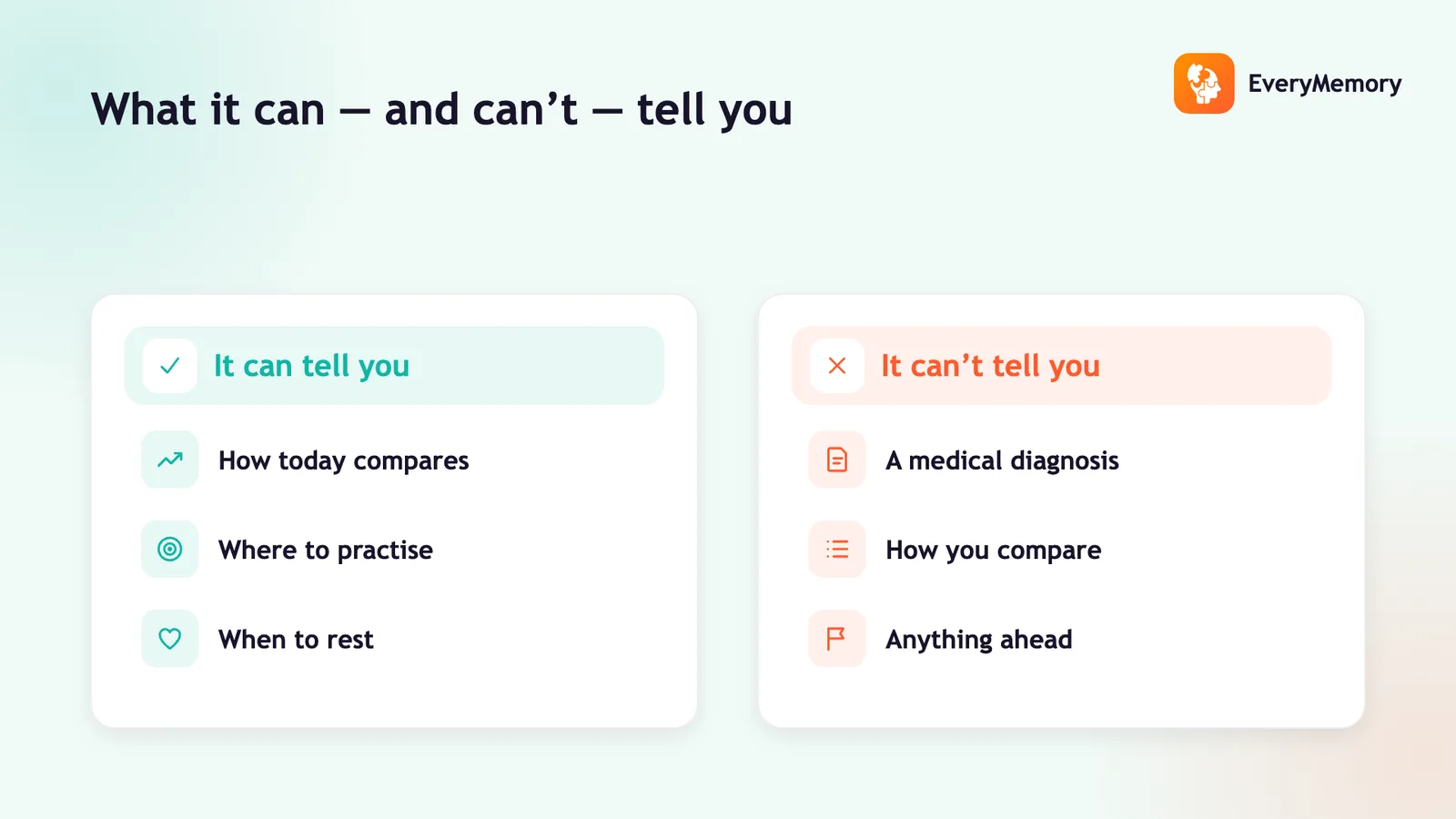
⚡ Quick answer
A simple at-home memory check can show you your own performance on specific recall and attention tasks right now, and - done regularly - how that performance changes over time. It cannot diagnose any condition, rule out any cause of memory changes, or tell you whether changes are medically significant. For any of those questions, a qualified healthcare professional is essential.
Key takeaways
- An at-home check can show your own recall trend over time, but it cannot diagnose any condition or rule out medical concerns.
- A good result does not mean everything is medically fine; many conditions do not appear on brief self-checks, especially early on.
- Once a month is the right frequency - more often creates noise rather than useful signal.
- Talk to a healthcare professional about sudden or worsening changes, or any memory difficulties that are affecting daily life.
The phrase "memory check" can sound clinical - something that happens in a doctor's office, with a professional watching and noting the results. But there's a quieter, everyday version of checking in on memory: a brief structured self-assessment done at home, on your own time, with no professional present.
These at-home checks can be genuinely useful. They can also be genuinely misunderstood. This guide is honest about both sides: what a simple self-check can show you, and - just as importantly - what it cannot, no matter how carefully you do it.
What "At-Home Memory Check" Actually Means
An at-home memory check is a non-medical self-assessment. It typically involves short tasks - recalling a word list, remembering details from a short story, noticing patterns, switching attention between tasks - and gives you a score or impression based on how you performed.
Unlike a clinical memory assessment, there's no trained professional interpreting the results in the context of your full health history. There's no standardised comparison to population norms validated for your age and education level. There's no follow-up built in.
That's not a criticism - it's just important to be clear about what it is. A non-medical self-check is a self-awareness tool, and a useful one. It just has a specific and limited scope.
For a clear explanation of how these tools fit into the broader landscape, what a non-medical memory check is gives a helpful overview.
What an At-Home Check CAN Show You
Here's where at-home checks are genuinely valuable - and the list is worth taking seriously:
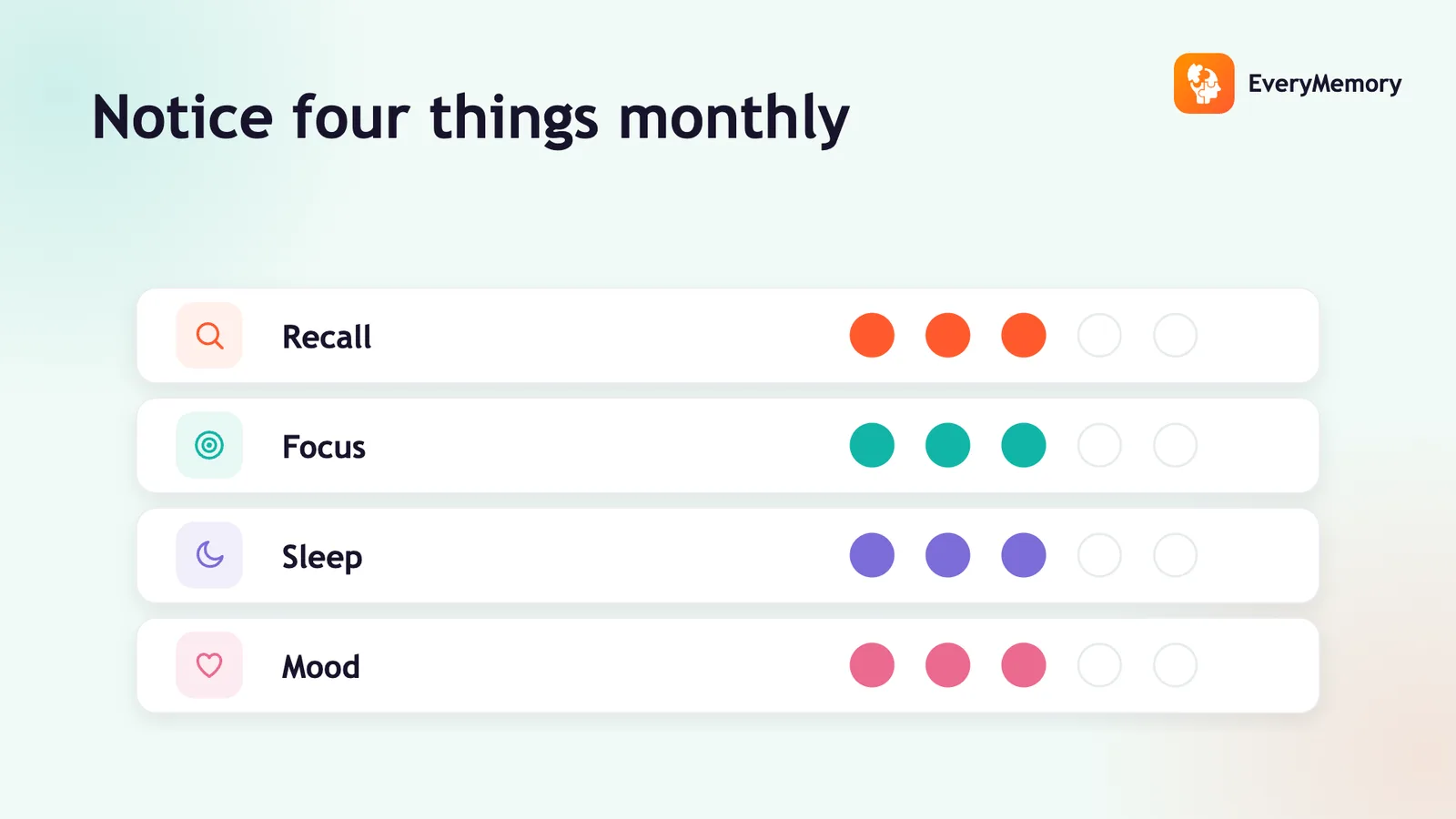
- Your own performance today: how you did on these specific tasks at this moment in time
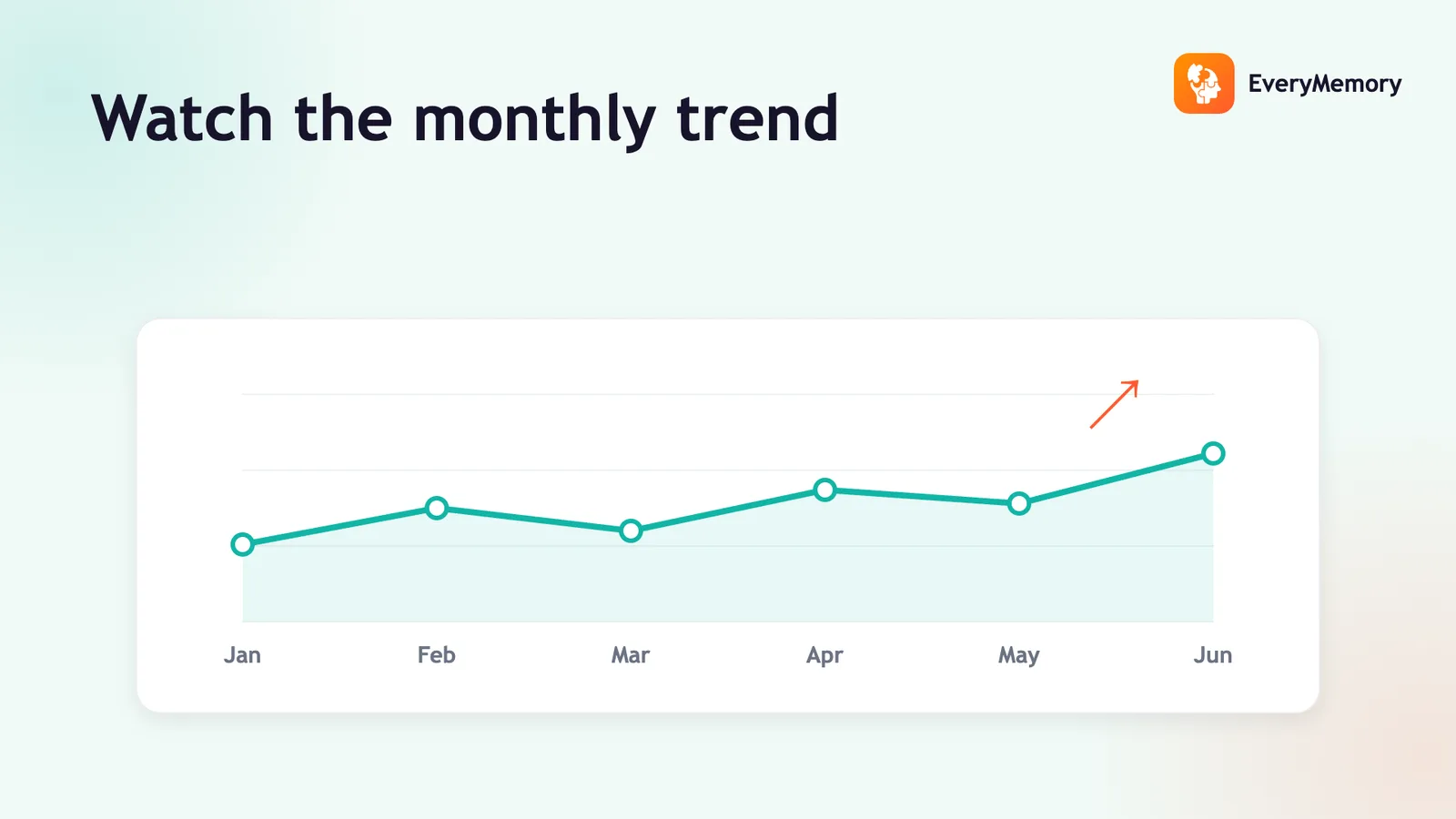
- Your own trend over time: if you do the same check regularly, you can see whether your scores are stable, improving, or declining - relative to yourself
- Which conditions affect your performance: many people discover that their scores reliably dip after poor sleep or during high-stress periods, and recover when circumstances improve
- Which task types feel harder: pattern recall, word retrieval, attention switching - a structured check can make it easier to notice which areas feel most effortful
- A concrete record: rather than vague worry, you have actual data - dates, scores, notes - which is useful if you later want to discuss concerns with a doctor
That last point matters. A consistent record of self-checks over several months - including notes about sleep and stress context - gives a healthcare professional much more to work with than "I think my memory has been off lately." See what to track before talking to a doctor for a practical guide to making that conversation count.
What an At-Home Check CANNOT Tell You
This section matters. Being clear about the limits of self-checks is part of using them responsibly.
- It CANNOT diagnose any condition - not mild cognitive impairment, not any form of dementia, not anything. Diagnosis requires a qualified clinician, a full history, and validated clinical tools.
- It CANNOT rule anything out - a good score does not mean nothing is wrong medically. Many people with early-stage conditions perform well on brief self-checks.
- It CANNOT tell you whether a change is medically significant - only a professional with full context can make that judgment.
- It CANNOT replace a clinical assessment - if you or someone close to you is genuinely concerned about memory changes in daily life, a self-check is not a substitute for seeing a doctor.
- It CANNOT compare you fairly to other people - results are meaningful as a self-relative measure, not as a comparison to norms or to other individuals
None of this means at-home checks are unhelpful. It means they're most helpful when used for what they're actually good at: building self-awareness, tracking your own trend, and providing context.
A Simple At-Home Check You Can Do Today
Here's a brief, practical self-check you can do without any app or equipment. It takes about ten minutes and gives you a rough personal baseline.
- Word recall: Read a list of 10 unrelated words slowly (apple, lamp, river, pencil, curtain, bridge, pillow, ticket, candle, mirror). Wait five minutes doing something else. Write down as many as you can recall. Note your score out of 10.
- Story detail: Read a short paragraph (a simple news story or a paragraph from a book). Wait ten minutes. Write down five details you remember from it without looking back. Note how many you got.
- Attention switching: Count backwards from 100 in 7s (100, 93, 86...) for one minute. Note how far you get and whether you needed to restart.
- Self-rating: On a scale of 1-10, how sharp did recall feel today overall?
Write all of this down with today's date. Next month, do the same check. The comparison between your own results over time is where the value lies.
How Often and How to Interpret Results
Once a month is enough for a self-check of this kind. Doing it more frequently creates noise rather than signal - performance varies too much day to day to make weekly scores meaningful.
When you read your results, resist the urge to interpret a single score. Look instead at the three-to-six-month trend. Are your word recall scores broadly stable? Is the self-rating holding steady or drifting? Is one task type consistently harder than the others?
If you want a structured framework for that monthly review, the monthly memory check-in guide gives a practical approach. And for tracking the results over time in one place, the month-by-month tracking guide walks through a simple logging method.
Day-to-day variation in recall is normal. Sleep and stress both have measurable effects on self-check performance - factoring that context into your notes makes the data far more interpretable.
When to See a Healthcare Professional
Use this self-check as a starting point, not an ending point. If you've been tracking for a few months and notice a clear, consistent decline - or if at any point you notice sudden or sharp changes rather than gradual ones - it's time to speak with a doctor, not do more self-checks.
Equally, if memory is affecting daily life - managing medications, finances, navigating familiar routes, following conversations - that's worth professional attention regardless of what a self-check shows. A self-check cannot tell you that you're fine any more than it can tell you that something is wrong. Only a qualified healthcare professional can give you that context.
If you're preparing for that conversation, what to track before talking to a doctor will help you bring the most useful information with you.
✅ Try this today - Do the 10-Minute At-Home Check
Try the simple four-part check described above and record your results:
- Write down today's date and your word recall score (out of 10), story detail score (out of 5), how far you got in the countdown, and your self-rating (1-10).
- Note briefly: how well did you sleep last night, and how stressed have you felt this week? That context is part of the record.
- Set a reminder to do the same check in exactly one month. The comparison is where the value starts.
⚠ When to talk to a professional
This at-home check is a non-medical self-awareness exercise. It cannot diagnose any condition and a good result does not rule out any medical concern. Day-to-day variation is completely normal and usually linked to sleep, stress, or physical health. If you notice sudden, rapid, or severe changes in memory or thinking - or any changes that are affecting your ability to manage daily life - please speak promptly with a qualified healthcare professional rather than relying on self-checks alone.