 EveryMemory
Smell and Memory: Why a Scent Brings Back the Past
A whiff of sunscreen and you are eight years old at the beach again. Here is the fascinating brain science behind why scent memories feel so vivid, emotional, and old.
Part of the guide: How to Keep Your Brain Healthy: A Complete Lifestyle Guide →
⚡ Quick answer
Smells trigger vivid, emotional memories because the brain's smell pathway connects almost directly to the regions that handle emotion and memory, the amygdala and hippocampus, bypassing the usual thalamic relay that other senses pass through first. This shortcut means scent signals arrive fast, richly tagged with feeling, and strongly encoded. The result is the phenomenon often called the Proust effect: a scent that transports you instantly to a specific moment from the past.
You open an old wardrobe and catch a trace of cedar and something floral, and for a second you are completely somewhere else. A grandmother's hallway, afternoon light, the particular feeling of being small and safe. No photograph or diary entry could have taken you there so fast.
This is one of the most reliably astonishing things the brain does, and almost everyone has experienced it. A smell arrives and a memory follows, not a dry, factual memory but a full scene, complete with emotion and atmosphere. It feels less like remembering and more like being briefly returned.
The reason it works this way is not poetic coincidence. It comes down to a specific quirk in how the brain is wired, one that sets the sense of smell apart from every other sense. Understanding it is genuinely useful, because it means you can put scent to work for your own recall and daily routines.
The Proust effect: a scent and a flood of memory
The name comes from the French novelist Marcel Proust, who in his early-twentieth-century novel sequence described biting into a small cake, a madeleine, dipped in lime-blossom tea, and being instantly flooded with a complete, vivid memory of childhood Sunday mornings at his aunt's house. The detail that makes the passage famous is not just that he remembered, but how he remembered: involuntarily, overwhelmingly, and with all the emotional texture of the original experience intact.
Psychologists and memory researchers now use "the Proust effect" as a shorthand for this exact phenomenon, an involuntary, highly emotional, sensory-triggered memory, most often triggered by smell. Studies consistently find that odor-cued memories are rated as more emotionally intense, more vivid, and more likely to feel like being mentally transported than memories cued by a word, a photograph, or even a piece of music. That is a remarkable finding given how little we tend to consciously attend to smell compared with sight or sound.
What makes it especially striking is the age of the memories involved. Scent-triggered memories are disproportionately old, often reaching back to early childhood, sometimes to the very first years of life. They tend to be first experiences: the first time you encountered that smell, the place it was attached to, the person who was there.
Why smell has a memory shortcut in the brain
Every sense you have sends its signals through a structure called the thalamus, a central relay station that sorts incoming information and passes it to the relevant cortical areas. Sight, sound, touch, taste: all of them go through the thalamus before reaching the parts of the brain that process meaning and emotion.
Smell is the exception. Signals from the nose travel first to the olfactory bulb, a structure that sits directly above the nasal cavity and connects, with almost no relay stops, to two regions at the heart of the brain's memory and emotion system: the hippocampus (critical for forming and retrieving memories) and the amygdala (the hub for emotional processing and emotional memory in particular). Only after that does the signal reach higher cortical areas for conscious analysis.
This is a very old arrangement, evolutionarily speaking. The olfactory system is one of the most ancient parts of the vertebrate brain. The tight anatomical link between smell, emotion, and memory almost certainly served survival, being able to instantly remember that a particular smell meant danger or food was enormously useful. We inherited that wiring intact, which is why a scent can bypass rational, deliberate thought and land directly in feeling and recollection. For a deeper look at how memory systems work in general, see our guide to how memory works.
Why scent memories feel so emotional and old
Two things explain why these memories tend to be emotionally charged and surprisingly early in life.
First, the direct connection to the amygdala means that when a smell encodes a memory, it encodes it with strong emotional context attached. Emotional memories are better consolidated, the brain literally tags them as worth keeping. When you retrieve them, you retrieve the emotional colouring along with the scene itself. That is why a scent memory does not feel neutral: it arrives pre-loaded with atmosphere.
Second, the "childhood peak" happens because many smells are encountered for the first time early in life, and first-time experiences are encoded more robustly than repetitions. Your brain is also still building its association networks in childhood, so a smell that gets linked to a place, a person, and a feeling during those years can form an unusually durable trace. Adult life tends to be more routine; the novel, formative moments cluster in the early years. So when a scent reaches back, it often reaches far back.
This also connects to why scent can influence mood so readily, the same short path that makes smells memorable also makes them effective at shifting emotional state, almost before you have consciously registered the scent. You can read more about the interplay between feeling and recall in our piece on emotional wellbeing and memory.
Putting scent to work for your own memory
The same wiring that makes scent memories involuntary can be used deliberately. There are a few simple, practical ways to recruit smell as a memory and wellness tool.
- Use a consistent scent while learning, then cue it during recall. If you study or read something important with a specific scent present, a particular candle, a drop of essential oil on a tissue, retrieving that scent later can help bring back what you encoded with it. The match between encoding context and retrieval context helps. Keep the scent distinctive and use it only for that purpose.
- Anchor a calming scent to a regular routine. If you associate a scent with a specific activity, a morning routine, a wind-down practice, a moment of quiet, the scent begins to cue the associated mental state almost automatically. Over time it becomes a reliable, fast signal to shift your nervous system in the direction you have trained.
- Use scent cues intentionally for mood. Because the olfactory pathway connects so directly to emotional processing, smells can shift how you feel faster than most other inputs. Identifying a scent you associate with calm, energy, or focus and having it available when you want that state is a low-effort, evidence-adjacent tool worth trying.
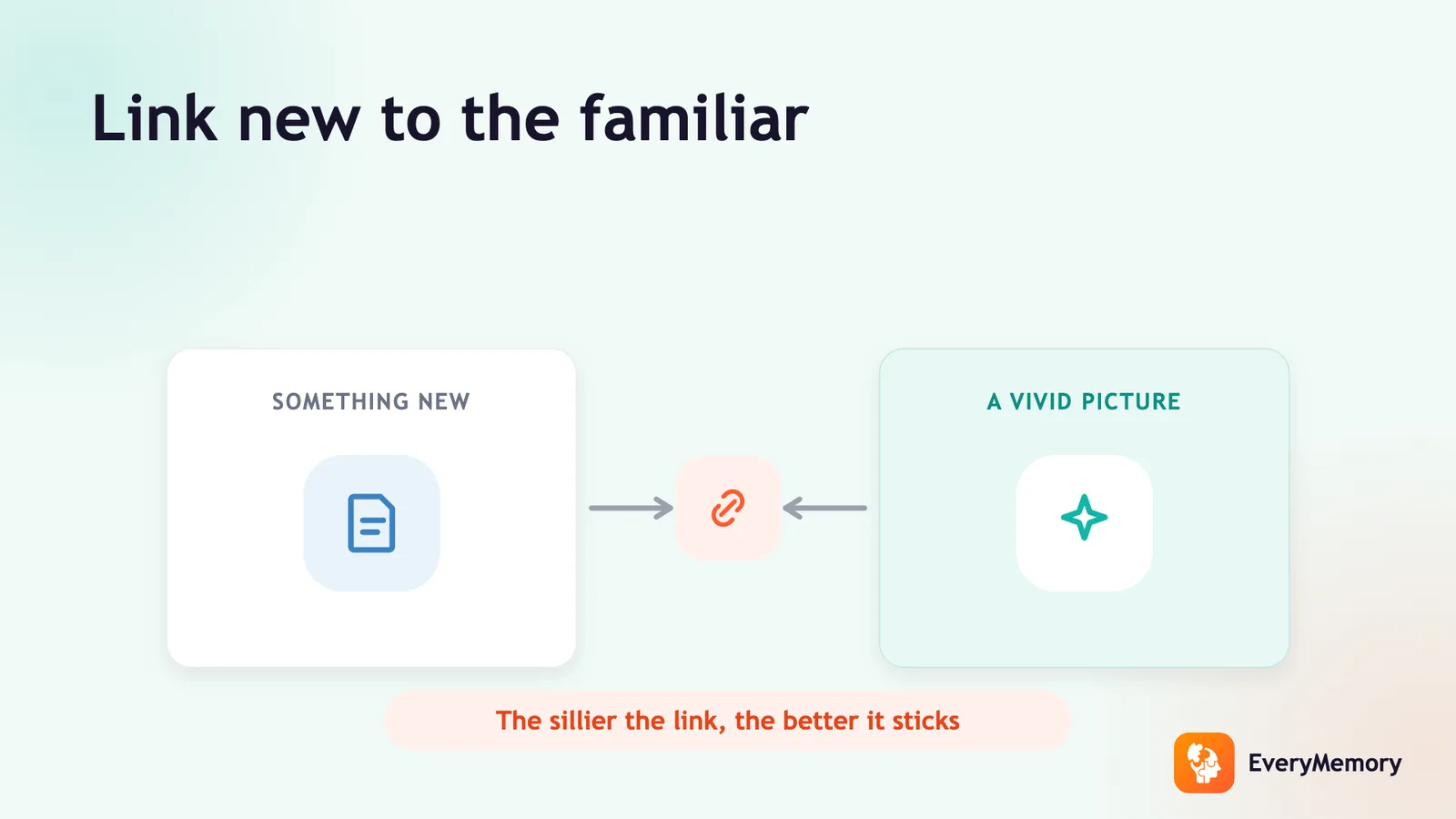
For more practical techniques that use association to strengthen what you remember, see our article on how to use association to remember more.
When changes in smell are worth noting
For most people, the relationship between smell and memory is simply something fascinating to notice and, if you like, to use. But it is worth knowing that a noticeable, lasting change in your sense of smell, a significant reduction, a distortion, or a loss, can occasionally reflect something happening in the body that a qualified health professional would want to know about.
This is not a reason to worry about normal day-to-day variation, which is common and usually trivial. But if a change in smell is persistent, unexplained, and out of character for you, mentioning it to your doctor is a sensible step. This article is not medical guidance, it is general information about how the senses interact with memory and brain function.
✅ Try this today - Try a scent memory anchor
Pick one specific scent you do not encounter randomly in daily life, a single essential oil, a particular candle, or even a spice. Use this three-step approach to start building a deliberate scent-memory link.
- Choose your anchor scent and use it only during one specific activity, reading, a focused work session, or a morning routine, for at least a week.
- When you want to recall what you read or shift into that mental state, bring the scent back. Notice whether the associated material or mood feels more accessible.
- After two to three weeks, reflect on whether the scent has begun to feel like a reliable cue. If it has, you have built a simple, working scent anchor you can use anywhere.
⚠ When to talk to a professional
This is general, non-medical information about how the senses and memory interact. A noticeable, lasting change in your sense of smell can be worth mentioning to a qualified professional.