 EveryMemory
Daily Brain Training Routine
A repeatable, mixed daily set of short mental drills - covering recall, attention, and processing - that takes under 15 minutes and fits any schedule.
Part of the guide: Brain Exercises for Seniors: The Complete Guide →
⚡ Quick answer
A daily brain training routine is a short, scheduled set of varied mental exercises done at the same time each day. Mixing recall, attention, and processing drills across the week keeps the brain challenged, prevents adaptation to a single task, and makes the habit easier to maintain than a single long workout done rarely.
Key takeaways
- A routine that mixes recall, attention, pattern, and processing-speed drills prevents the brain from adapting to a single task and stops producing real challenge.
- Twelve to fifteen minutes a day, at a fixed time and place, is enough to cover all four drill types across a week.
- The sample seven-day schedule includes a light Saturday session and a review-only Sunday, balancing daily habit with consolidation time.
- Keeping materials out and ready removes the small friction points that are often enough to break a new habit on a busy morning.
A single exercise type, repeated every day, quickly stops being a challenge - and without challenge, there is limited benefit. A well-designed daily brain training routine mixes different drill types across the week so that memory, attention, and processing speed all get regular work, while none of them becomes stale.
This guide lays out a complete, repeatable daily routine that takes 12 to 15 minutes from start to finish. Each drill has a clear purpose, the schedule rotates to prevent adaptation, and the whole thing is built to run without any special equipment or app. If you are already doing occasional exercises, this gives you the structure to make them consistent - and to know you are covering all the important bases.
Why variety matters more than intensity
Memory, attention, and processing speed are related but distinct. A drill that works one does not automatically strengthen the others. Focusing only on word recall, for example, will improve word recall - but may leave visual attention or working-memory span untouched.
Mixing drill types across a week also prevents the brain from simply learning the format of a specific task rather than building a transferable skill. This is called task-specific learning, and it is why someone can score very well on a single brain-training game while noticing little benefit in daily life. Variety forces broader adaptation.
You do not need many different exercises. Three or four types, rotated intelligently, cover the main bases without making the routine feel complicated or hard to remember.
The four building blocks of a good routine
Every session in the routine below draws on one or more of these four drill types. Each one is described in detail in its own guide, so you can go deeper on any of them.
- Recall drills: Study a short list or scene, then reproduce it from memory after a delay. Targets the encoding and retrieval process. See word recall practice for a full how-to.
- Attention drills: Sustain or switch focus under a mild time or distraction constraint. Targets the filtering system that lets you follow one thing without being pulled away.
- Pattern and sequence drills: Observe and rebuild a visual, number, or shape sequence. Targets the visual-spatial working memory. Full details in pattern memory exercise.
- Processing speed drills: Complete a simple cognitive task as quickly and accurately as possible - for example, cross out all even numbers on a page or name the colour of each word in a list. Targets mental quickness under mild pressure.
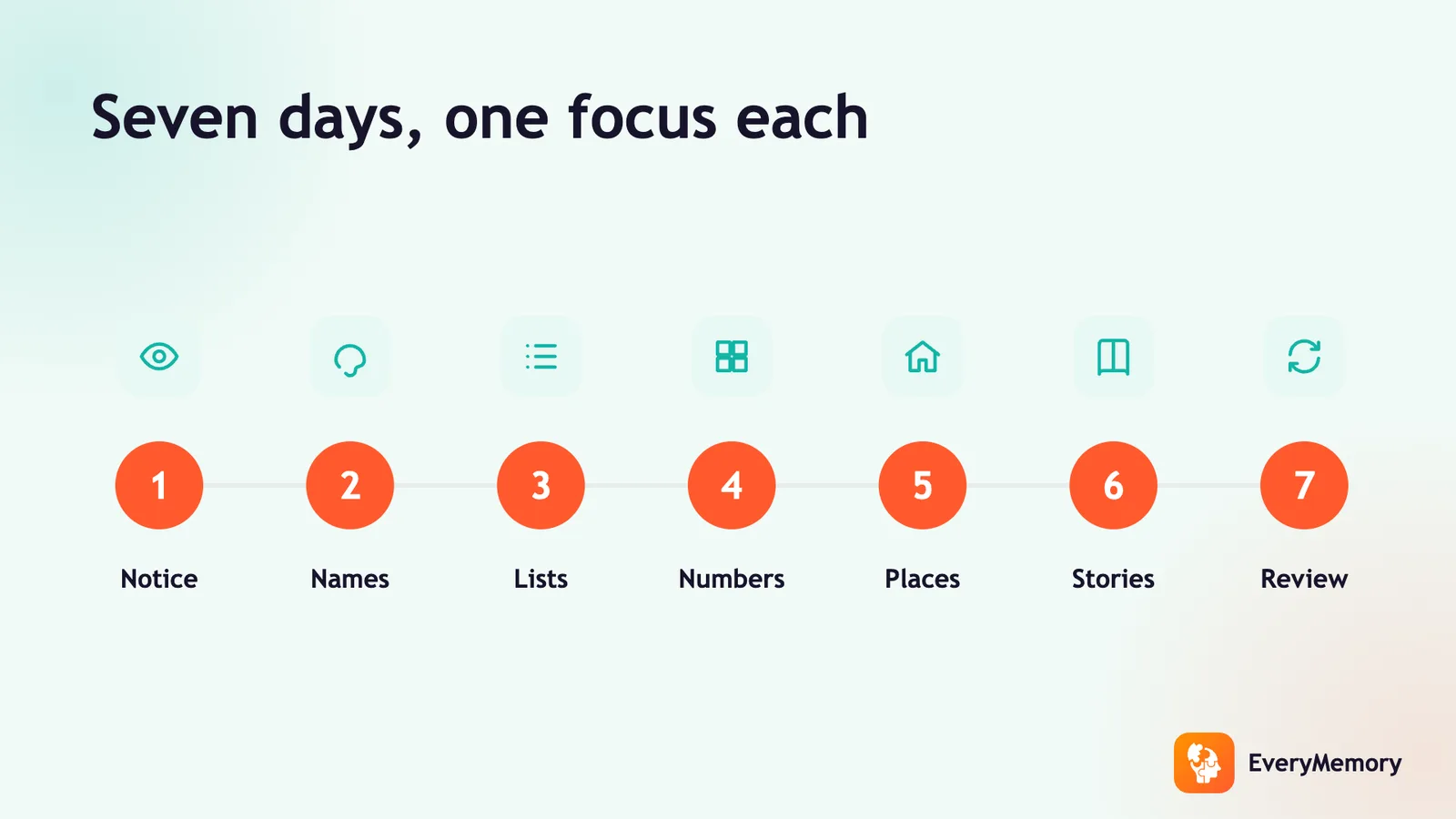
A complete 7-day sample routine
Each session runs 12 to 15 minutes. The structure is: 2-minute warm-up, 8 to 10 minutes of drills, 2-minute review. Do this at the same time and place each day - morning is ideal because attention tends to be sharper, but any consistent slot works.
- Monday - Recall focus. Warm-up: name 5 things you can see from where you sit. Main: read a 10-word list, cover it, wait 3 minutes, then write it from memory. Second round with a new list.
- Tuesday - Attention focus. Warm-up: count backwards from 50 by 3s. Main: open a magazine or newspaper page, set a 2-minute timer, and circle every letter 'e' you can find. Count your hits and misses.
- Wednesday - Pattern focus. Warm-up: repeat Tuesday's count-back with a different number. Main: draw two 4x4 grids, shade 6 squares in each, study both for 20 seconds, then recall both on blank grids.
- Thursday - Processing speed focus. Warm-up: name 10 animals as fast as you can. Main: write the numbers 1 to 50, then cross out all multiples of 3 and circle all multiples of 7 - time yourself and aim to beat yesterday's score.
- Friday - Mixed recall and pattern. Warm-up: describe what you had for breakfast in as much detail as possible. Main: one word-list recall round plus one shape-chain recall round.
- Saturday - Light day. 5-minute session only: one round of word recall, no time pressure, no scoring. This keeps the habit without overloading a weekend.
- Sunday - Review. No new drills. Open your log, check scores from the week, note which drill felt hardest, and decide if any difficulty level needs adjusting next week.
Easier and harder adjustments
The routine above is a starting point, not a fixed prescription. Adjust each drill so it sits just at the edge of your comfort - easy enough to complete without frustration, hard enough that you have to concentrate.
- Easier: reduce word lists to 6 items; allow 30 seconds of study instead of 15; skip the distraction delay.
- Easier: on attention days, use larger text, focus on only one target letter, and remove the time limit.
- Harder: add a 30-second distraction task (describe a room in your house in detail) between study and recall.
- Harder: increase word lists to 15 items; use two simultaneous attention targets; extend the pattern drills to 3 grids.
- Harder: on processing speed days, add a second rule (cross out multiples of 3 AND circle primes) and reduce the allowed time.
Making the routine stick - practical habit tips
The routine only works if you show up for it consistently. A few structural choices make that much more likely than motivation alone.
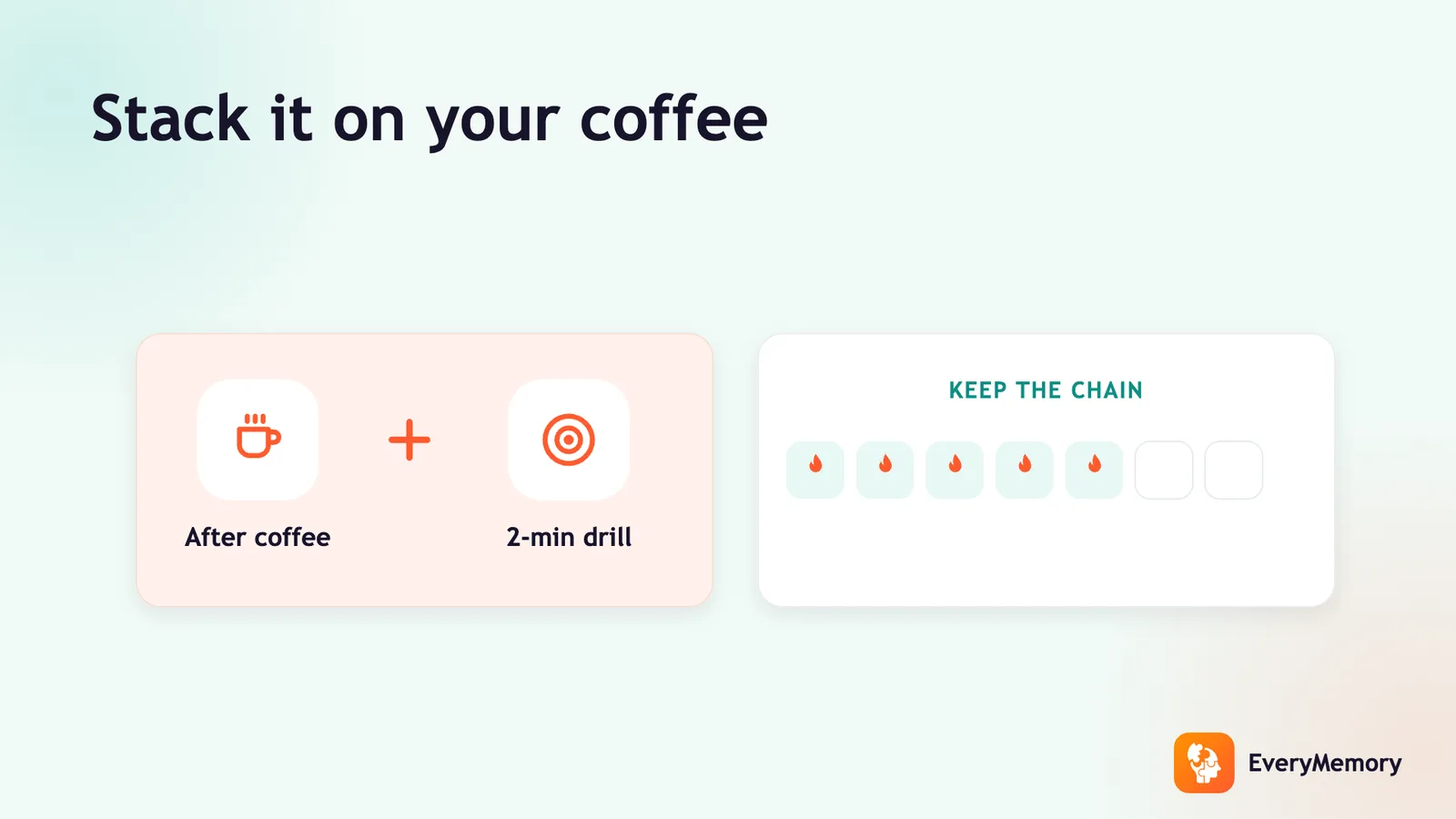
First, assign a fixed time and location. The brain is strongly cued by context, so doing your drills in the same chair at the same time every day means the habit triggers automatically rather than requiring a new decision each morning. Our guide on building a simple daily memory routine goes into more detail on this.
Second, keep your materials out and ready. If you need to find your notebook, sharpen a pencil, and print a grid before you start, those small friction points are enough to break the habit on a busy morning. A dedicated notebook on the kitchen table is far more reliable.
Third, log your scores. Even a simple tick chart where you note how many items you recalled correctly each day provides the feedback loop that keeps people engaged. Progress is motivating, and you cannot see progress without a record. The weekly memory check-in template is a simple format you can use alongside your drill log.
✅ Try this today - Your first 15-minute session
Set a timer and try this right now:
- Warm-up (2 min): Count backwards from 50 by 3s out loud.
- Main drill (8 min): Write 10 random words, study them for 90 seconds, cover the list, wait 3 minutes while you do something else, then write as many as you can from memory. Score yourself, then repeat with a new list.
- Review (2 min): Note your score in a notebook. That score is your baseline - every improvement from here is measurable progress.