 EveryMemory
7 Surprising Facts About How Memory Works
Memory is not a recording - it is a creative act. These seven science-backed facts will change the way you think about remembering, forgetting, and your own life story.
Part of the guide: How to Keep Your Brain Healthy: A Complete Lifestyle Guide →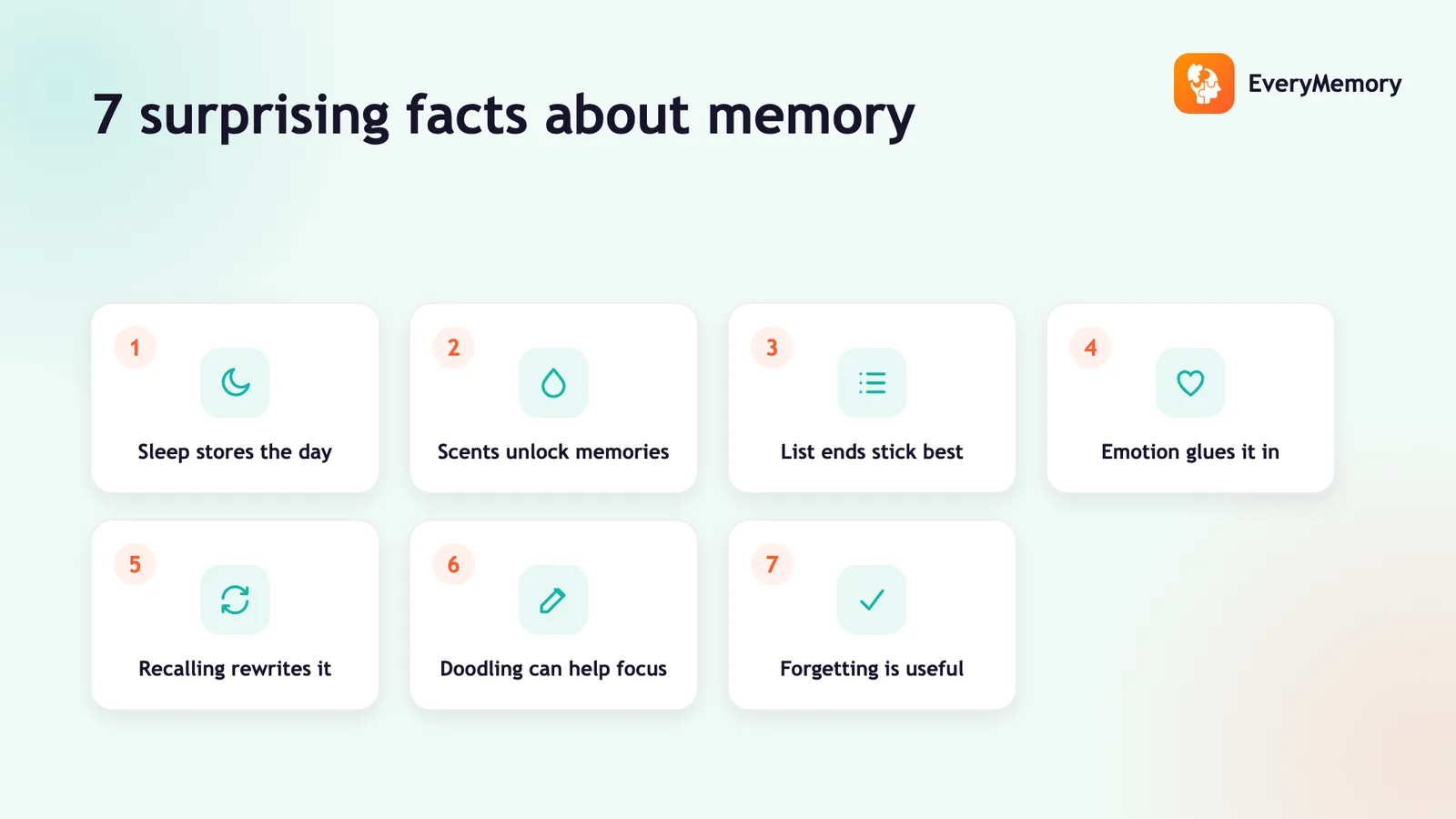
⚡ Quick answer
Human memory is reconstructive rather than reproductive - every recall is a fresh act of assembly, not a playback. It is shaped by sleep, emotion, smell, the position of items in a list, and the era of life when events occurred. The good news is that memory skills can improve with deliberate practice at any age, thanks to the brain's ongoing capacity for change.
Key takeaways
- Memory is reconstructive - every recall is a fresh reassembly, not a playback, which is why memories drift over time.
- Sleep actively consolidates memories; slow-wave sleep replays the day's learning and transfers it to long-term storage.
- The serial position effect means you naturally remember the start and end of any list better than the middle.
- Memory is a trainable skill: consistent, deliberate practice with proven techniques produces real improvements at any age.
Most of us picture memory as a mental video camera - press record and the moment is saved exactly as it happened. The reality is far more interesting. Memory is an active, creative process that your brain rebuilds from scratch every time you remember something.
Understanding a few of the stranger truths about memory can make you a better learner and a more patient self-observer. Here are seven facts that tend to genuinely surprise people - each grounded in decades of research.
Memory Is Reconstructive, Not a Recording
Perhaps the most counterintuitive fact about memory is that it does not store experiences like a hard drive stores files. Each time you recall something, your brain reassembles the memory from stored fragments - filling gaps with inference and whatever you have learned since. Psychologist Elizabeth Loftus compared memory to a Wikipedia page: editable by anyone who comes along, including yourself.
This is why two people can honestly remember the same event differently, and why memories drift without us noticing. Far from a flaw, this reconstructive quality is what makes memory flexible - the same machinery that rebuilds the past also runs forward simulations. For a deeper look, see how memory works.
Why it matters: When your recollection differs from someone else's, curiosity serves you better than certainty. You are both probably right about something.
Sleep Is When Your Brain Files the Day
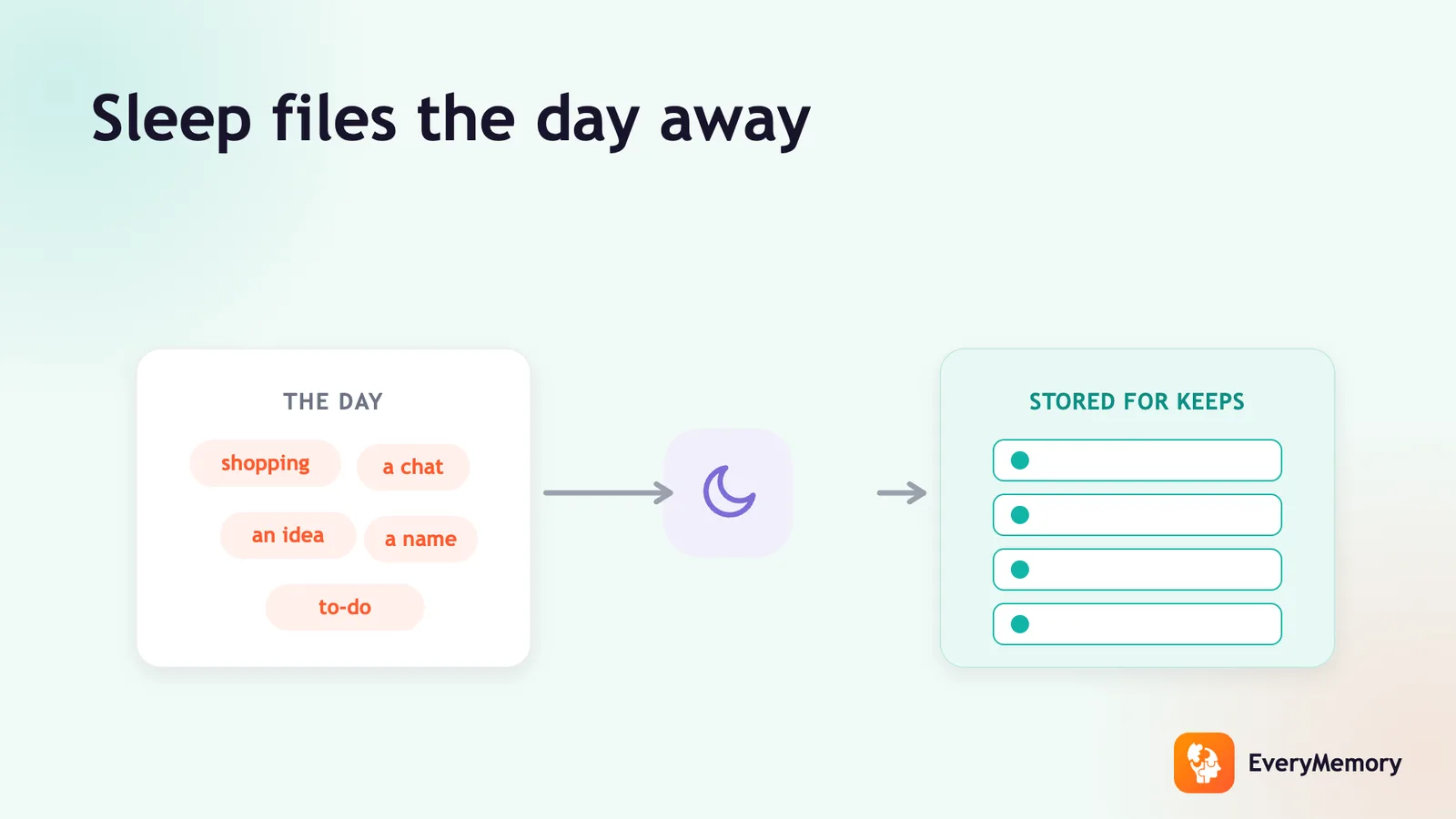
Sleeping on it is not a figure of speech. During slow-wave sleep, the brain replays and strengthens the day's new memories, shifting them from the hippocampus into more durable cortical storage. REM sleep then knits emotional and procedural memories into the wider web of existing knowledge. A full night of sleep after learning can roughly double recall compared with staying awake. Even a 90-minute afternoon nap produces measurable gains. The connection between sleep and memory is one of the most consistently replicated findings in cognitive science.
Why it matters: Staying up late to review new information is almost always counterproductive - the hours of sleep that follow do as much consolidating work as the session itself.
Smells Bypass the Brain's Gatekeeper
Every other sense passes through the thalamus - the brain's central relay - before reaching the memory and emotion centres. Smell is the only sense that skips this step, connecting directly to the amygdala and hippocampus. That short-circuit is why a whiff of sunscreen or old books can drop you into a vivid scene from decades ago with no warning.
The phenomenon is called the Proust Effect, named for the novelist who described a childhood flooding back from the smell of a madeleine dipped in tea. Research confirms that odour-triggered memories tend to be older, more emotional, and more detailed than memories sparked by any other sense.
Why it matters: You can use this deliberately - linking a particular scent to a study session or meaningful routine can make the context, and the memories in it, easier to retrieve.
You Remember the Start and End of Lists Best
Ask anyone to recall a spoken list of words and a striking pattern emerges: items at the start and end are remembered far better than anything in the middle. Psychologists call this the serial position effect - the advantage at the beginning is the primacy effect (early items get more rehearsal and encode more deeply) and the advantage at the end is the recency effect (final items are still active in working memory at recall time). The middle zone gets neither benefit.
Why it matters: Put the most important item first or last in any list you want to hold. When learning something new, building short breaks into a session resets the clock - every restart creates a fresh primacy advantage.
Your Teens and Twenties Leave a Disproportionate Imprint
If you ask adults over fifty to recall their most vivid memories, a strikingly large proportion cluster around the years from roughly fifteen to twenty-five. Researchers call this the reminiscence bump, and it appears consistently across cultures, genders, and educational backgrounds.
That period is packed with genuine first-time experiences - first love, first independence, the shaping of personal identity - and novelty encodes memories more strongly. High emotion during those years adds further weight, since emotion acts as a biological highlighter pen for memory. The bump is especially strong for music: the songs from your late teens tend to feel like your songs in a way later music rarely matches. Curious about why older memories can feel more vivid than recent ones? The reminiscence bump is part of the answer.
Why it matters: This is not nostalgia for its own sake - it is your brain anchoring your sense of self. Those formative memories are a genuinely accessible mood and motivation resource.
Emotion Acts as a Biological Highlighter
When something emotionally significant happens, the amygdala signals the hippocampus to encode the surrounding details more vividly. Stress hormones released during intense moments further cement the encoding - which is why we remember joyful, frightening, or moving experiences in richer detail and for longer than neutral ones.
This is the engine behind "flashbulb memories" - those vivid recollections of where you were when surprising news hit. The vividness feels like proof of accuracy, but emotional memories are still reconstructive. Research confirms that flashbulb content drifts just as ordinary memories do, even when people feel completely certain. Emotional charge makes them feel reliable; it does not make them error-free.
Why it matters: Connect any information you want to remember to something that genuinely moves you - curiosity, humour, or personal relevance. A single moment of real engagement outperforms hours of dry repetition.
Memory Is a Trainable Skill
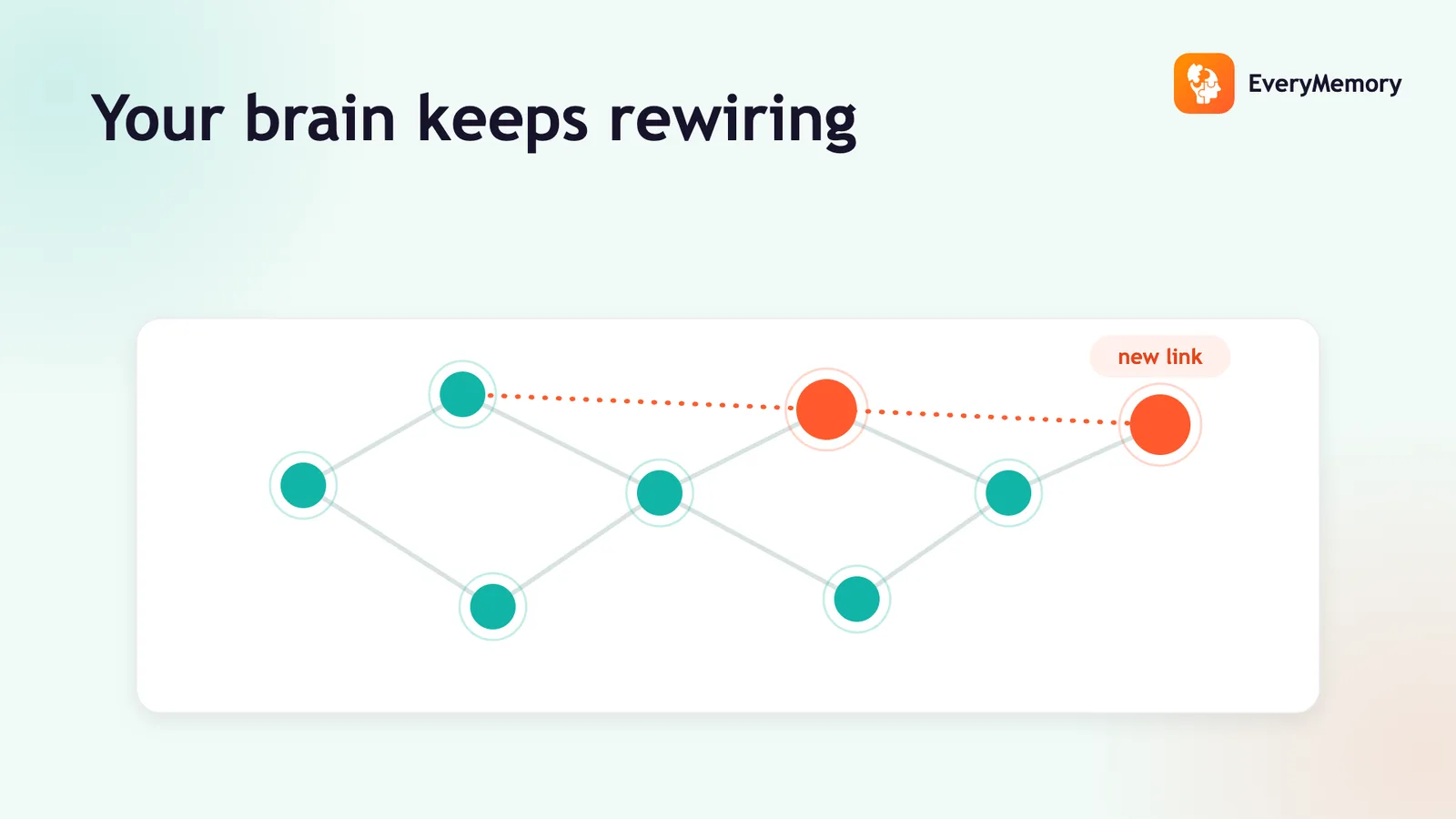
Memory is not a fixed trait you are born with and slowly lose. It is a set of skills that respond to practice. Thanks to neuroplasticity - the brain's lifelong capacity to form new neural connections - deliberate practice produces real, measurable improvements at any age.
Techniques like spaced repetition, the memory palace, and chunking have strong research support. Studies of memory athletes - people who memorise a shuffled deck in under a minute - show brains structurally similar to everyone else's. The difference is practice with efficient encoding strategies, not innate talent.
Why it matters: Consistency beats intensity. Ten minutes of deliberate practice a day compounds noticeably over weeks - and it is never too late to start.
✅ Try this today - A Three-Step Memory Experiment
Try this tonight - it demonstrates three facts from this article in under five minutes.
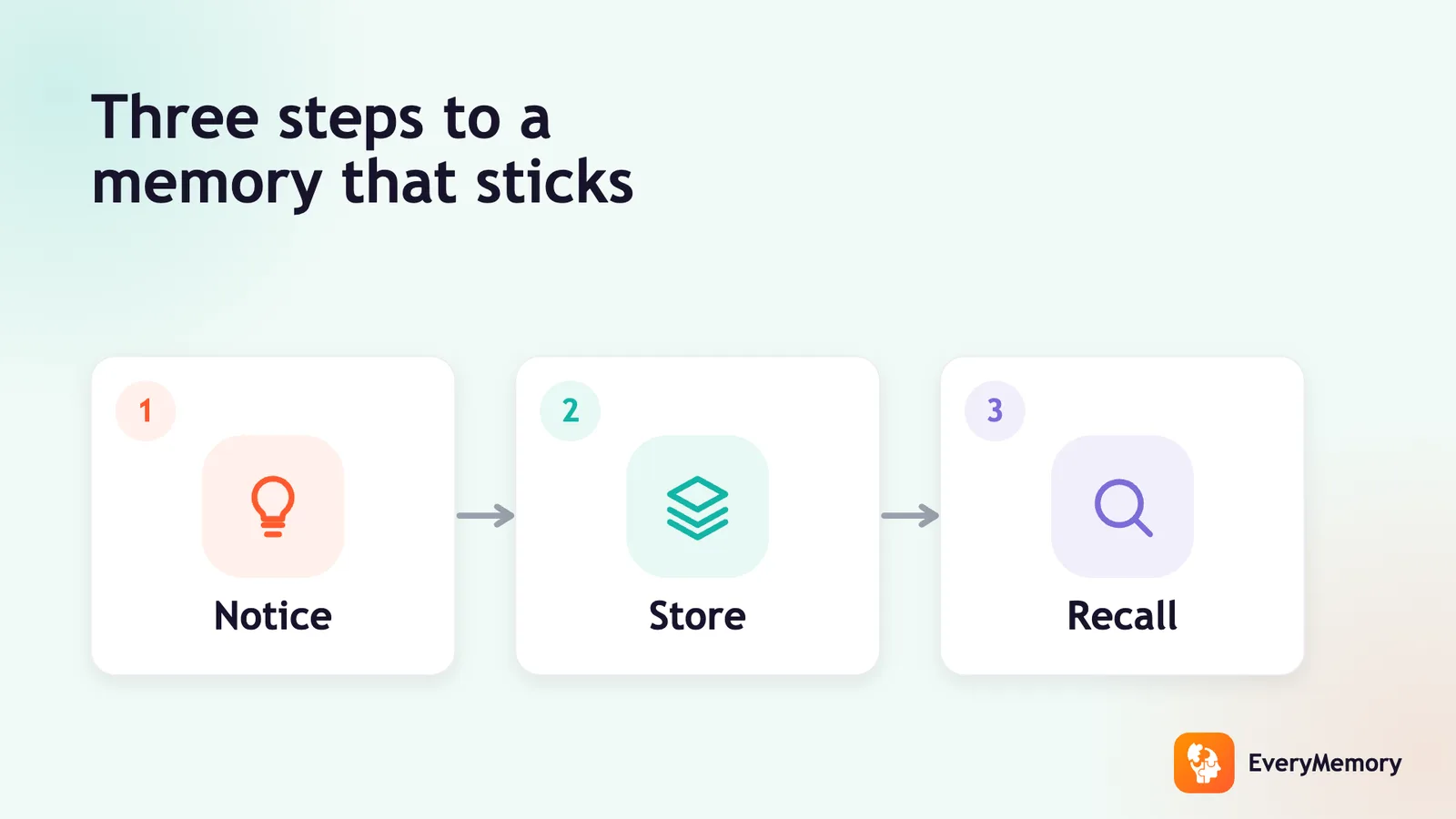
- Write ten random objects, put the list away, then try to recall them. Notice which positions you got right - primacy and recency usually show up immediately.
- Think of one thing you want to remember from today. Spend sixty seconds linking it to a vivid personal image or a moment that made you smile.
- Just before sleep, do a thirty-second mental review of what you want to retain. Test yourself in the morning and notice how much sleep has already consolidated.
⚠ When to talk to a professional
Occasional forgetfulness is a normal part of how reconstructive memory works and is not a cause for concern. If you notice sudden, rapid, or significantly worsening changes in your memory or thinking, it is worth speaking with a qualified healthcare professional.