 EveryMemory
Why Do I Forget Words While Speaking?
That 'tip of the tongue' feeling - knowing the word but being unable to say it - is one of the most universal memory experiences. Here's what's really happening, and how to get the word back.
Part of the guide: Understanding Memory Loss and Forgetfulness: A Calm, Reassuring Guide →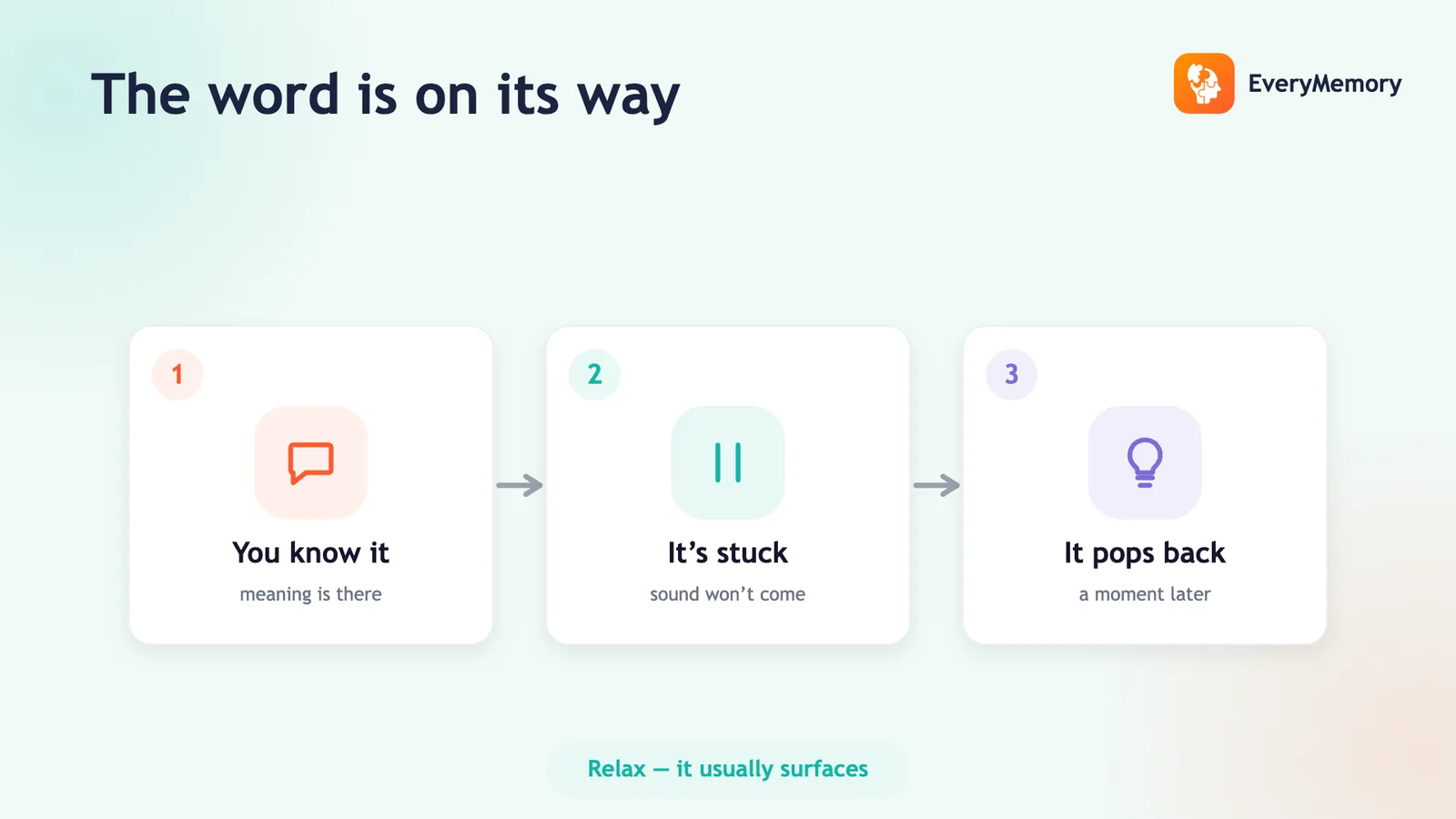
⚡ Quick answer
Forgetting a word mid-sentence is almost always a temporary retrieval glitch, not lost knowledge. Your brain stores what a word means separately from how it sounds, and a tip-of-the-tongue moment happens when the meaning fires but the link to the sound is briefly weak. The word is still there and usually returns on its own - often once you stop chasing it.
Key takeaways
- The brain stores a word's meaning and its sound separately, so a tip-of-the-tongue moment means the meaning has fired but the link to the sound is briefly weak - the knowledge is intact.
- Straining harder often makes it worse by locking onto a wrong similar word; the correct word typically surfaces on its own once you let go and move on.
- Describing the meaning out loud, cycling through first letters, or simply moving on are the most reliable ways to coax a stuck word back without adding pressure.
- Tip-of-the-tongue moments become slightly more frequent with age and are a normal feature of word retrieval, not a sign of lost vocabulary.
You're telling a story, building to the good part, and then - the word evaporates. You can feel its shape. You know it starts with a 'p,' maybe. It means exactly the thing you want to say. But it simply will not come, and the harder you reach for it, the further it retreats. Twenty minutes later, washing the dishes, it arrives out of nowhere: peculiar!
This is the famous "tip of the tongue" state, and it is one of the most studied - and most universal - experiences in all of memory research. People in every culture and every age group have it, and it tends to become a little more frequent as we get older.
Understanding why it happens makes it far less unsettling. It also points to a few simple ways to coax the word back when you're stuck.
Meaning and sound are stored apart
Here's the key insight: your brain doesn't keep each word as a single neat package. It stores a word's meaning in one place and its sound - the actual syllables you need to say it - in another, linked by a connection that's usually instant and invisible.
A tip-of-the-tongue moment is what it feels like when the meaning lights up but the link to the sound is momentarily weak. That's why you can often recall the first letter, the number of syllables, or a similar-sounding word: you've reached the right neighbourhood, you just can't grab the exact sound yet. Far from being a failure, this is precise evidence that the knowledge is intact and well-organised - the wiring is just briefly slow.
Why chasing the word backfires
The natural instinct is to strain harder. Unfortunately, that often makes things worse. When you keep reaching, you tend to lock onto a wrong-but-similar word - the "ugly sister" - and the more you repeat it, the more it blocks the path to the one you actually want.
This is why the word so reliably arrives later, when you've given up and moved on to something else. Letting go releases the block and lets the correct sound surface naturally. Counterintuitive, but it works.
Gentle ways to retrieve a stuck word
When you do want the word now - mid-conversation, say - a few low-effort techniques can re-open the path without the counterproductive strain:
- Describe the meaning out loud. Talking around the word ("you know, when something's a bit odd and hard to explain…") often surfaces it naturally, and keeps the conversation moving either way.
- Run through the alphabet. Cycling "a… b… c…" sometimes triggers recognition the instant you hit the right first letter.
- Think of related words. Synonyms and associated ideas live nearby and can pull the target word into reach.
- Or simply move on. Trust that it'll return - it almost always does within minutes.
What makes it more frequent - and what helps
Tip-of-the-tongue moments spike with the usual suspects: tiredness, stress, and divided attention. A well-rested, relaxed brain retrieves words more fluidly, which is one more reason sleep and managing stress matter so much for everyday sharpness.
Staying mentally and socially active helps too. Conversation is a genuine workout for word retrieval - the more you reach for and use varied vocabulary, the more fluent those pathways stay. Reading, word games, and simply talking with people all keep the system well-exercised. A light focus and attention workout can help as well, since fluent retrieval depends on steady attention.
When word-finding is worth a closer look
Occasional tip-of-the-tongue moments - even daily ones - are a normal feature of language and memory, especially as we age. It's worth paying closer attention if word-finding trouble becomes frequent and clearly worse than before, starts to disrupt conversations regularly, or comes alongside other changes in communication that others are noticing.
If you're trying to gauge where the ordinary ends and something more begins, our guide on memory loss vs. normal aging is a good next read.
✅ Try this today - The let-go retrieval trick
Next time a word is stuck on the tip of your tongue:
- Stop straining and describe the word's meaning out loud instead.
- Cycle slowly through first letters - 'a, b, c…' - until one feels right.
- If it still won't come, deliberately move on. Note how it tends to surface on its own within minutes.
⚠ When to talk to a professional
Occasional word-finding hiccups are normal and become a little more common with age. If trouble finding words is frequent, clearly worsening, or paired with other changes in communication that others notice, consider speaking with a qualified healthcare professional.