EveryMemory
How to Remember Names and Faces
A step-by-step technique guide for remembering names the moment you hear them - using attention, repetition, and visual anchors.
Part of the guide: How to Improve Your Memory: The Complete Beginner's Guide →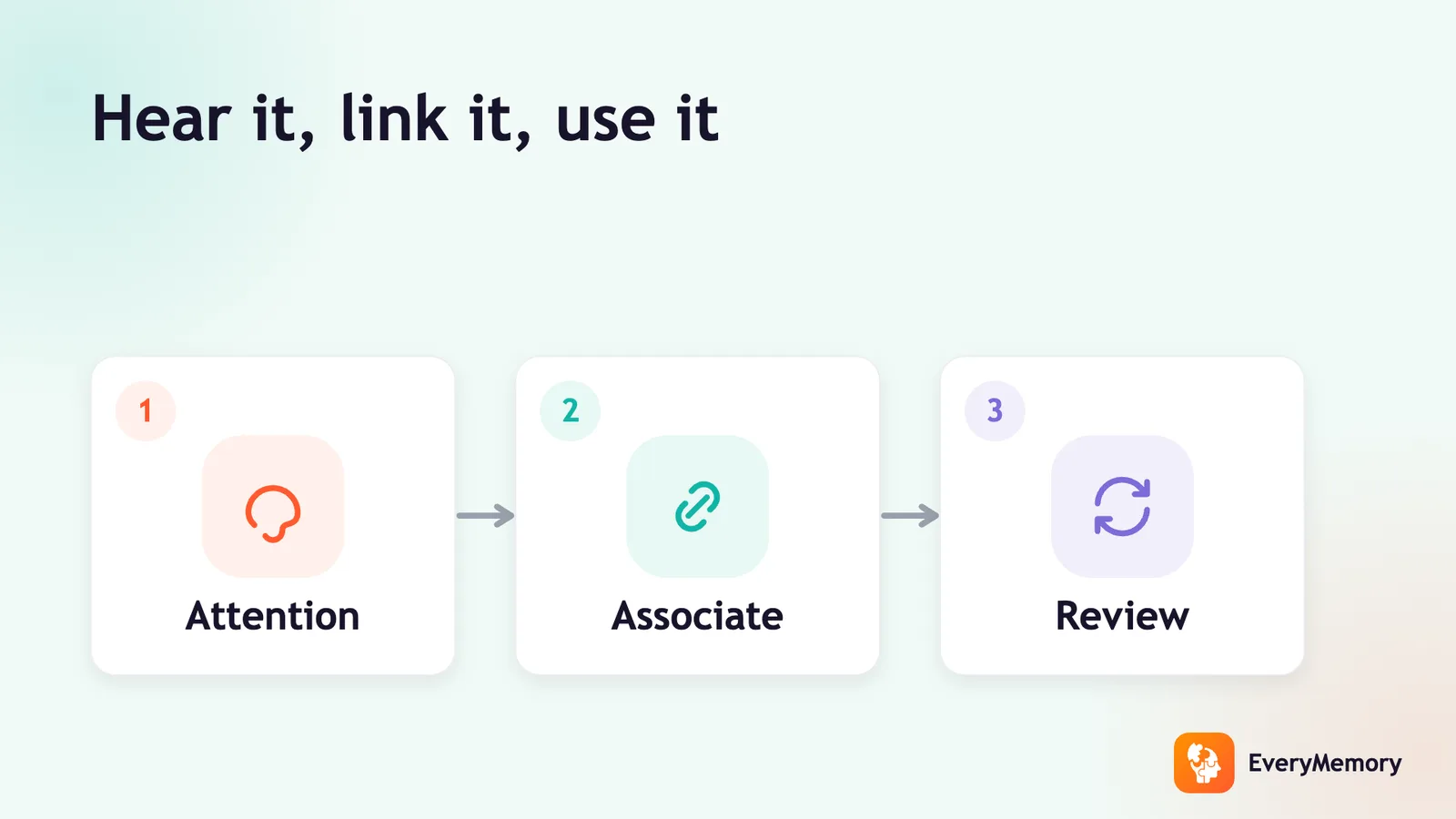
⚡ Quick answer
To remember a name, give it three seconds of deliberate attention: repeat it aloud when introduced, link it to one vivid feature of the face, and use it once more before the conversation ends. Most forgotten names were never properly encoded in the first place - slowing down at the moment of introduction fixes most of the problem.
Key takeaways
- Say a new name back immediately after hearing it to give your brain a chance to process it.
- Pick one distinctive facial feature and spend two seconds linking it to the name with a vivid mental image.
- Use the name once more before the conversation ends to move it from short-term to longer-term storage.
- A brief mental review that same evening - face, anchor, name - reveals whether the encoding actually worked.
You leave a party knowing you met at least six interesting people. By the next morning, four of the names have dissolved completely. It is one of the most common memory frustrations of adult life - and one of the most solvable, once you understand why names disappear and what to do about it in the moment.
This article is a deep dive into the techniques behind name and face memory: why the standard approach fails, how your brain actually stores people, and a repeatable method you can start using today. If you want a structured daily exercise to build the skill over time, our names-and-faces memory exercise walks you through exactly that.
Why the brain struggles with names
Names are arbitrary labels. "Karen" doesn't tell you anything about Karen. "David" contains no clues about what David looks like or does. Memory is built on connections, and names arrive with almost none.
Compare that to a job title. "She's a nurse" links to everything you already know about nursing - hospitals, caring, night shifts. A name like "Sandra" sits alone, with no pre-existing network to hook into. Psychologists call this the Baker/baker paradox: people remember the word "baker" as an occupation far more easily than "Baker" as a surname, because the occupation connects to a rich web of meaning while the surname connects to nothing.
Add to that the noise of a typical introduction - your brain is sizing up the person and planning what to say next - and the name slides past, unprocessed. That is not a memory problem. That is an attention problem. Attention is something you can train.
The three-step encoding method
The core technique has three moves, all done in the first thirty seconds of meeting someone. Miss this window and you're relying on guesswork later.
- Repeat the name immediately. The moment you hear it, say it back: "Great to meet you, Patricia." This forces your auditory cortex to process the sound rather than let it wash through. It also buys a fraction of a second to do the next step.
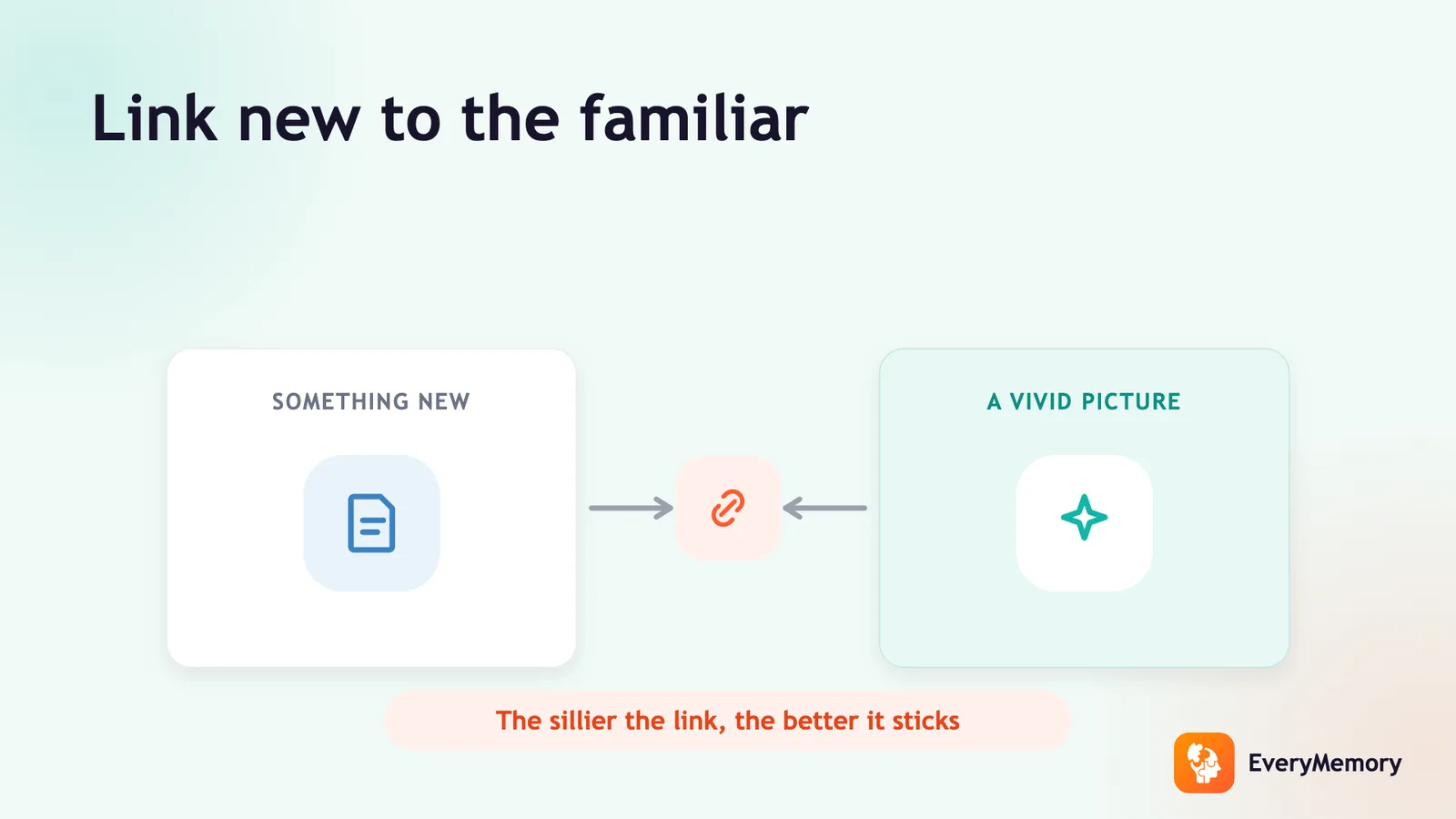
- Anchor the name to a face feature. Scan the face quickly and choose one distinctive feature - a strong brow, a warm smile, unusually bright eyes. Now create a vivid, slightly ridiculous mental image connecting that feature to the name. Patricia with a particular laugh: picture her laughing and the name "Patricia" lighting up above her head. The more vivid and unusual the image, the stickier the link.
- Use the name once more before parting. "Really enjoyed talking with you, Patricia." A second, spaced use is often all it takes to shift a new name from short-term holding into longer-term storage.
These three steps take less than ten seconds and cost nothing. The difficulty is remembering to do them while also being a normal, engaged human being - which is why practice matters. The 10-minute memory workout includes a names drill you can run daily at home.
Choosing the right face anchor
The anchor is the heart of the technique. Pick a feature that is distinctive to that person, stable over time (hairstyle changes; a prominent nose doesn't), and something you can attach a concrete image to.
Good candidates: the shape of the jaw, the set of the eyes, a strong forehead, the way someone holds their mouth. Once you pick the feature, spend two seconds building the visual link to the name. The odder the image, the better - unusual things command attention, and attention drives encoding.
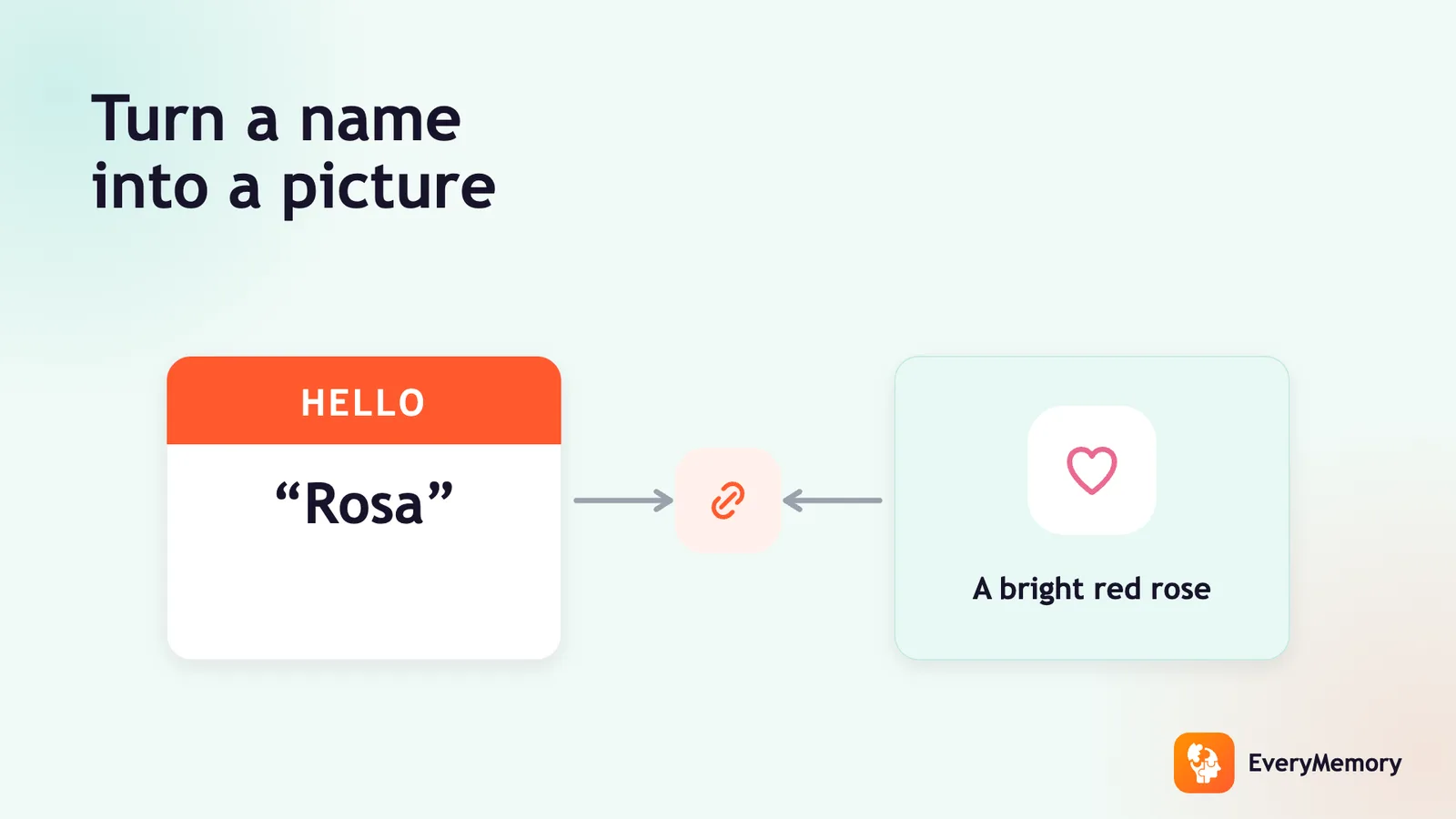
For very common names, build a personal image in advance: every "James" gets a crown, every "Rose" a red flower, every "Peter" a stone. Create each image once; then slot new faces into the system.
What goes wrong - and how to fix it
Even people who know the technique slip up in predictable ways. Here are the four most common mistakes and the fixes:
- Skipping the repeat. You feel awkward saying the name back, so you skip it. Fix: most people are mildly flattered to hear their name. A brief "Nice to meet you, Patricia" reads as warm attention, not strange behaviour.
- Choosing a weak anchor. "Nice face" is not an anchor. Pick something specific that you would notice if you closed your eyes and tried to sketch the person. If you can't land on something in two seconds, choose the most prominent feature - the first thing you noticed.
- Never using the name after the introduction. The second use is what moves a name out of short-term holding. Find a natural moment: a direct question, a goodbye, a moment of agreement.
- Meeting too many people at once. At crowded events, don't try to apply the full technique to everyone. Pick three or four people you'll likely talk to again and invest fully. Shallow encoding of fifteen names produces nothing useful.
If this has been a long-standing frustration, our article on whether it is normal to forget names after 60 puts the everyday slips in context.
When the name won't surface
You see someone whose name you know you know, but it won't come. Don't panic - panicking blocks retrieval. Instead: relax for a beat, reconstruct context (where did you meet? what did you talk about?), then run through the alphabet slowly. Often the first letter is enough to trigger the full name.
If it still won't come, admit it gracefully: "I'm terrible with names - remind me of yours?" People appreciate honesty. Once you have the name again, re-anchor it with the three-step method right there.
Building the habit through spaced practice
Every real-world introduction is a practice rep - you don't need to carve out extra time. What helps is a brief review after the fact: that evening, run through the people you met. For each one, reconstruct the face, the anchor, and the name. Can't retrieve it? That tells you the encoding was weak. Note it; try again tomorrow.
This brief spaced review is the core of spaced repetition - one of the most reliable memory techniques available. The names-and-faces memory exercise on EveryMemory gives you a structured daily drill to build the habit.
✅ Try this today - The 30-second name anchor drill
Use this the next time you're introduced to someone new:
- Repeat the name back immediately after hearing it: "Good to meet you, [Name]."
- Scan their face for one distinctive feature. Spend two seconds creating a vivid mental image connecting that feature to the name.
- Before the conversation ends, use the name one more time naturally - in a question, a comment, or a goodbye.
- That evening, picture the person and test yourself: face first, then anchor, then name. If it comes back, it's stored. If not, note it and try again tomorrow.