 EveryMemory
Why Am I So Forgetful Lately? Common Causes
If your memory has felt unreliable lately, the cause is most likely one of several very common, very changeable everyday factors - not something permanently wrong.
Part of the guide: Understanding Memory Loss and Forgetfulness: A Calm, Reassuring Guide →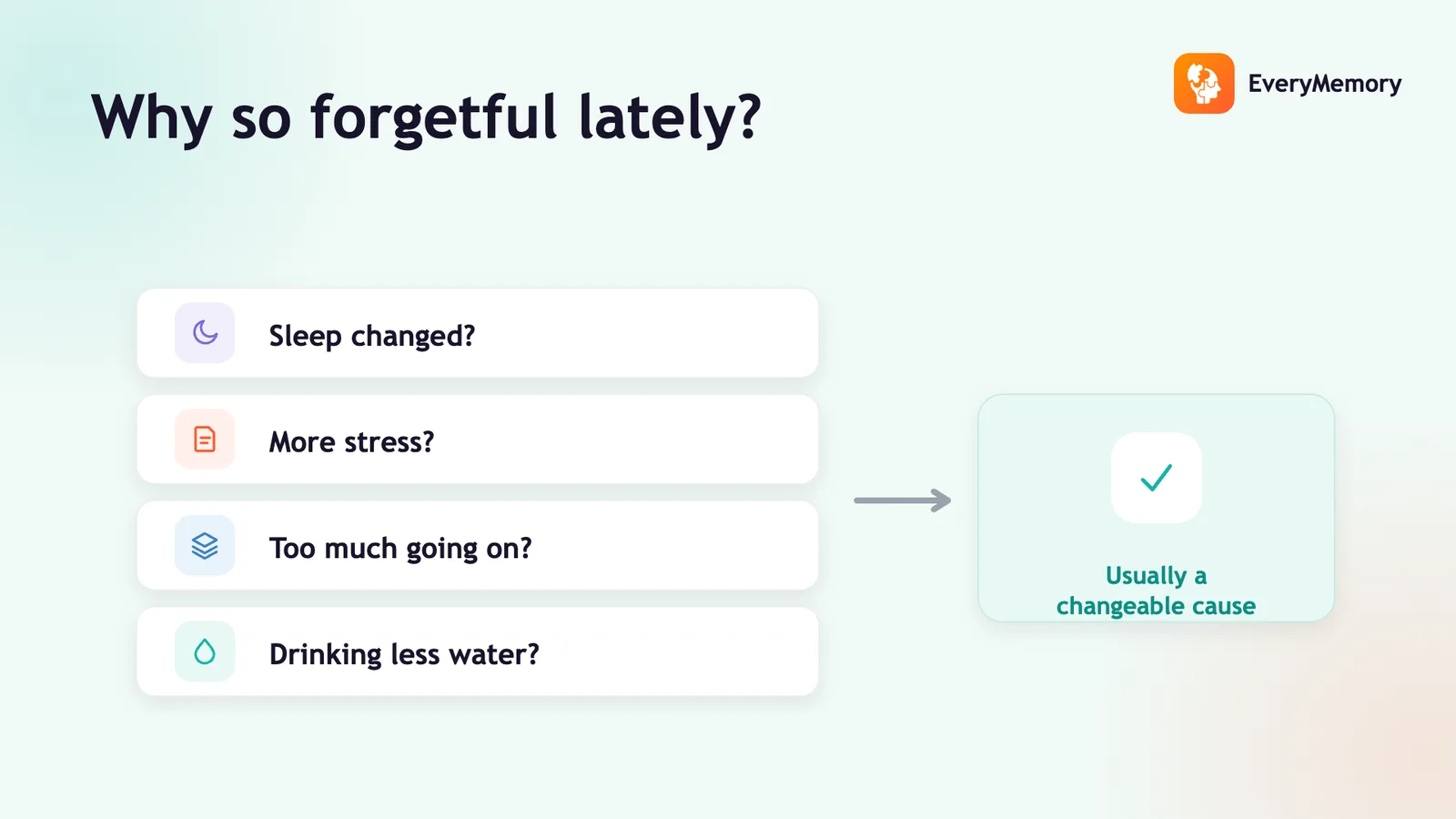
⚡ Quick answer
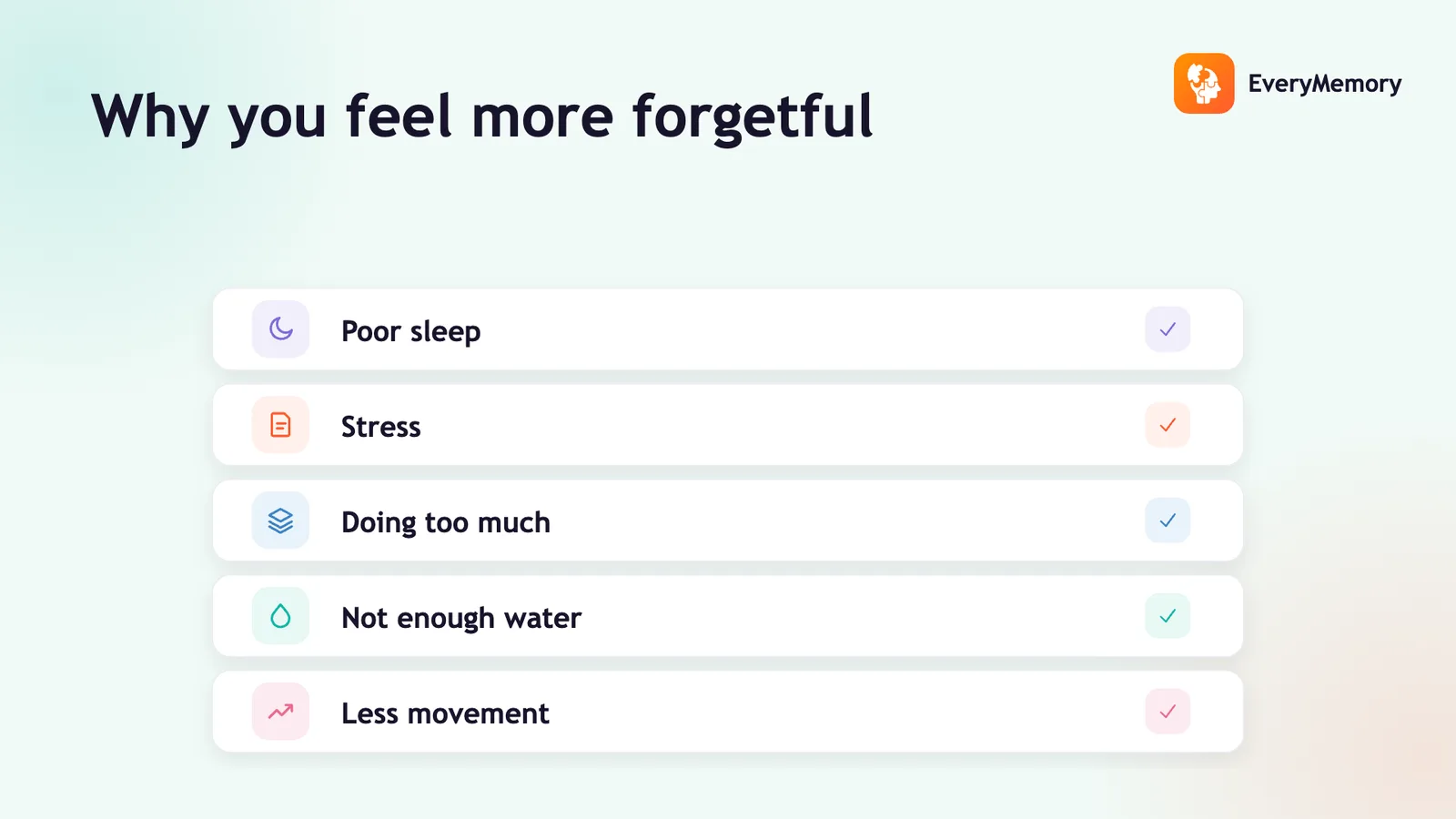
A recent increase in forgetfulness is most often caused by poor sleep, heightened stress, cognitive overload from doing too much at once, mild dehydration, or the mental toll of illness or big life changes - all of which are temporary and changeable. These factors impair the attention and consolidation processes that memory depends on, but they do not represent permanent damage. Identifying which factor is affecting you is usually the most useful first step.
Key takeaways
- A recent rise in forgetfulness is most often caused by poor sleep, sustained stress, doing too much, or dehydration - all changeable factors.
- Divided attention is a leading cause: memories that were never properly encoded because you were distracted cannot be retrieved later.
- Illness, recovery, grief, and major life transitions all create temporary cognitive load that commonly shows up as forgetfulness.
- Sudden, rapidly worsening, or daily-life-disrupting memory changes are worth discussing promptly with a qualified healthcare professional.
You put your keys down and cannot find them two minutes later. You forget what you were about to say mid-sentence. You walk into a room and have no idea why you went there. If this has been happening more than usual, the first feeling is often a quiet dread - then the question: is something wrong with me?
For most people, the honest answer is: probably not. A sudden uptick in forgetfulness is far more often the product of recent, changeable circumstances than a sign of anything serious. Sleep, stress, overload, dehydration, illness, and big life changes can all put visible dents in everyday memory. This article walks through the most likely culprits, how to spot your cause, and the signs that suggest a professional's view would be worthwhile.
Sleep: the most underrated cause
A few nights of poor sleep alone can account for a surprising amount of forgetfulness. During sleep - particularly deep and REM sleep - the brain consolidates the day's experiences into more stable storage. When sleep is cut short or fragmented, that process is disrupted, and information that was never properly stored cannot be reliably retrieved.
The effect falls hardest on new information: names heard last week, what someone said in a conversation, where you put something that evening. Older, well-established memories are more resilient. If your forgetfulness centres on recent events and new details, and your sleep has been poor, that is a strong signal about where to look first. Our article on the sleep and memory connection explains the mechanics and what disrupts them.
Stress and anxiety: when cortisol gets in the way
Sustained stress is one of the most consistent memory disruptors known. Cortisol - helpful in short bursts - becomes harder on memory when elevated for days or weeks. The hippocampus, the region most involved in forming and retrieving recent memories, is particularly sensitive to prolonged cortisol. Under sustained stress, encoding new information becomes harder, and retrieval can feel like searching a drawer that has been hastily shuffled.
Anxiety adds a second layer: when attention is occupied by worry, there is less resource available to focus on what is in front of you, and a memory never properly formed cannot be retrieved later. When the source of stress eases, memory clarity typically eases with it. Our piece on whether stress can make you more forgetful covers this link in depth.
Doing too much: the overload problem
The brain's working memory - the mental workspace that holds information long enough to use it - has a genuine capacity limit. When too many demands press on it simultaneously, things slip through. Checking a phone during a conversation, mentally drafting an email while making dinner, jumping between tasks before any single one is done: these habits mean that information arrives when attention is elsewhere, so it is never properly encoded.
This is not a memory problem in the clinical sense - it is a divided-attention problem that looks like one. If you have taken on more responsibilities lately, are caring for others, or are simply busier than usual, that load alone can explain a meaningful rise in forgetfulness. Our article on everyday reasons for forgetfulness includes a checklist for tracing this kind of pattern.
Dehydration, illness, and big life changes
Three further causes deserve mention. Dehydration: even mild fluid shortfall - not dramatic thirst, just going a long stretch without drinking enough - is linked with reduced concentration and gaps in short-term recall. It is one of the quickest factors to test. Illness and recovery: any significant illness or surgery diverts resources toward healing, and mental clarity often falters first and returns last.
Major life transitions - moving, bereavement, a new caregiving role, retirement - create emotional load that directly competes with memory. Grief in particular can produce a hazy, forgetful state that surprises people. These effects ease as circumstances stabilise. Our piece on brain fog: causes and what helps covers these overlapping contributors in depth.
How to spot your own cause
Rather than worrying in the abstract, look for patterns. These questions often point to the main driver quickly:
- Has your sleep changed? Fewer hours or more disruptions over the past two to four weeks is often enough to explain noticeable memory dips.
- Is your stress higher than usual? Sustained background tension - financial worry, a difficult relationship, a demanding period at work - has a bigger effect than acute short-term pressure.
- Are you doing more than usual? A heavier schedule or more responsibilities than you are used to managing.
- Are you drinking enough water? Many adults do not reliably register mild thirst and slip into mild dehydration without realising it.
- Have you been unwell or are you still recovering? The mind can take several more weeks to clear after the main illness has passed.
- Has something big changed recently? Losses, new roles, or transitions create emotional load that competes directly with memory.
If the timing fits a recent change, that is useful information - both for knowing what to address and for setting aside unnecessary worry. Our article on memory loss versus normal aging offers a framework for distinguishing ordinary forgetfulness from patterns worth investigating.
What actually helps
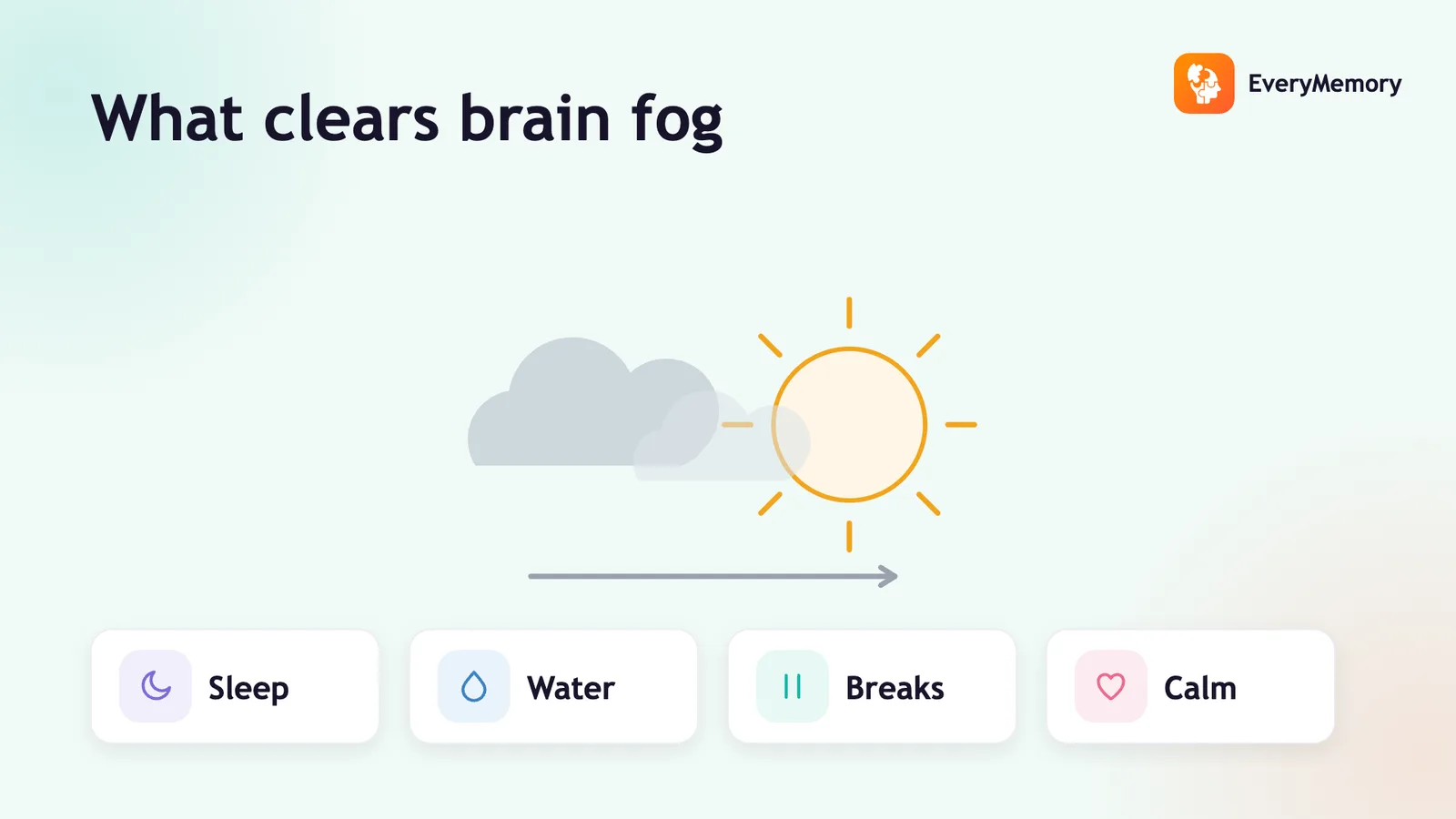
Once you have identified your likely cause, the path forward is usually clear. Prioritising sleep - even adding thirty minutes most nights - tends to produce the most noticeable difference within a week or two. Reducing multitasking during tasks you want to remember directly improves how well new information is encoded. Drinking water consistently through the day is a small, immediate change.
Stress is harder to address quickly, but modest reductions - one fewer commitment, a short daily walk, sharing a worry with someone trusted - tend to ease cognitive fog over time. Simple habits also help: giving new information your full attention for a moment, saying a name out loud after hearing it, linking new things to something already familiar.
✅ Try this today - The three-day cause check
A simple structured review that usually points to the main driver quickly.
- Each evening for three days, jot down: hours slept last night, rough stress level (low / medium / high), and how much water you drank. Don't change anything yet - just observe.
- After three days, look for patterns. Short sleep or high stress most days is a strong candidate to address first. Low hydration is the easiest to test: add an extra glass of water with each meal for one day and note whether afternoon clarity improves.
- Choose one concrete change for the coming week - an earlier bedtime, one item removed from your schedule, water with every meal. Narrow, specific changes are easier to act on and easier to evaluate than broad resolutions.
⚠ When to talk to a professional
This article is general, non-medical information only. If your forgetfulness is sudden, clearly worsening over weeks, involves forgetting entire recent events or confusion about familiar people or places, or is significantly disrupting daily life, please speak with a qualified healthcare professional.