 EveryMemory
Everyday Reasons You Feel More Forgetful
Most everyday forgetfulness has an ordinary, changeable cause - poor sleep, stress, divided attention, or a disrupted routine. Here's a reassuring checklist to help you identify yours.
Part of the guide: Understanding Memory Loss and Forgetfulness: A Calm, Reassuring Guide →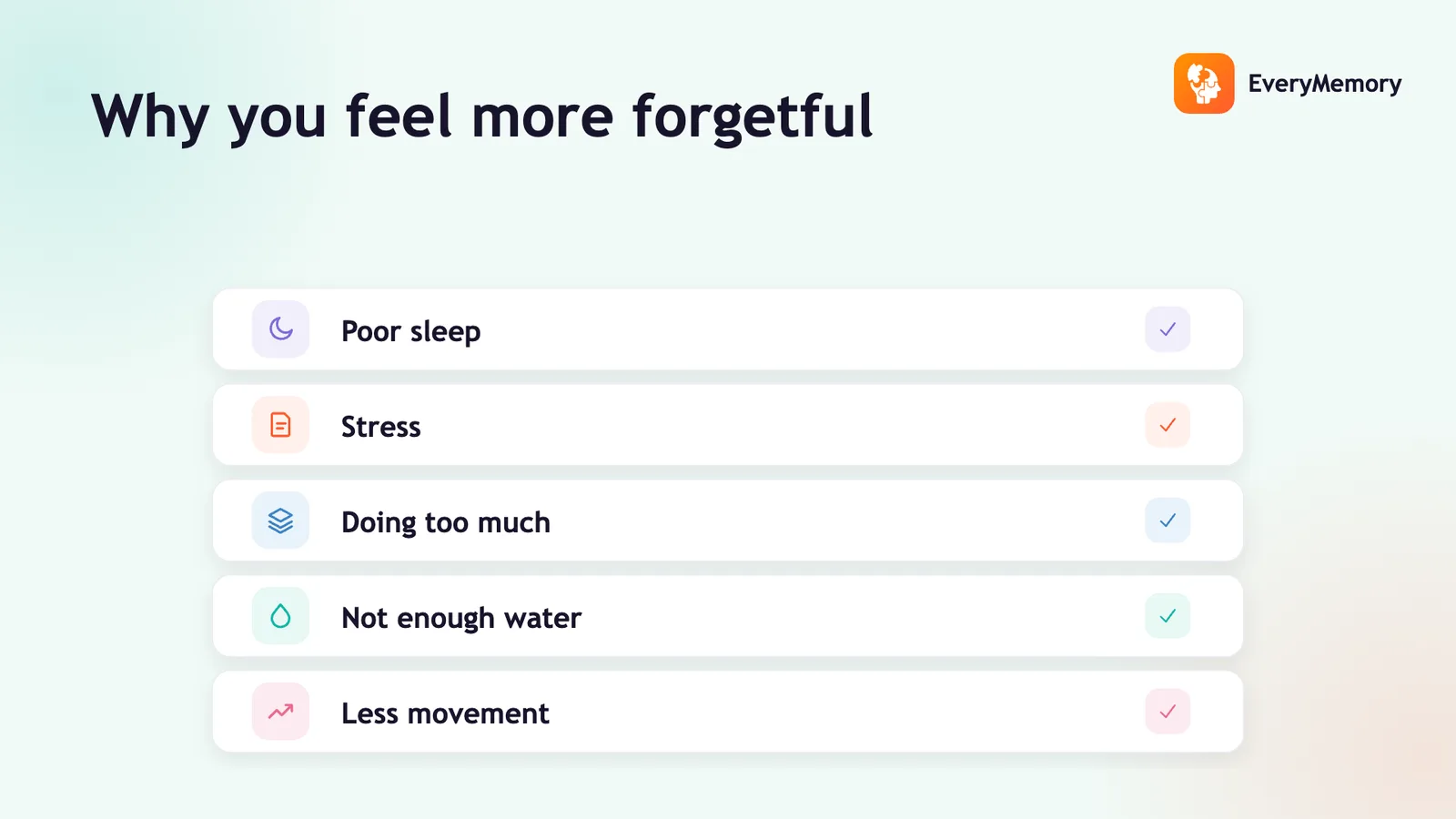
⚡ Quick answer
Most everyday forgetfulness is linked to changeable factors: poor sleep, high stress, divided attention, mild dehydration, reduced movement, big life transitions, recovering from illness, or a broken routine. When one or more of these are present, memory and focus commonly suffer - and tend to improve once the underlying factor is addressed.
Key takeaways
- Most everyday forgetfulness is linked to changeable factors: poor sleep, stress, divided attention, dehydration, or a broken routine.
- Grief, major life changes, and recovering from illness are all commonly linked with temporary brain fog and slower recall.
- Improving one or two underlying factors - particularly sleep and stress - often produces a noticeable improvement in memory.
- Sudden, rapid, or worsening memory changes are worth discussing with a healthcare professional rather than assuming they are everyday forgetfulness.
Noticing that your memory feels off lately can be unsettling - but in most cases the real culprit turns out to be something far more ordinary than the worst-case explanations the mind reaches for.
This article is a checklist of the most common everyday reasons people feel more forgetful, with a signpost to a deeper guide on each. Most of these causes are changeable. Finding which one is most relevant to you is a useful starting point.
Poor sleep: the most underestimated culprit
Sleep is when the brain consolidates new information - transferring experiences from short-term to longer-term storage. When sleep is cut short or fragmented, that process is interrupted, producing genuinely impaired recall the next day. Even one rough night can make names and recent events harder to access; over weeks, the effect compounds.
Our guide on the sleep and memory connection covers what each sleep stage does for recall - and practical steps if your nights have been rough.
Stress and anxiety: when cortisol crowds out memory
Under stress, the brain releases cortisol to prepare for immediate demands. In short bursts this is helpful. But sustained high cortisol is linked with difficulty forming new memories and retrieving existing ones - the hippocampus, the brain's memory hub, is particularly sensitive to it.
The forgetting that stress produces is real, but it is also typically reversible. When the source of stress eases, or when someone finds reliable ways to bring cortisol down, recall often improves alongside mood. Our article on whether stress makes you more forgetful goes deeper on this mechanism.
- Anxiety can block retrieval even when the memory was stored correctly - the information is there, but inaccessible under pressure.
- Chronic low-level worry is often harder to notice than acute stress, but produces similar effects over time.
- Stress and poor sleep usually travel together, compounding both problems.
Doing too much at once: divided attention and memory
If information never receives your full attention, it is unlikely to be stored clearly. Multitasking - half-listening while scrolling, cooking while on a call, reading while the television runs - splits the brain's encoding resources across competing inputs. Later, when you try to recall something, there is simply less of a trace to find.
This is not a failing of memory; it is a failing of attention at the moment of input. The memory was never formed properly in the first place. Our piece on multitasking and memory explains why single-tasking genuinely improves recall - and offers simple ways to protect your attention during the moments that matter.
Dehydration and low physical movement
Even mild dehydration - the kind you would not necessarily notice as thirst - is commonly linked with reduced concentration and a foggier sense of clarity. Older adults are particularly susceptible because the sensation of thirst often becomes less reliable with age. Our guide on hydration and focus in older adults is worth a read if you suspect this may be a factor.
Regular physical movement supports blood flow to the brain and helps neurons communicate effectively. People who shift to a more sedentary routine - after a health event, retirement, or a seasonal change - sometimes notice their thinking feels cloudier within weeks. Our piece on walking and brain health explains how even modest increases in movement are associated with sharper focus.
Big life changes and grief
Major transitions - bereavement, retirement, moving home, a significant health scare - occupy enormous amounts of mental bandwidth. Grief in particular is associated with what some call "grief brain": difficulty concentrating, forgetting recent events, and a sense of mental slowness, as the brain allocates resources to processing an emotionally demanding situation.
This kind of forgetfulness is a normal, temporary response to abnormal circumstances - it typically eases as the mental load lightens, though this can take weeks or months. Our article on brain fog causes and what helps covers grief-related fog alongside other common contributors.
Recovering from illness
Even a straightforward cold or flu puts the immune system into a state of high activity that temporarily draws resources away from cognitive function. The brain fog that commonly follows a respiratory illness is a well-recognised phenomenon, not imagination - and it is compounded by the sleep disruption and dehydration that illness tends to bring.
Recovery usually brings a gradual return to normal sharpness. Give yourself the same patience you would for physical recovery.
Broken routines and lost structure
Daily routines are not just habits - they are a form of cognitive scaffolding. When your schedule is predictable, less working memory is needed to navigate it, leaving more capacity for other tasks. When routines break - during a holiday, a house move, a change in circumstances - the brain has to consciously manage things it previously handled automatically. This extra cognitive load can feel, temporarily, like forgetting more.
Rebuilding a simple daily structure, even an informal one, often brings a noticeable improvement in mental clarity. Our article on why routine matters for focus explains this mechanism in practical terms.
When it is worth a professional's view
The causes above are all ordinary and, importantly, changeable. But it is worth knowing the signs that suggest something beyond everyday forgetfulness deserves a professional conversation.
- Memory changes that are sudden, rapid, or noticeably worsening over weeks rather than months.
- Forgetting recent events completely, rather than just struggling to recall details.
- Getting confused about time, place, or familiar people.
- Personality or behaviour changes that others have commented on.
- Memory problems that are significantly interfering with daily life or safety.
Our article on memory loss versus normal aging offers a detailed guide to distinguishing typical cognitive changes from patterns worth discussing with a doctor.
✅ Try this today - Your forgetfulness checklist
Run through these questions honestly - they often point quickly to the most likely contributor.
- Sleep check: Have you had fewer than seven hours most nights this week, or been waking frequently? If yes, this is the single most likely explanation for any memory dip - and the most directly improvable one.
- Stress and attention check: Rate your stress level out of ten. Are you frequently doing two things at once? If your stress is above six, or you are rarely fully present for any single task, these are worth addressing before anything else.
- Body basics check: How much water have you drunk today, and how much have you moved in the last 48 hours? If both are low, try a glass of water and a ten-minute walk - and notice whether your thinking feels clearer an hour later.
⚠ When to talk to a professional
This article contains general, non-medical information only. If you notice sudden, rapid, or worsening changes in memory - or changes that are significantly affecting daily life - please speak with a qualified healthcare professional. These patterns are worth discussing promptly rather than waiting to see if they resolve.