 EveryMemory
Dual Coding: Pair Words With Visuals to Remember More
Combining words with visuals gives your brain two retrieval routes instead of one. Here is exactly how dual coding works and how to apply it to any subject.
Part of the guide: How to Improve Your Memory: The Complete Beginner's Guide →
⚡ Quick answer
Dual coding means pairing verbal information with a related visual representation. Because the brain processes language and imagery in separate but linked systems, encoding the same idea both ways creates two independent retrieval routes. You do not need artistic skill; a rough hand-drawn sketch works as well as or better than a polished graphic, because the act of generating the image is what builds the memory trace.
You read a paragraph three times, feel certain you understand it, then close the book and realise almost nothing stayed. This is not a focus problem. It is a storage problem: the information entered through one channel, text, and it left through the same door. Dual coding is the practice of deliberately encoding the same idea through a second, separate channel - a sketch, a diagram, a simple spatial map - so that your brain builds not one memory trace but two, each capable of pulling the other back.
The approach comes from psychologist Allan Paivio, who proposed in the late 1960s that the brain operates two distinct but interconnected symbolic systems: one for language and one for mental imagery. Activating both systems for the same piece of information does not simply double the effort; it creates redundant retrieval pathways. When one route is blocked, the other can still surface the memory. That is why you might forget the definition of a word but instantly recall the odd little sketch you drew beside it in your notebook.
This guide explains the research logic behind dual coding, clears up a widespread confusion with the learning-styles myth, and then gives you concrete, immediately usable methods - including a full worked example showing how to dual-code a multi-step process from scratch.
The Science in Plain Language
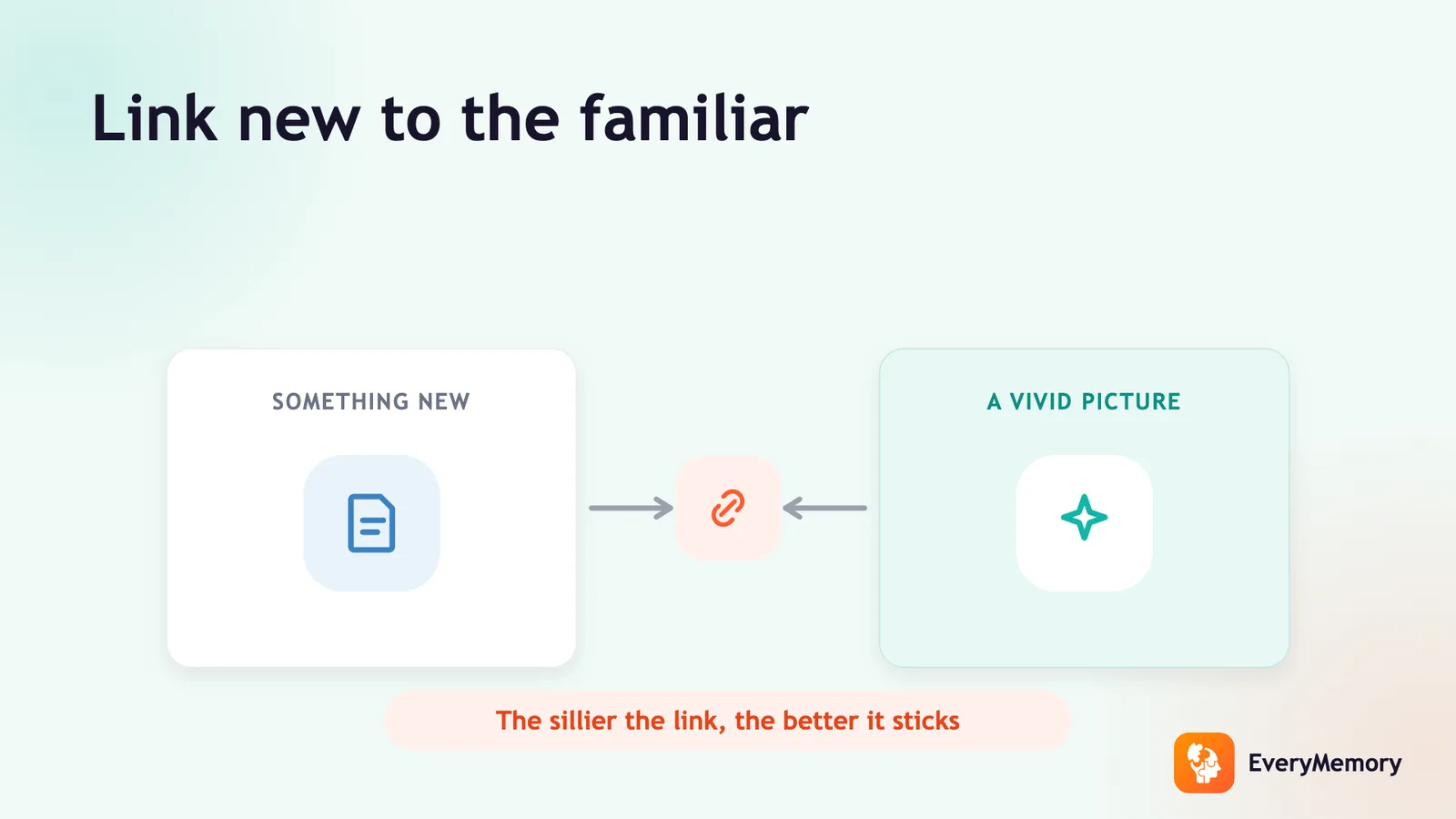
Paivio's dual-coding theory rests on one central observation: verbal and imagistic representations are not just stylistic variations of the same thing - they are functionally distinct. Verbal codes are sequential and arbitrary; the word "photosynthesis" has no built-in resemblance to the process it names. Imagistic codes are analogue and spatial; a rough arrow diagram of carbon dioxide entering a leaf and glucose leaving it carries structural similarity to the actual process.
When you encode something only verbally, recall depends on a single chain of associations. Interrupt that chain - distraction, time, interference from similar words - and the memory can go silent entirely. Add an imagistic code and you create an independent anchor. The two codes are linked (seeing the sketch cues the label; hearing the label cues the image), but each can operate alone. Research consistently shows that paired verbal-visual material is recalled significantly better than verbal material alone, across age groups and subject domains.
One nuance worth noting: the benefit is largest when the visual is generative, meaning you construct it yourself rather than passively viewing someone else's diagram. The cognitive effort of deciding what to draw and where to put it is part of the encoding work. Passively re-reading a textbook illustration does far less for memory than sketching an approximate version with your own hand.
Dual Coding Is Not the Learning-Styles Myth
A critical distinction: dual coding is sometimes confused with the idea that some people are "visual learners" who need pictures while others are "verbal learners" who are fine with text. That idea - the learning-styles hypothesis - has been tested extensively and repeatedly fails to hold up. There is no reliable evidence that matching instruction format to a person's preferred style improves learning outcomes.
Dual coding makes a completely different claim. It says that everyone's memory benefits from combining verbal and visual representations, regardless of any personal preference. It is not about catering to a learning type; it is about exploiting an architectural feature of human memory that all healthy brains share. If you have ever remembered a face while forgetting a name, or recalled a diagram while forgetting the caption, you have already experienced the two systems operating independently.
Five Practical Ways to Dual-Code
The most accessible method is the marginal sketch: as you read or listen, draw a tiny rough image in the margin next to each key idea. It does not need to be accurate or attractive. A stick figure running toward a door labeled "fight-or-flight" beside a note on the sympathetic nervous system is more useful than an anatomically precise illustration, because you made it and it maps directly to your words.
- Convert a process into a flowchart. If a text describes a sequence (a biological cycle, a historical chain of events, a recipe), draw boxes and arrows in the order of the steps. The spatial layout encodes the sequence in a way prose cannot.
- Sketch a timeline. Dates and periods are abstract until you spread them along a line and add rough icons at each event. The relative distance between events becomes a visual cue for their separation in time.
- Pair vocabulary with a vivid mental image. This overlaps with mnemonics and association techniques: link the sound or meaning of a new word to a concrete visual scene. The Spanish word mariposa (butterfly) is easier to retain if you picture a butterfly wearing a wedding dress ("marry a pose") than if you only repeat the translation.
- Redraw someone else's diagram from memory. Close the textbook, try to reproduce the diagram on a blank page, then check and correct. Each error you notice and fix is a high-quality encoding event.
- Build a concept map. Write a central term, then branch out with related ideas connected by labelled arrows. The spatial structure of the map becomes part of the memory for the relationships between concepts.
A note on note-taking strategy: split-page formats (Cornell notes, for example) lend themselves naturally to dual coding because they reserve a column for cues. Use that column not just for verbal prompts but for quick sketches.
A Worked Example: The Water Cycle in Eight Minutes
Suppose you need to remember the water cycle for an exam. A typical approach is to re-read the four stages - evaporation, condensation, precipitation, collection - until the words feel familiar. Familiarity is not the same as retrievability.
Here is a dual-coding version. On a blank page, draw a rough mountain on the right, a body of water on the left, and a sun in the upper corner. Now add arrows and labels as you work through each stage. From the water body, draw a wavy upward arrow and write "evaporation" with a small note: "heat from sun converts liquid to vapor." Near the top of the page, draw a cluster of squiggly lines representing a cloud and label it "condensation - vapor cools, forms water droplets." From the cloud, draw downward lines hitting the mountain and write "precipitation." Then draw arrows from the mountain's slopes back down to the water body and label them "runoff/collection."
The finished sketch is not polished. It is spatially organised, self-generated, and directly mapped to the verbal definitions. You have now encoded the water cycle twice: once as a verbal sequence and once as a spatial diagram with directional arrows. When asked about evaporation in an exam, you can retrieve either the definition or the mental image of upward arrows from water to sun, and each cue helps recover the other. This is how memory works at its most efficient - layered, redundant, and self-reinforcing.
Why Crude Sketches Beat Polished Graphics
There is a counterintuitive finding that trips up many people: spending time making a diagram beautiful actively undermines its memory benefit. When you focus on line quality, colour coordination, and neatness, your cognitive resources shift from meaning-making to aesthetics. The diagram becomes a performance rather than an encoding exercise.
The benefit of dual coding comes almost entirely from the generative act - deciding which elements to include, how to position them spatially, and what relationships to show with arrows or groupings. A 90-second scrawl made while actively thinking about the material outperforms a 20-minute polished infographic copied from a slide, because the scrawl required more meaningful decisions. When reviewing material for the purposes described in reading for retention, rough self-generated visuals are the correct tool.
One practical implication: do not wait until you have the "right" image in mind before drawing. Start drawing and let the image develop as your understanding develops. The act of revision - crossing out, redrawing an arrow, shifting a label - is itself high-quality encoding.
The One Pitfall That Cancels the Benefit
Not all visuals create dual coding. Decorative images - stock photos of people looking thoughtful beside a paragraph about memory, or coloured borders around a definition - add zero encoding benefit and can actually dilute attention by making the page feel complete before the information is processed. The defining criterion for a dual-coding visual is semantic alignment: every element of the image must map to a specific element of the verbal content.
If you draw a diagram and cannot point to a specific part of it and say exactly what concept it represents, the diagram is decorative. Redraw it with that alignment as the goal. Likewise, if you copy a diagram from a textbook without first trying to produce one yourself, you are consuming information in passive mode rather than encoding it. The memory benefit disappears. The test is simple: could you reproduce the sketch from memory and explain what each part means? If yes, it is doing its job.
✅ Try this today - Add a Visual to Every Key Idea
Take one page of notes you took this week - from a book, a lecture, a meeting, anything. You are going to add a small sketch to each key idea. Budget about ten minutes.
- Read through the page and circle the three to five most important concepts or claims. These are your targets for dual coding.
- For each circled item, draw a rough image in the margin or on a facing page. It does not need to be recognisable to anyone else - it just needs to map to the meaning for you. An arrow, a simple object, a stick figure in a scene: any of these count.
- Cover the text, look only at your sketches, and try to recall each concept out loud. Note which ones you could retrieve and which ones felt blank - those gaps tell you where to re-study.
⚠ When to talk to a professional
This article describes non-medical recall practices for everyday learning; it is not a substitute for professional advice regarding any memory or cognitive health concern.