 EveryMemory
What Are Mnemonics? (And How to Use Them)
A mnemonic is any trick that makes information easier to recall by giving it pattern or meaning. The main types, why they work, and how to make your own.
Part of the guide: How to Improve Your Memory: The Complete Beginner's Guide →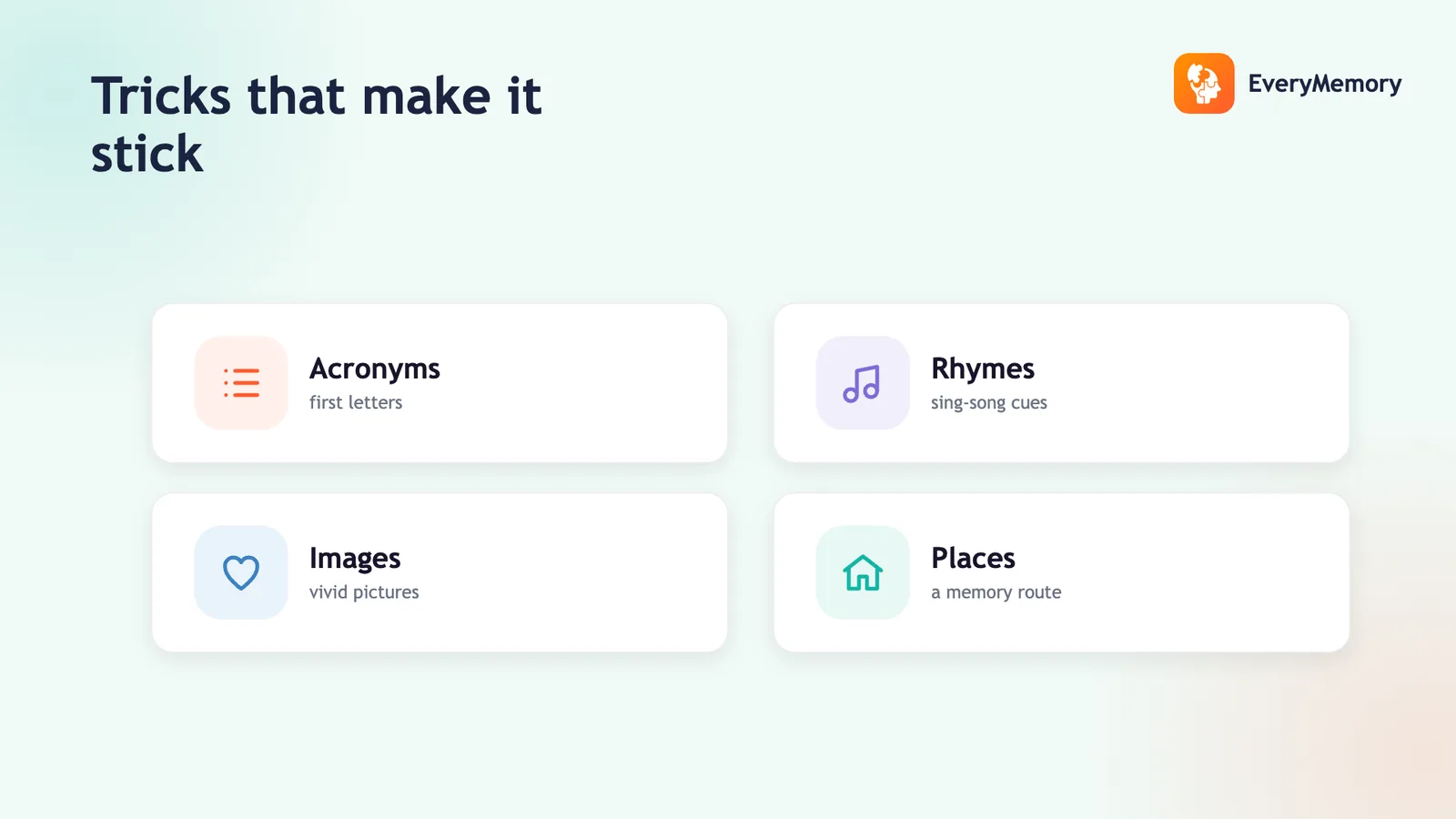
⚡ Quick answer
A mnemonic is any trick that makes information easier to remember by giving it structure or meaning - like 'ROYGBIV' for rainbow colours, or a rhyme for spelling. Mnemonics work because they replace arbitrary information with a pattern, image, rhyme, or story your brain can hold onto. Common types include acronyms, acrostics, rhymes, the memory palace, and association.
Key takeaways
- A mnemonic is any device that makes information easier to recall by giving it a pattern, image, rhyme, or story.
- They work by replacing arbitrary information - which memory handles poorly - with something structured your brain holds easily.
- Main types: acronyms and acrostics, rhymes and songs, imagery and association, the memory palace, and chunking.
- Use them for facts and lists you must recall exactly; for understanding, explaining and retrieval work better.
You've used mnemonics without naming them: 'thirty days hath September', or 'ROYGBIV' for the colours of the rainbow. They're the everyday face of memory technique.
Here's what a mnemonic actually is, why such simple tricks work so well, and how to build one for anything you keep forgetting.
What a mnemonic is
A mnemonic (the first 'm' is silent) is any device that turns hard-to-remember information into something easier - a word, a phrase, a rhyme, an image, or a place. It doesn't add information; it repackages what's there into a form with a handle on it.
Why such simple tricks work
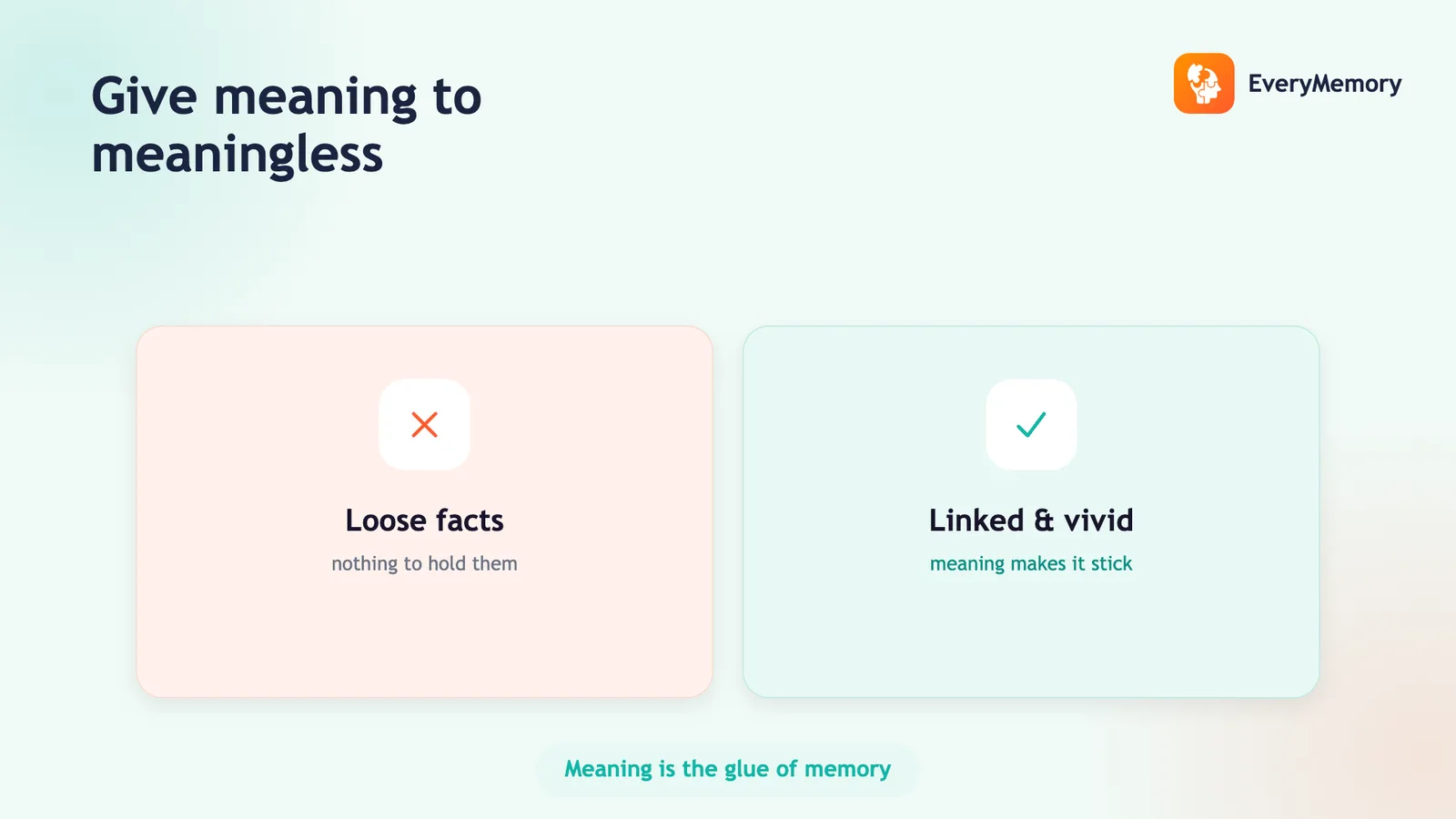
Arbitrary information is what memory struggles with. A mnemonic gives it one of the two things memory loves: a pattern (rhyme, acronym, order) or a meaning (image, story, connection). Either gives your brain something to grab, so recall becomes pulling one cue instead of reconstructing the whole thing.
The main types of mnemonic
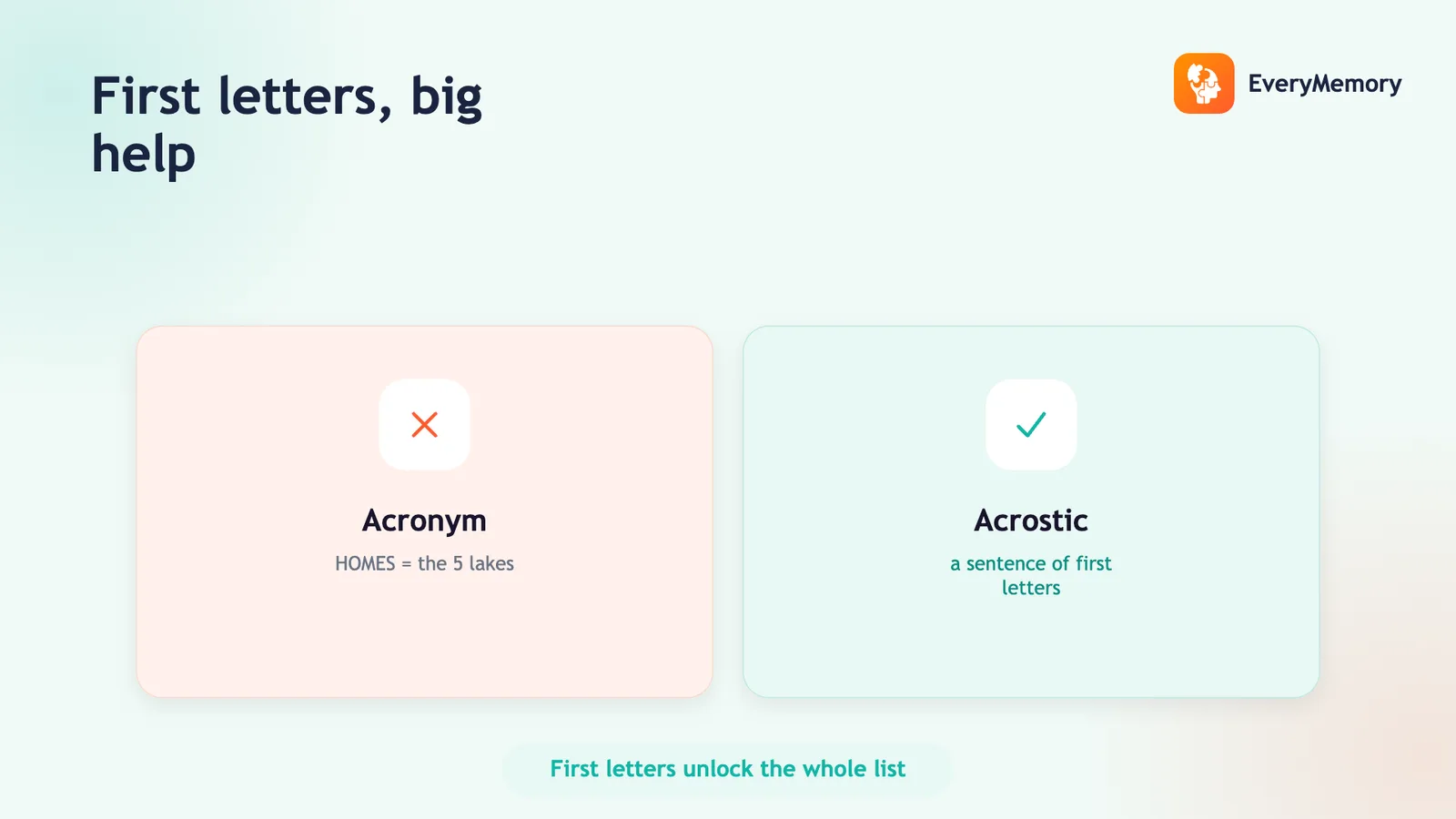
- Acronyms & acrostics - first letters become a word or sentence. See acronyms and acrostics.
- Rhymes & songs - 'i before e except after c'; rhythm and rhyme make verbatim recall easy.
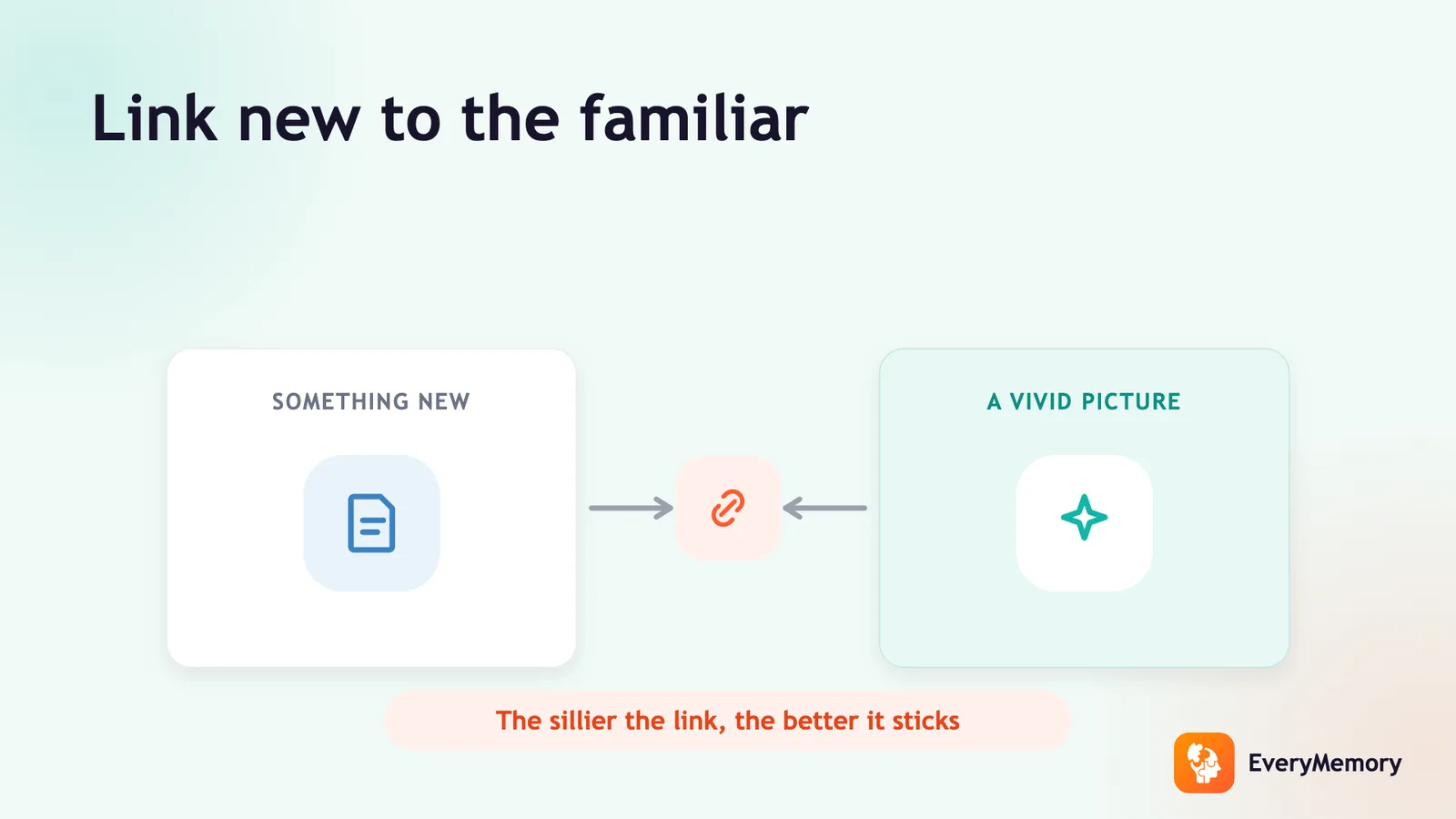
- Imagery & association - turn a fact into a vivid picture linked to what you know. See association.
- The memory palace - place images along a familiar route. See the memory palace.
- Chunking - group long strings into meaningful pieces. See remembering numbers.
When to use one - and when not to
Mnemonics are perfect for arbitrary, must-recall-exactly information: lists, sequences, spellings, facts. They're the wrong tool for understanding - if you need to grasp how something works, connecting and explaining it beats memorising it by rote. Use mnemonics for the bits that simply have to be remembered as-is.
How to make your own
- Pick the few items you actually need to recall.
- Choose a type that fits: a word from first letters, a rhyme, or a vivid image.
- Make it personal and a little absurd - your own silly version sticks better than a standard one.
- Test it from memory a few times across the next day.