 EveryMemory
The Feynman Technique: Learn Anything by Explaining It Simply
If you cannot explain a concept in plain words, you have not learned it - you have only memorized the shape of it. The Feynman Technique fixes that in four concrete steps.
Part of the guide: How to Improve Your Memory: The Complete Beginner's Guide →
⚡ Quick answer
The Feynman Technique is a four-step learning method: write the concept at the top of a blank page, explain it in plain language as if teaching a 12-year-old, identify every spot where you got stuck or defaulted to jargon, then return to the source to fill those gaps and rewrite using simpler words and analogies. Repeating this cycle until no gaps remain is what converts surface-level familiarity into durable, retrievable understanding.
Richard Feynman won the Nobel Prize in Physics and was equally famous for something less celebrated: his insistence that if you could not explain a concept to a first-year student, you did not actually understand it. He kept a notebook he called his "notebook of things I don't know about" and worked through each topic until he could write it out in plain, jargon-free language. That habit became what we now call the Feynman Technique.
The technique is built on a simple but uncomfortable observation. Most study feels productive but isn't. Reading a textbook chapter twice, highlighting key sentences, reviewing your notes - all of it creates a sense of familiarity that your brain mistakes for understanding. Psychologists call this the illusion of knowing. You recognize the words, the diagrams look familiar, and you assume you could reconstruct the idea if asked. Then someone asks, and the words aren't there.
The Feynman Technique short-circuits that illusion by forcing you to produce rather than consume. The moment you try to explain a concept without your notes, every gap becomes immediately obvious. This guide walks through each of the four steps in detail, shows a complete worked example, and covers the mistakes that cause people to run the method without getting the results.
Step 1 - Choose One Concept and Commit It to a Blank Page
Start with a single, clearly bounded idea - not a whole chapter, not a broad subject. "Photosynthesis" is a workable concept. "Biology" is not. "How vaccines train the immune system" is good. "Immunology" is too wide. Write the concept name at the top of a blank piece of paper or a new document. The physical or digital blankness matters: you are not annotating existing text, you are building an explanation from scratch, which immediately raises the difficulty and the payoff.
One concept per session also prevents a common failure mode: drifting into adjacent topics when the current one gets hard. When you notice yourself thinking "well, to explain X I first need to explain Y and Z," write Y and Z down as separate sessions rather than expanding the current one. This keeps each pass tight and makes your gap-spotting much more precise.
Step 2 - Explain It in Plain Language, No Jargon Allowed
Write out your explanation as if you are talking to a curious 12-year-old who has never encountered the topic. Use short sentences. Reach for everyday analogies. Forbid yourself from using any term you cannot immediately define in even simpler language. If you write "the mitochondria produce ATP via oxidative phosphorylation" and you cannot immediately replace every word in that sentence with a plainer version, the sentence is jargon and it does not count.
Do not stop, edit, or look anything up during this step. The goal is to surface what you actually have in your head, not what you can copy from a reference. Write until you run out of things to say. Gaps, stumbles, and vague hand-waves are not failures at this stage - they are data. You are building a diagnostic, not a finished explanation. Most people are surprised by how quickly and how completely their explanation runs out of steam, even on topics they thought they knew well.
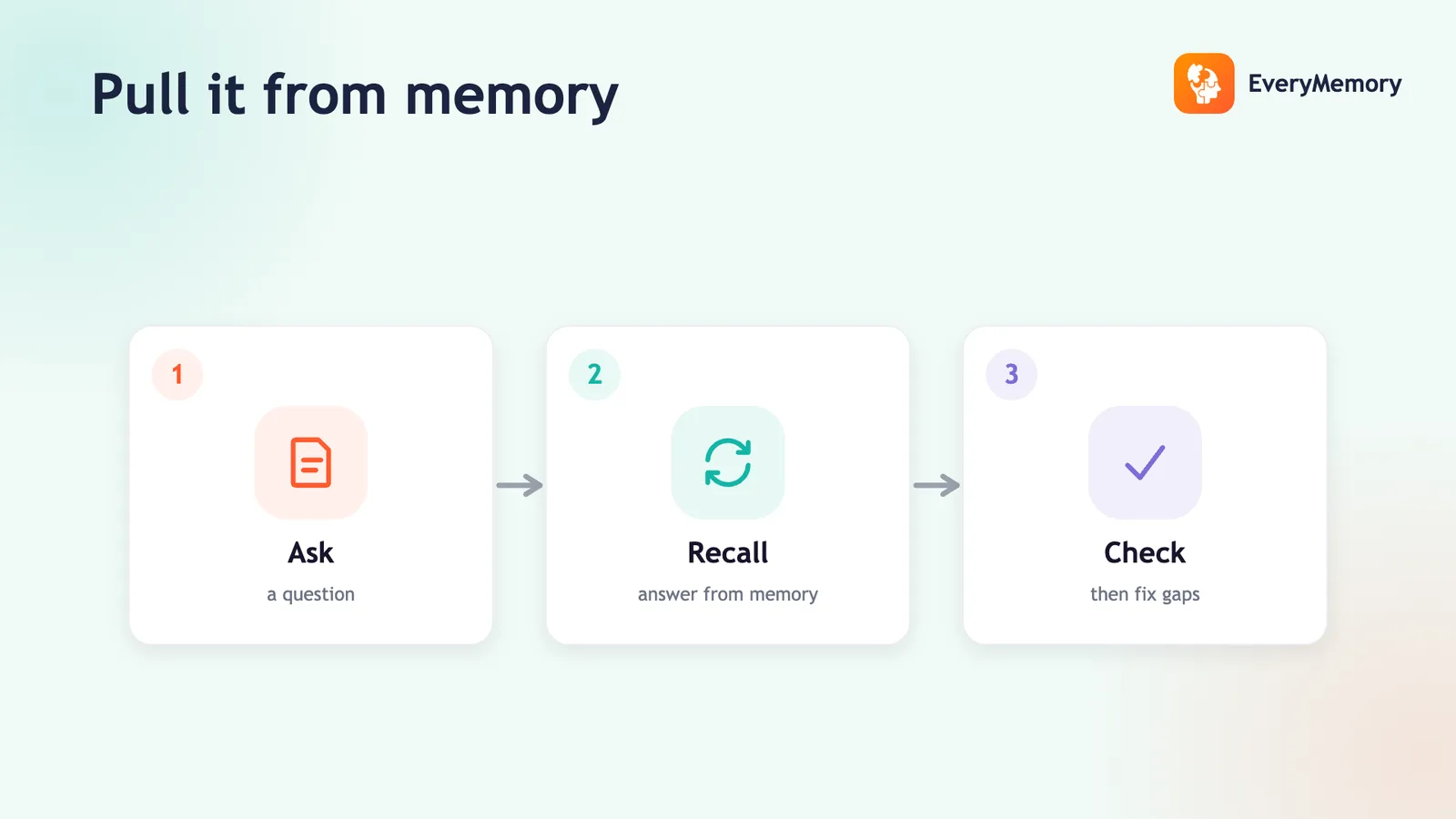
The reason this step is cognitively powerful is that it engages active recall - you are retrieving and reconstructing, not recognizing. Retrieval practice is consistently shown to produce stronger, longer-lasting memories than rereading, and the generation effect (the memory boost you get from producing an answer yourself, even imperfectly) applies to conceptual understanding just as much as to raw facts.
Step 3 - Find the Gaps and Go Back to the Source
Read what you wrote and mark every place where you: got vague ("and then somehow it works out"), used jargon you cannot unpack, skipped a logical step, or simply stopped because you did not know what came next. These are your gaps. They are the actual learning agenda for this session - far more precise than a chapter outline.
Now and only now do you go back to your source material - textbook, lecture, paper, video. Read or watch specifically to answer the gaps you identified. Take notes only on the missing pieces, not a re-summary of the whole thing. This targeted return to the source is more efficient than a second full read because you arrive with specific questions rather than a passive readiness to receive.
This step is where the Feynman Technique separates itself from simply "studying more." Passive re-reading gives you more exposure to familiar material you already sort-of-know. Gap-targeted re-reading gives you exactly what you are missing. The difference in retention is substantial, because how memory works favors material that fills a felt need over material that arrives without context.
Step 4 - Simplify, Use Analogies, and Rewrite
With the gaps filled, rewrite the explanation from scratch. Do not patch the old draft - start a new blank page. This time, lean hard into analogies. A good analogy is not decoration; it is the cognitive scaffold that allows a new idea to attach to something your brain already has a structure for. The trick is finding an analogy that is accurate at the level of mechanism, not just surface similarity. "The nucleus is the brain of the cell" is a common analogy but a poor one, because brains process information dynamically and nuclei mostly store and transcribe. "The nucleus is the cell's archive room - it holds the master copies and sends out working copies" is more mechanistically honest.
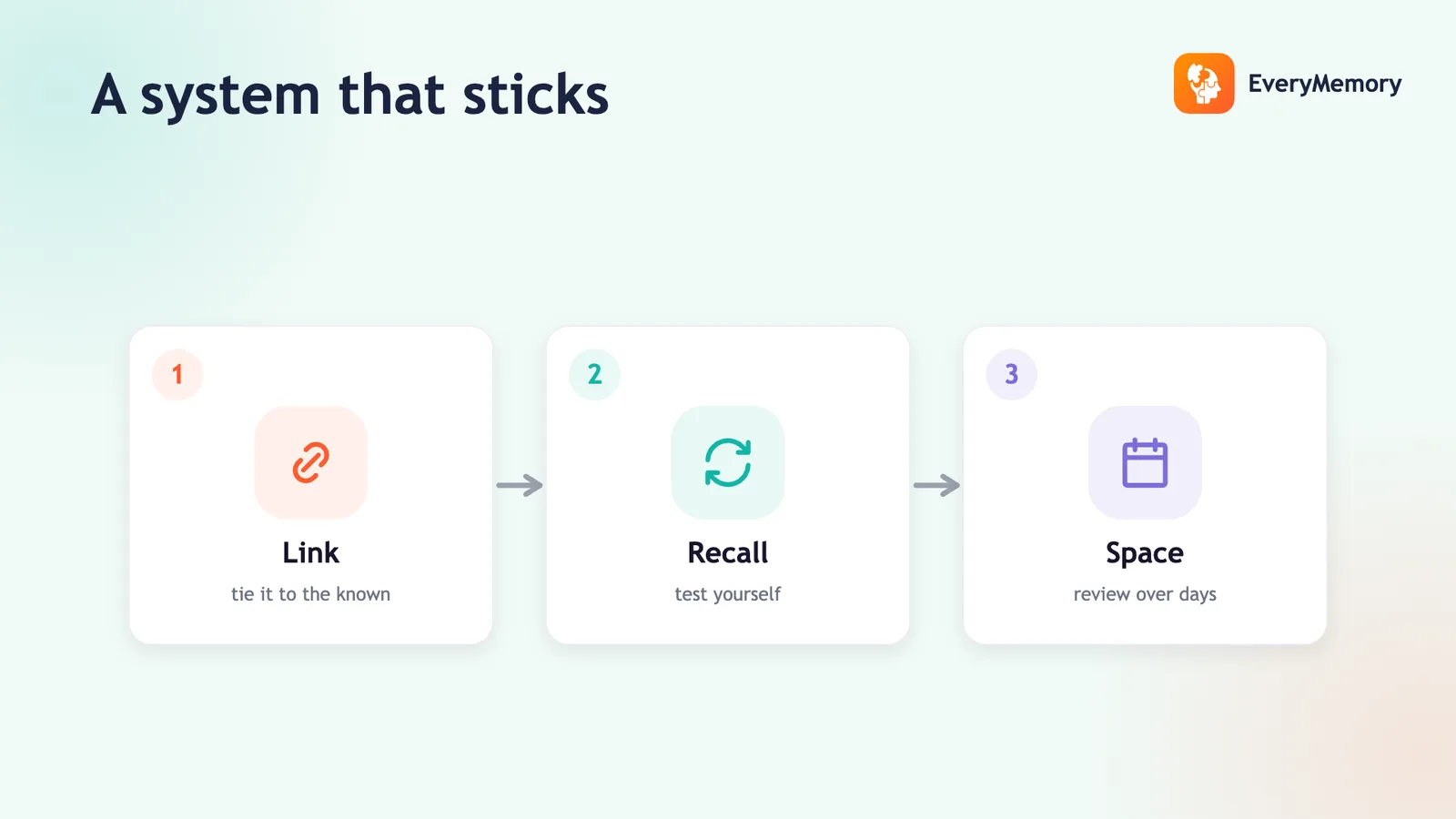
Refine until a non-specialist could follow your explanation without stopping to ask what a term means. If you are preparing for an exam, a presentation, or a job where you will need to apply this knowledge, you can then add one more pass: put the explanation away for 24 to 48 hours and try to reproduce it again from memory. Any decay you notice is another gap to fill. This delayed retrieval step connects the Feynman Technique to spaced practice, making it one of the most complete self-study loops available.
Worked Example - Compound Interest from Scratch
Here is what running the four steps actually looks like. Concept chosen: compound interest. Step 1 - write "Compound Interest" at the top. Step 2 attempt: "Compound interest is when you earn interest on your interest, not just on your original money. So if you put $1,000 in an account and earn 10% in year one, you have $1,100. In year two you earn 10% on $1,100, not on $1,000, so you get $110 instead of $100, and now you have $1,210. The longer you leave it, the faster it grows because the base keeps getting bigger." That is a solid start. But then: "The formula is... A equals P times... something with r and n and t..." - stopped. Gap identified: the formula and what each variable means.
Step 3 - go back to source, find: A = P(1 + r/n)^(nt), where P is principal, r is annual interest rate as a decimal, n is how many times per year interest compounds, and t is years. Step 4 - rewrite: "The formula just formalizes the snowball. P is your starting pile. r/n is the slice of interest you earn each compounding period - monthly, quarterly, whatever. You raise the whole thing to the power of (n times t) because you are multiplying that growth together across every single compounding period over all your years. More compounding periods means more frequent snowballing, which is why a 10% rate compounded monthly beats 10% compounded annually." No jargon, mechanistically honest, formula explained by its logic rather than memorized as a string of symbols.
Common Mistakes That Kill the Results
The most common mistake is copying the textbook in slightly different words. If your explanation contains full sentences that are paraphrases of the source text rather than reconstructions from your own understanding, you are not running the technique - you are just rephrasing, which preserves the illusion of knowing rather than exposing it. If you have to look at the source to write your explanation, close it first and write everything you can, then check.
The second mistake is hiding behind technical vocabulary without unpacking it. Writing "neurons fire action potentials" is not an explanation unless you can immediately continue with what an action potential physically is in plain terms. Every technical term you use is a debt you owe the reader. Pay it immediately or strike the term. The third mistake is stopping at the first full pass and calling the concept learned. One clean explanation is a good start, not a finish. Learning that lasts requires retrieval over time, so schedule at least one delayed pass 48 hours later. A fourth mistake, less often discussed, is choosing concepts that are too large. If you find your explanation keeps branching into sub-explanations that are themselves incomplete, split the concept into smaller units and run each one separately. See also how to study effectively for complementary scheduling strategies, and how to remember more of what you read for pairing Feynman with reading workflows.
✅ Try this today - Run the Feynman Technique on One Concept This Week
Pick one thing you are currently trying to learn - a concept from a course, a work skill, a topic you have been meaning to understand properly. Set aside 20 minutes and run the full four-step cycle.
- Write the concept name at the top of a blank page. Set a timer for 8 minutes and write your explanation in plain language without looking at any source material. Aim for the level of a curious 12-year-old.
- Read what you wrote and circle every vague phrase, every piece of jargon you cannot immediately unpack, and every place where your explanation just stops. List these gaps explicitly.
- Return to your source material only to answer the specific gaps you identified. Take notes on the missing pieces, then close the source again.
- Rewrite the explanation from a blank page using what you now know. Add at least one concrete analogy or worked example. Then set it aside for 48 hours and try to reproduce the key points from memory.
⚠ When to talk to a professional
The Feynman Technique is a self-directed learning and recall practice for general knowledge and skill development, not a medical or therapeutic intervention.