 EveryMemory
How to Remember Where You Put Things
A practical system for ending the daily hunt for keys, glasses, and phones - using designated homes, a brief verbal habit, and a simple mental snapshot.
Part of the guide: How to Improve Your Memory: The Complete Beginner's Guide →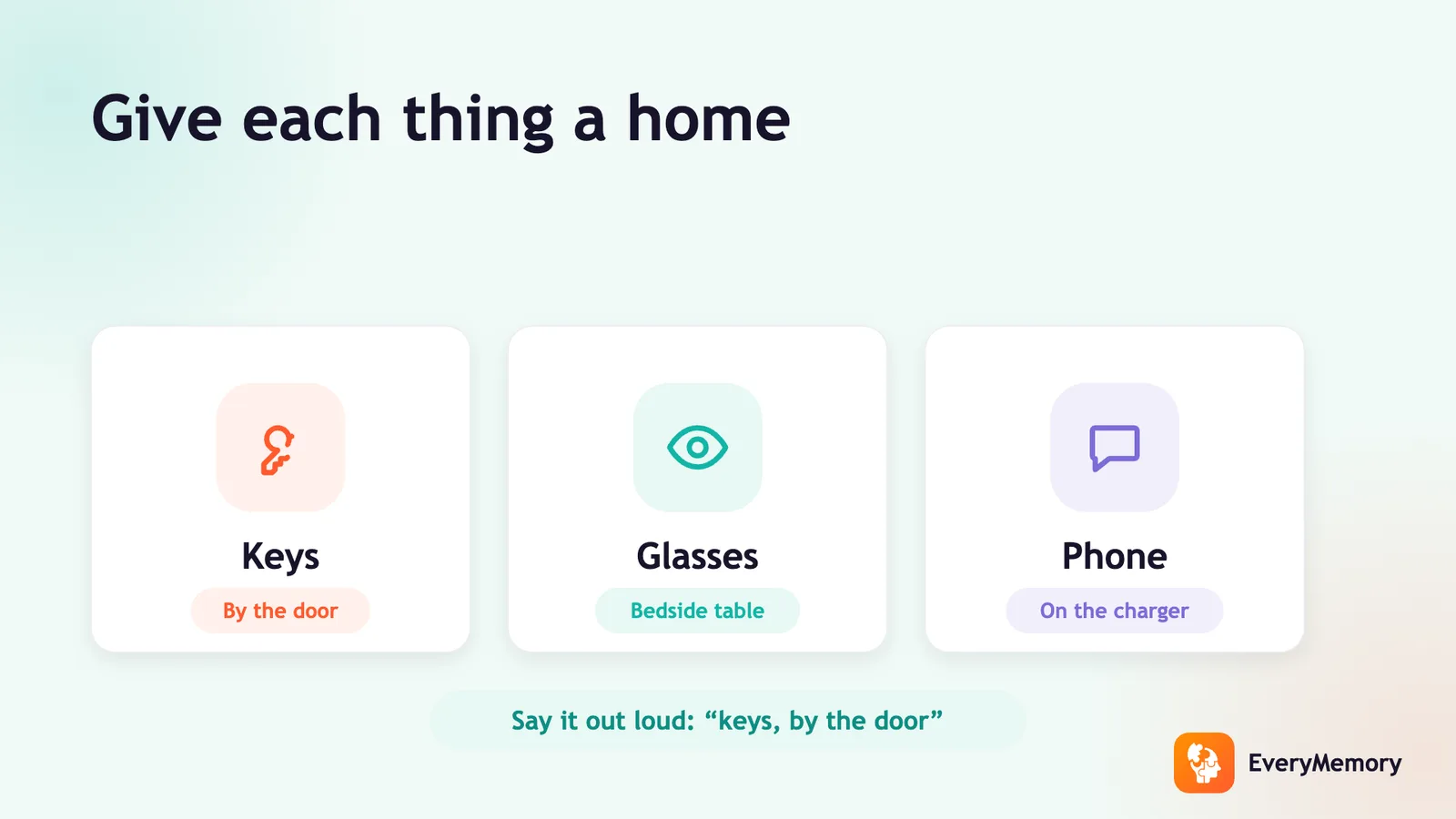
⚡ Quick answer
Losing things is nearly always an attention problem: you put them down automatically, without noticing. The fix is two habits combined - give every frequently used item a fixed home and always say aloud where you're putting it ('Keys on the hook'). The verbal check-in forces a moment of real attention that creates a genuine memory trace.
Key takeaways
- Assign a fixed, permanent home to every item you regularly lose and treat the rule as absolute - no exceptions.
- Say aloud where you are putting something every time you set it down, even when it goes to its designated spot.
- For items placed somewhere unusual, add a quick mental snapshot of the surroundings and narrate one distinctive detail.
- Start the verbal check-in habit with just one item for a week, then add a second - the habit forms in about ten to fourteen days.
The keys are not in the bowl by the door. They're not in your coat pocket. They're not on the counter. You've been to every logical place twice. You are now late. This scenario is so universal that most people simply accept it as an unavoidable feature of a busy mind - but it isn't. Losing objects is almost always an attention problem, not a memory problem.
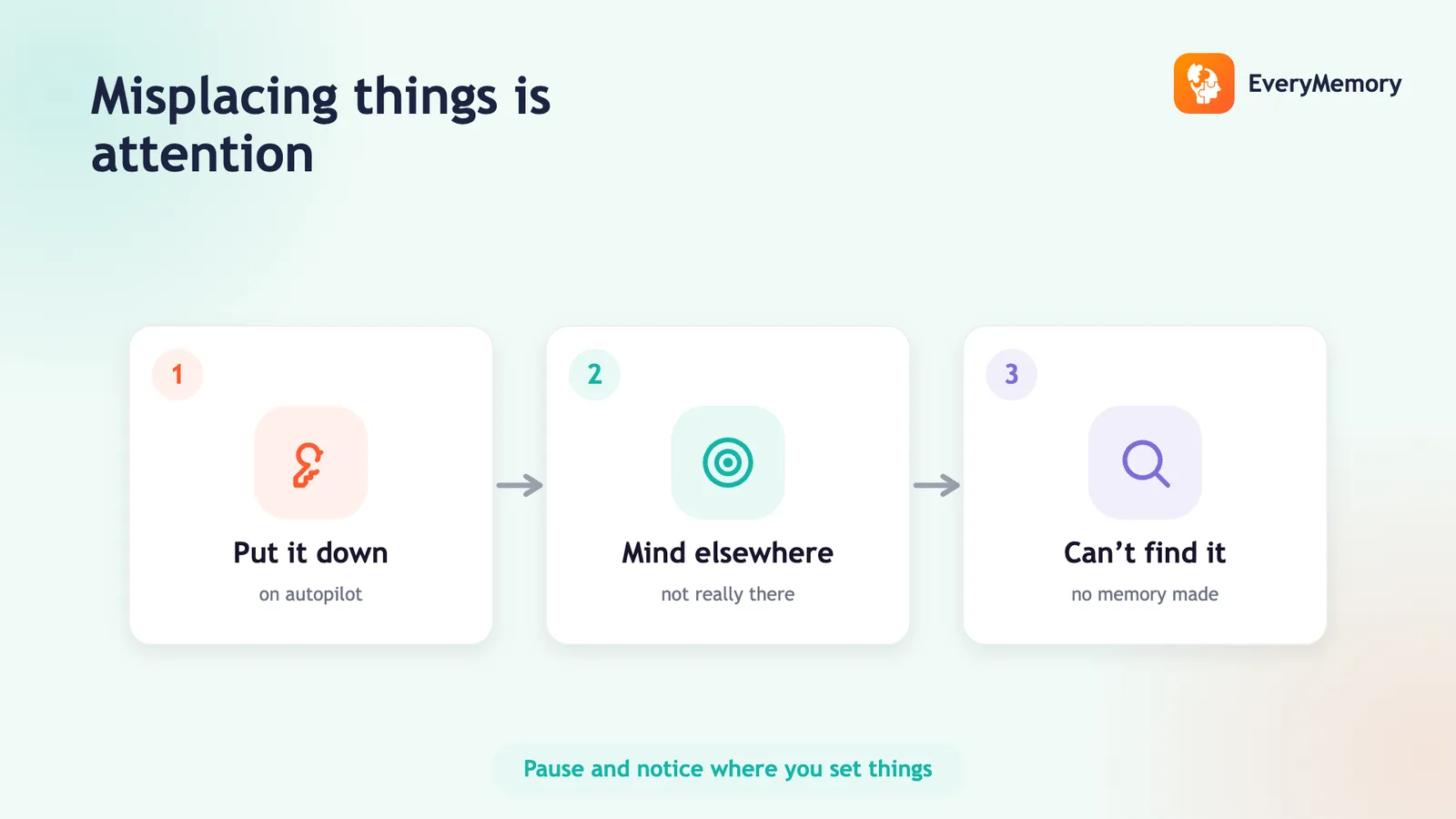
You don't forget where you put your keys. You never actually registered where you put them. The two seconds it took to drop them on the counter happened on autopilot, while your attention was somewhere else entirely. The fix, then, is equally simple: give those two seconds your full attention. This article shows you exactly how to do that - and how to back it up with a few structural changes that make absent-minded placement almost impossible.
Why you lose things (it's not your memory)
When you walk through the door and drop your keys on the hall table, your conscious attention is often on something else entirely - what to make for dinner, a conversation you're replaying, the bag you're trying to put down. The physical action happens on what researchers call "automatic pilot." Your hands placed the keys; your brain did not register it.
This is the same mechanism behind walking into a room and forgetting why you went. If you'd like the full explanation, why you forget why you entered a room covers it in detail. The short version: automatic behaviour is processed differently from deliberate, attended behaviour, and it leaves a far weaker memory trace.
The practical implication is this: the problem is almost never retrieval - it's encoding. You can't remember where you put something because the placement was never stored in the first place. You don't need a better memory; you need one moment of genuine attention.
Give every important item a fixed home
The most powerful structural change you can make is assigning a permanent, consistent location to every item you regularly lose. When an item has a fixed home, finding it requires no memory at all - you simply go to the home.
- Keys: a hook or bowl immediately inside the front door, never anywhere else.
- Glasses: a case on the bedside table and a second case in the kitchen or reading chair.
- Phone: a charging pad in one room - bedroom or kitchen - as the default resting place.
- Wallet or handbag: a shelf or drawer at the same height by the door.
- Medication: next to the kettle or coffee maker - somewhere you always go in the morning.
The rule is absolute: the item goes to its home or it doesn't come inside at all. No exceptions for "just this once." The exceptions are exactly where the losses happen.
If you keep misplacing the same item despite having a home for it, why you keep misplacing things explores the underlying habits worth examining.
The verbal check-in habit
Fixed homes solve the structural problem. The verbal check-in solves the attention problem for the moments when you can't put something in its home right away.
The habit is exactly what it sounds like: whenever you put something down, say aloud where you're putting it. Not in your head - out loud. "Keys on the kitchen counter." "Glasses on top of the bookshelf." "Phone face-down on the bathroom shelf."
Saying it aloud forces your brain to switch momentarily out of automatic pilot and into conscious attention. That brief switch is enough to create a genuine memory trace. When you're looking for the item later, the verbal memory - "glasses on top of the bookshelf" - is there to retrieve.
It feels slightly odd at first, especially if someone else is home. Tell them what you're doing. Within a week most people find it natural, and within two weeks they often report a significant drop in lost-item incidents.
The mental snapshot technique
For items placed somewhere unusual - you stopped at a friend's house and left your sunglasses on their side table - the verbal check-in can be backed up with a quick mental snapshot. As you put the item down, take one deliberate second to look at it in its surroundings and form a visual image: sunglasses, brown side table, lamp to the left, window behind.
This is a simplified form of the technique described in visual memory training for older adults - using a deliberate visual impression to anchor an object in context. You don't need to construct a whole scene; a single distinctive detail is enough.
Say the detail aloud as you form the image: "Sunglasses next to the lamp at Maria's." The combination of visual and verbal encoding gives you two routes to retrieve the location - and either one is usually enough.
When items disappear mid-task
A common variant of the losing-things problem isn't about a fixed home - it's about items put down in the middle of doing something. You're cooking and set down the spoon to answer a question. You're sorting papers and put your glasses down to look more closely. You're on a call and leave your keys on a random shelf.
For these mid-task misplacements, a single rule helps enormously: pause and narrate before walking away. Before you step away from whatever you were doing, take one second to look at where things are and say it once. This is especially effective for glasses, since people rarely notice they've set them down until they can't see clearly.
- Before leaving any surface during a task, do a quick visual sweep.
- Name any item that isn't in its designated home: "Glasses on the cutting board."
- Return it to its home if you won't need it again in the next few minutes.
Building the habit over 2 weeks
The verbal check-in habit takes about 10-14 days to become automatic. Start with just one item - typically keys, since their loss is most disruptive. For one week, every time you put down your keys, you say where. Once that's natural, add glasses. Then the phone.
Track progress with a simple count: how many times did I search for something this week? Most people see a clear drop by week two. For a broader framework, building a memory training habit pairs well with this system.
✅ Try this today - Set up three fixed homes today
Before you go to bed tonight, take 10 minutes to set up permanent homes for your three most-lost items:
- Choose a specific spot for your keys (a hook, bowl, or drawer by the door) and put them there right now.
- Choose a permanent spot for your glasses when you're not wearing them - ideally a case in the room where you most often set them down.
- For the next 3 days, say the location aloud every single time you put either item down, even when it goes to its designated home.
- At the end of day 3, note whether you've had to search for either item. Most people report a clear improvement within the first week.