 EveryMemory
Information Overload: Why You Forget When There's Too Much
Forgetting names, losing your train of thought, re-reading the same sentence three times - these are not signs of a failing memory. They are signs of an overloaded one. Here is what is happening and how to fix it.
Part of the guide: Understanding Memory Loss and Forgetfulness: A Calm, Reassuring Guide →
⚡ Quick answer
Information overload blocks memory because your working memory can only hold a few things at once. When too many inputs arrive simultaneously, notifications, tabs, multitasking, endless feeds, nothing gets processed deeply enough to transfer into longer-term recall. The fix is not a better memory; it is a calmer, more focused information environment.
You sit down to read an article, check one notification, open a second tab, glance at a group chat, and by the time you return to the article you have forgotten what the first paragraph said. Sound familiar? Most people assume this means their memory is getting worse. The more likely explanation is that your memory is doing exactly what it is designed to do, it is just being asked to hold far more than it was ever built to handle.
Working memory, the mental workspace where you briefly hold and use information, is surprisingly small. Research in cognitive psychology consistently shows that most adults can actively hold only around three to five meaningful pieces of information at one time. When you flood that workspace with notifications, background noise, open browser tabs, and a running to-do list, new information does not get a fair chance to stick. It slips away not because anything is wrong with your memory, but because there was no room for it.
The good news is that this kind of forgetting is entirely situational. Change the environment and the conditions under which you take in information, and your recall can improve noticeably, often within the same day. This article explains exactly why overload blocks memory formation and gives you a set of practical tools to work with your memory's real capacity instead of against it.
Why working memory has a small capacity
Working memory is not like a hard drive where you can keep cramming in more files. It is better imagined as a small whiteboard, useful, fast, and flexible, but limited in space. Cognitive scientists have studied this limit for decades, and the consistent finding is that the average person can actively juggle roughly three to five chunks of information at any moment before earlier items start to fade or get displaced.
This limit exists for good structural reasons. Working memory is the part of your mind that actively manipulates information, connecting what you are reading now to what you read three sentences ago, forming a plan, or following a conversation. That kind of active processing is metabolically expensive and cognitively demanding. A small capacity keeps the system fast and responsive. The problem is that the modern information environment was not designed with that limit in mind.
When you try to hold too many things at once, the email you have not replied to, the task you were mid-way through, the alert that just buzzed, and the sentence you are trying to read, each item competes for space. The most recent arrivals tend to bump older ones out. This is why you walk into a room with a clear purpose, get a notification on the way, and arrive having completely forgotten what you came for. Nothing went wrong with your memory. Your whiteboard simply got overwritten.
The daily sources of overload
The modern day is structured, almost by design, to exceed working memory's limits. Smartphones deliver interruptions at an average rate of dozens per day. Browser sessions sprawl across ten or fifteen tabs. Work tools like email, chat, and calendar notifications create a constant stream of task-switching demands. Social media feeds are engineered to keep presenting new stimuli so that the brain never fully settles on one thing.
Screen time and memory are closely linked, not because screens are harmful in themselves, but because the way most people use them involves rapid context-switching and shallow skimming rather than sustained, deep engagement. Skimming feels productive because information is flowing, but skimming rarely leads to retention. If your eyes moved over something but your attention was split three ways, the information never had a real chance to encode.
Multitasking affects memory in a direct and measurable way. Each switch between tasks carries a small cognitive cost, a brief moment where your brain has to reload the context of the new task and let the previous one go. String together enough of these switches and your mind spends most of its day in transition rather than in genuine processing. By the end of the day, it can feel as though you worked hard and absorbed nothing.
The real cost: shallow attention and mental tiredness
When working memory is perpetually overloaded, the brain adopts a coping strategy: it processes everything more shallowly. Instead of following a thread of reasoning to its conclusion, it grabs the headline and moves on. Instead of linking new information to what it already knows, which is how strong memories are built, it holds just enough to get through the next moment. The result feels like poor memory, but the real problem is that the encoding step was too weak for anything to stick.
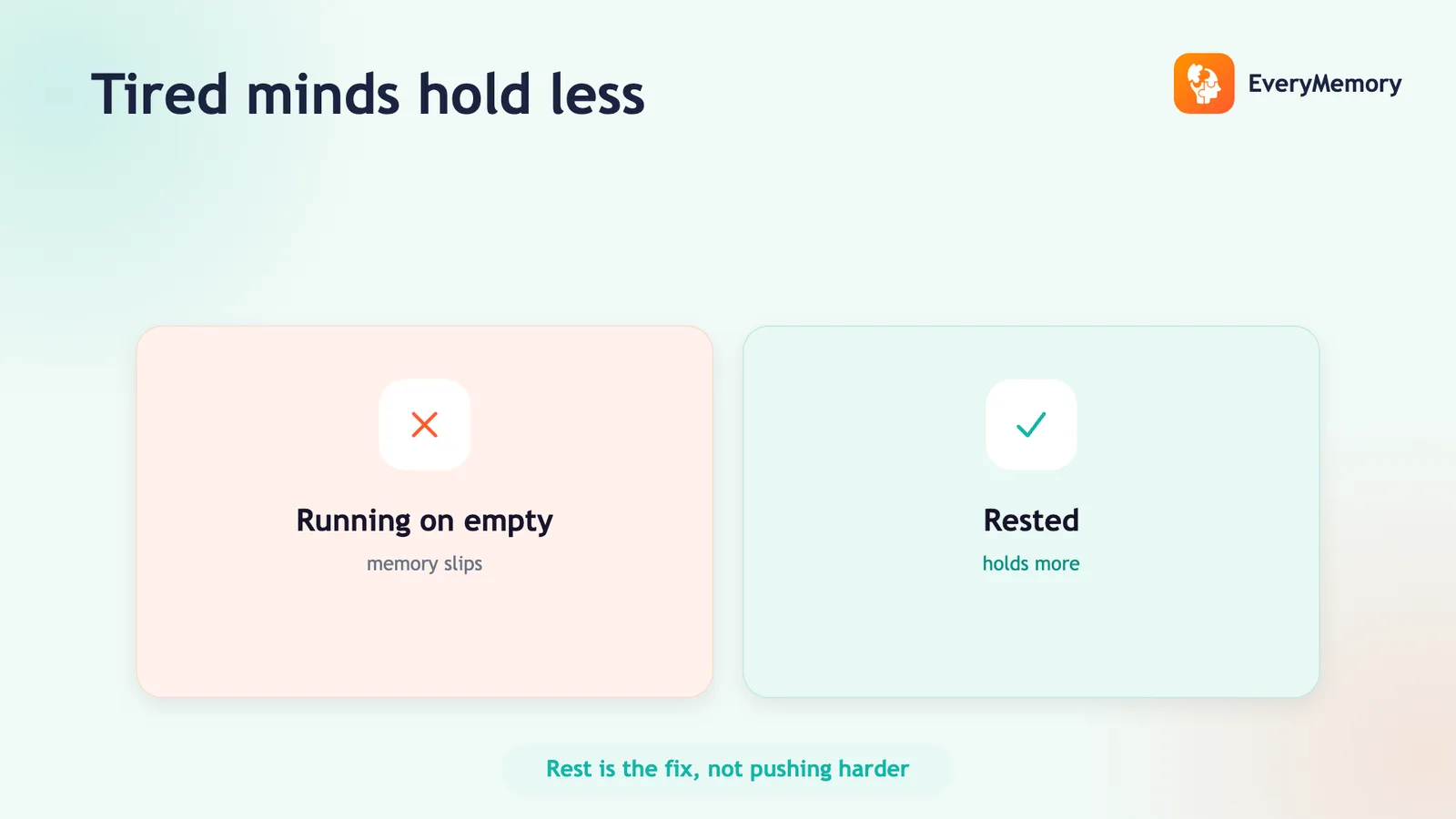
There is also a tiredness dimension that compounds the problem. Mental fatigue and memory are tightly coupled: the more decisions, interruptions, and context-switches you accumulate across a day, the harder it becomes to focus on the next thing. Decision fatigue is a real phenomenon, by the afternoon, many people find that even simple choices feel effortful. In that depleted state, the brain encodes new information even less efficiently than when fresh.
This creates a self-reinforcing cycle. Overload leads to shallow processing, which leads to forgetting, which leads to re-reading, re-checking, and more mental effort, which accelerates fatigue, which makes encoding even weaker. Breaking the cycle requires reducing the input load, not pushing harder to concentrate through it.
Practical defences: reducing input and protecting focus
The most direct remedy is to reduce the number of things competing for your working memory at any one moment. Batch your notifications rather than receiving them continuously, check messages at two or three set times rather than responding to each alert as it arrives. Close browser tabs that belong to tasks you are not actively working on. A cluttered tab bar is not just visual noise; each visible tab is a faint background demand on attention, a reminder of an unfinished thread.
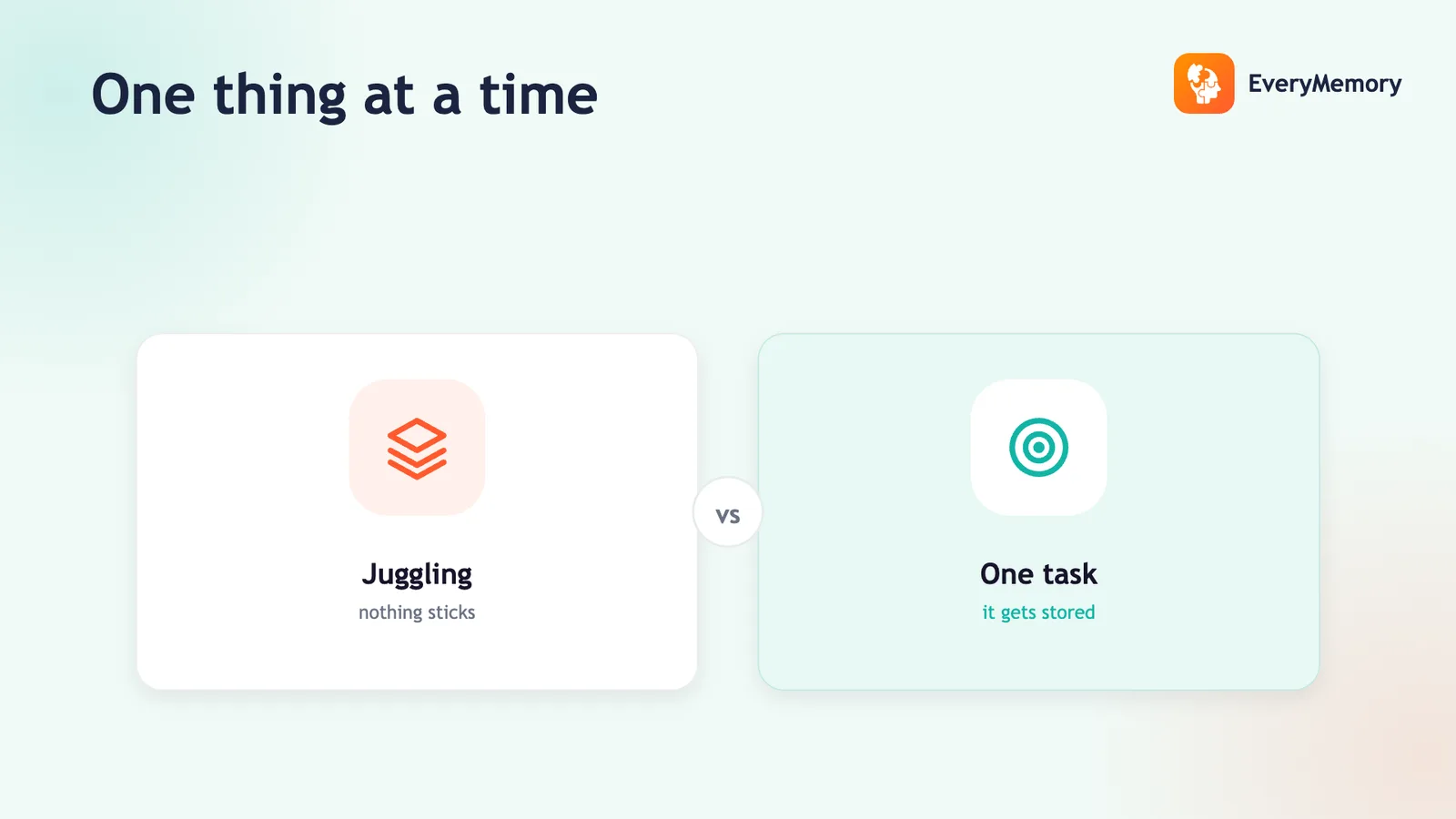
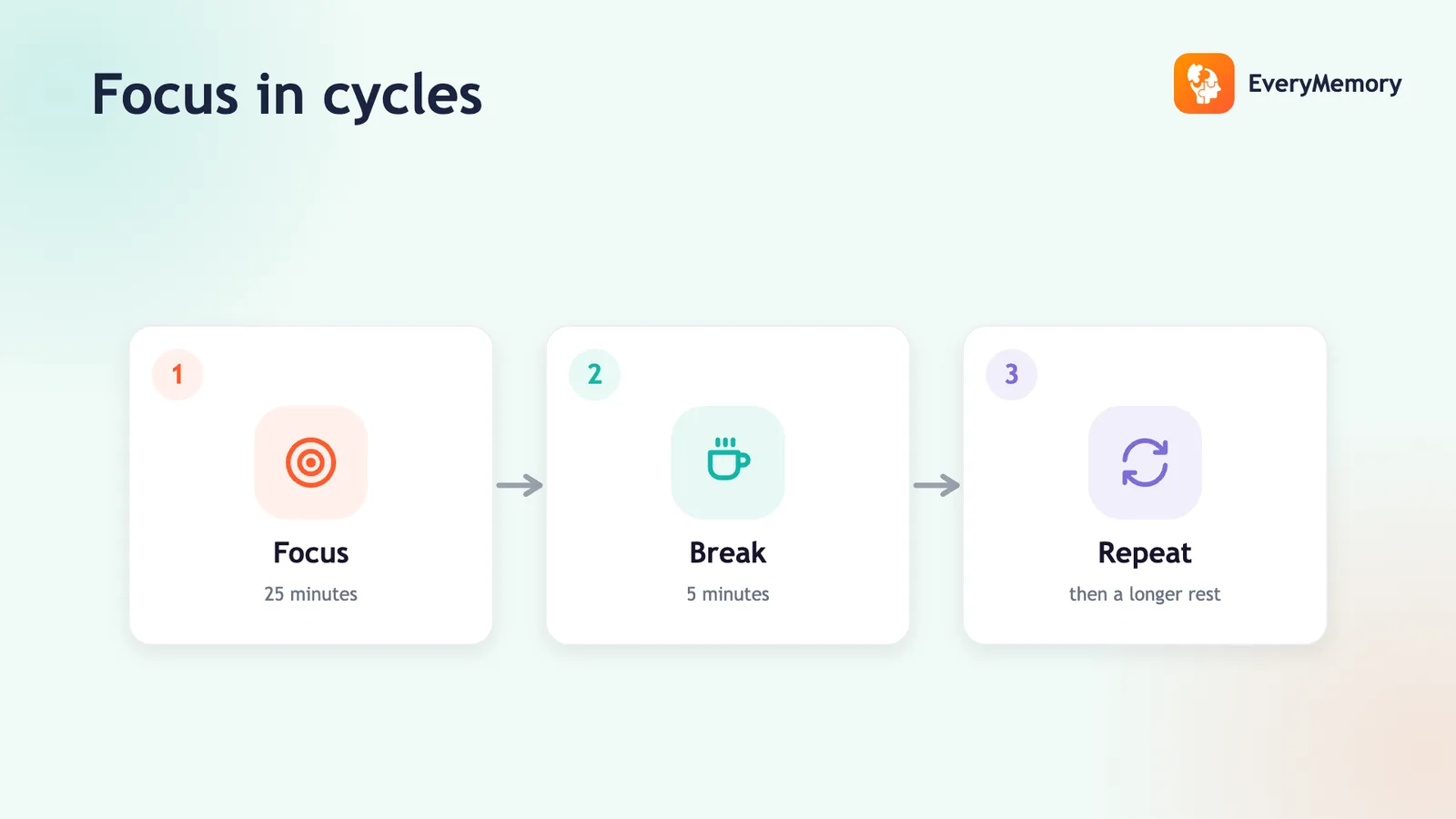
Staying focused becomes much easier when the environment supports focus rather than fighting it. This means creating protected blocks of time for single-task work, one task, phone face-down, notifications paused, for a defined period. Even 20 uninterrupted minutes of genuine single-tasking tends to produce more useful output and better retention than an hour of fragmented multi-track effort. The goal is not monastic silence; it is simply giving each piece of information a fair window of attention.
Offloading is another powerful strategy. Your working memory works best when it is processing and connecting ideas, not acting as a holding pen for things you need to remember to do. A simple external list, a notebook, a notes app, a whiteboard, frees up working memory to focus on the task at hand. Write down the errand, the follow-up email, the idea that just occurred to you, and then let it go. You are not forgetting it; you are trusting your system. Thinking more clearly is often less about mental effort and more about reducing the number of things your mind is trying to simultaneously track.
Process deeply, not broadly
One of the most counterproductive habits in the information age is consuming more content in the hope of staying informed or learning faster. More volume rarely produces more knowledge. The brain retains what it processes deeply, information it has connected to existing knowledge, thought about, and ideally revisited. A single article read carefully and reflected on will almost always stick better than five articles skimmed in the same time.
Remembering more of what you read comes down to slowing down and engaging actively: pausing to ask what a passage means, connecting it to something you already know, summarising a section in your own words before moving to the next. These micro-actions take a little more time per article but dramatically improve how much you actually carry away from the reading.
Taking real breaks also matters more than most people expect. The brain consolidates and organises information during rest, not during the next wave of input. A ten-minute walk without a podcast, a few minutes away from screens, or even a brief pause where you look out a window rather than at a feed gives the mind a chance to file what it has just encountered. Many people report that insights and memories surface during these quiet gaps precisely because the brain has been given space to complete the encoding process it started earlier.
✅ Try this today - The one-thing-at-a-time focus block
Set aside 20 minutes to practise genuine single-tasking. This is not about doing more, it is about giving your working memory a single clear target so that what you process actually sticks.
- Choose one specific task or piece of content to engage with, one article, one work document, one topic. Close every unrelated tab, put your phone face-down, and write the name of your chosen task at the top of a notepad so your attention has a clear anchor.
- Work on that single task for the full 20 minutes without switching. If an unrelated thought or to-do arrives in your mind, write it on the notepad and immediately return to the task, you have not lost it, you have just parked it outside your working memory.
- When the 20 minutes are up, pause for two minutes before opening anything else. Jot down one or two things you learned or completed. This brief reflection step is where encoding solidifies, it is the moment your brain moves the information from temporary to more durable storage.
⚠ When to talk to a professional
This article is for general interest and non-medical self-exploration only - it is not a substitute for professional advice, and if you have concerns about your memory or cognitive health, please speak with a qualified healthcare provider.