 EveryMemory
Interleaving: A Smarter Way to Practice and Study
Mixing different topics in one session feels chaotic and slow - but research consistently shows it produces stronger long-term retention than the tidy, one-topic-at-a-time approach most people use.
Part of the guide: How to Improve Your Memory: The Complete Beginner's Guide →
⚡ Quick answer
Interleaving means mixing different topics or problem types within one practice session rather than finishing all of one type before starting another. It feels harder than blocked practice and learners consistently underestimate how much they learned - but tests taken days or weeks later show significantly better retention and the ability to apply knowledge to new problems. The extra difficulty is the point: your brain is forced to retrieve and select the right approach every time, not just repeat a memorised procedure.
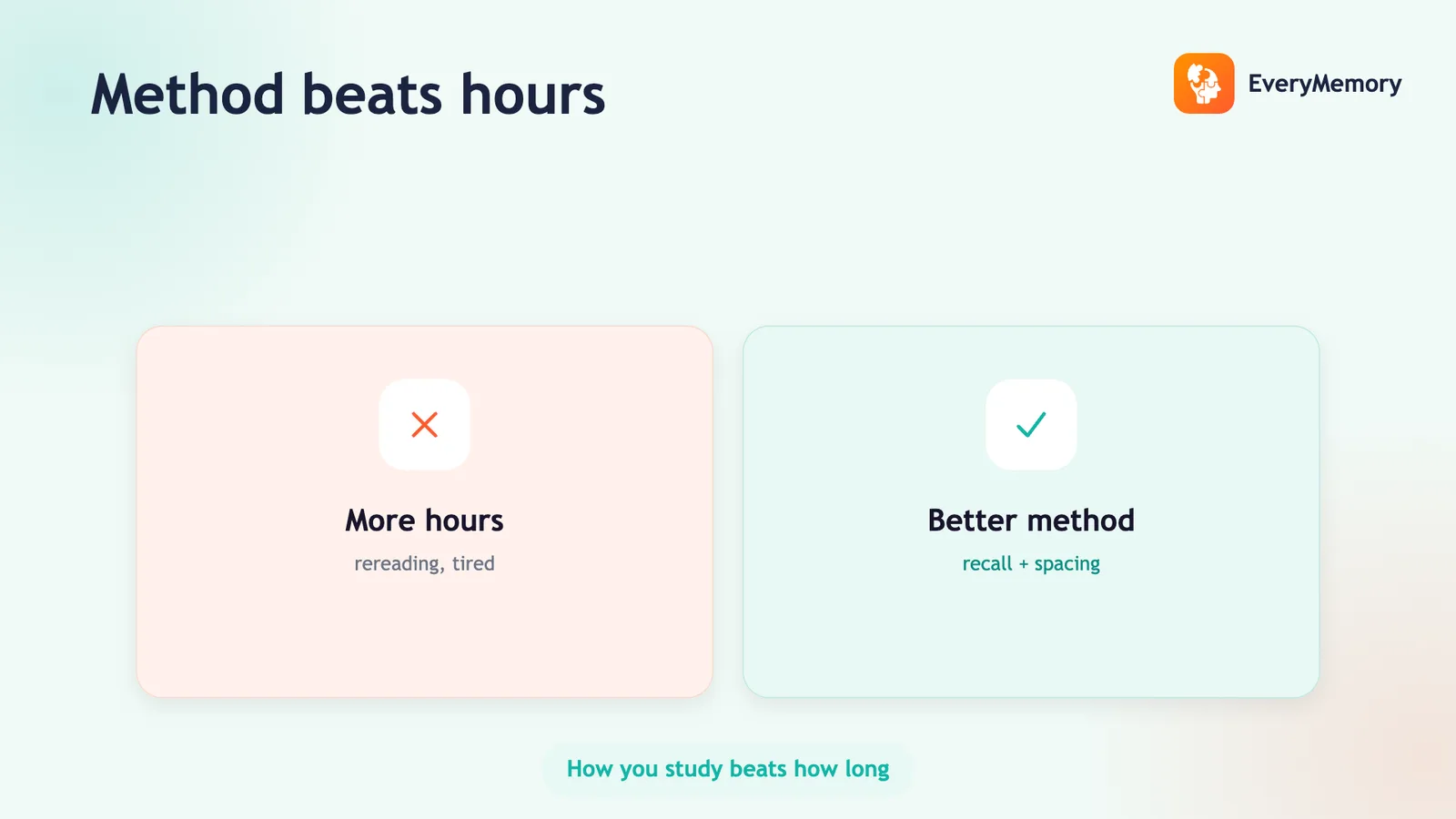
Most people study the way it feels productive: finish all of Chapter 4 before touching Chapter 5, drill thirty long-division problems before moving on to fractions, spend Monday on verbs and Tuesday on nouns. This is called blocked practice - one topic, one type, until it feels solid. It is organised, comfortable, and deeply intuitive. It is also, according to a substantial body of research, one of the least effective ways to lock information into long-term memory.
The alternative is interleaving: deliberately mixing different topics, problem types, or skills within a single session. Where blocked practice follows a pattern like AAABBBCCC, interleaved practice follows something closer to ABCBCACAB - you never stay on one category long enough to fall into a groove. Sessions feel harder, slower, and less satisfying. Studies consistently show that learners rate interleaved sessions as more frustrating and believe they learned less - even when tests taken days later prove the opposite. That gap between feeling and outcome is exactly why interleaving is worth understanding.
This guide explains what interleaving is, why it works at a cognitive level, where it helps most (and where it does not), and how to build a practical interleaved practice routine you can start this week - including how to stack it with spaced repetition and active recall for even stronger results.
Blocked vs. Interleaved: A Clear Contrast
Imagine a maths student working on three topics: volume of cylinders (A), surface area of cones (B), and volume of spheres (C). In a blocked session she does ten cylinder problems, then ten cone problems, then ten sphere problems. Each block feels smooth because she has just done nine identical problems before this one - the formula is already loaded, the procedure is running on autopilot. Her accuracy within the session is high. She finishes feeling competent.
In an interleaved session she works through the same thirty problems, but the order is mixed: cylinder, cone, sphere, cone, cylinder, sphere, sphere, cone, cylinder - and so on. Every problem requires her to stop, read the question, identify which formula applies, retrieve it from scratch, and then execute it. Her accuracy within the session is lower. She finishes feeling like she struggled. Yet when both groups sit a test a week later, the interleaved group consistently outperforms the blocked group - sometimes by a large margin. This pattern has been replicated across mathematics, science, foreign language vocabulary, motor skills, and visual category learning.
Why Interleaving Works: The Cognitive Mechanism
The core explanation is sometimes called discriminative contrast. In a blocked session, you never need to figure out which procedure to apply - the category is given to you by the block itself. You are practising execution, not selection. In an interleaved session, every problem begins with an implicit question: what kind of problem is this, and what does it require? That selection step is cognitively demanding, and it is precisely the demand that strengthens memory. You are building not just a procedure but a retrieval cue - a mental hook that connects the problem type to the right approach.
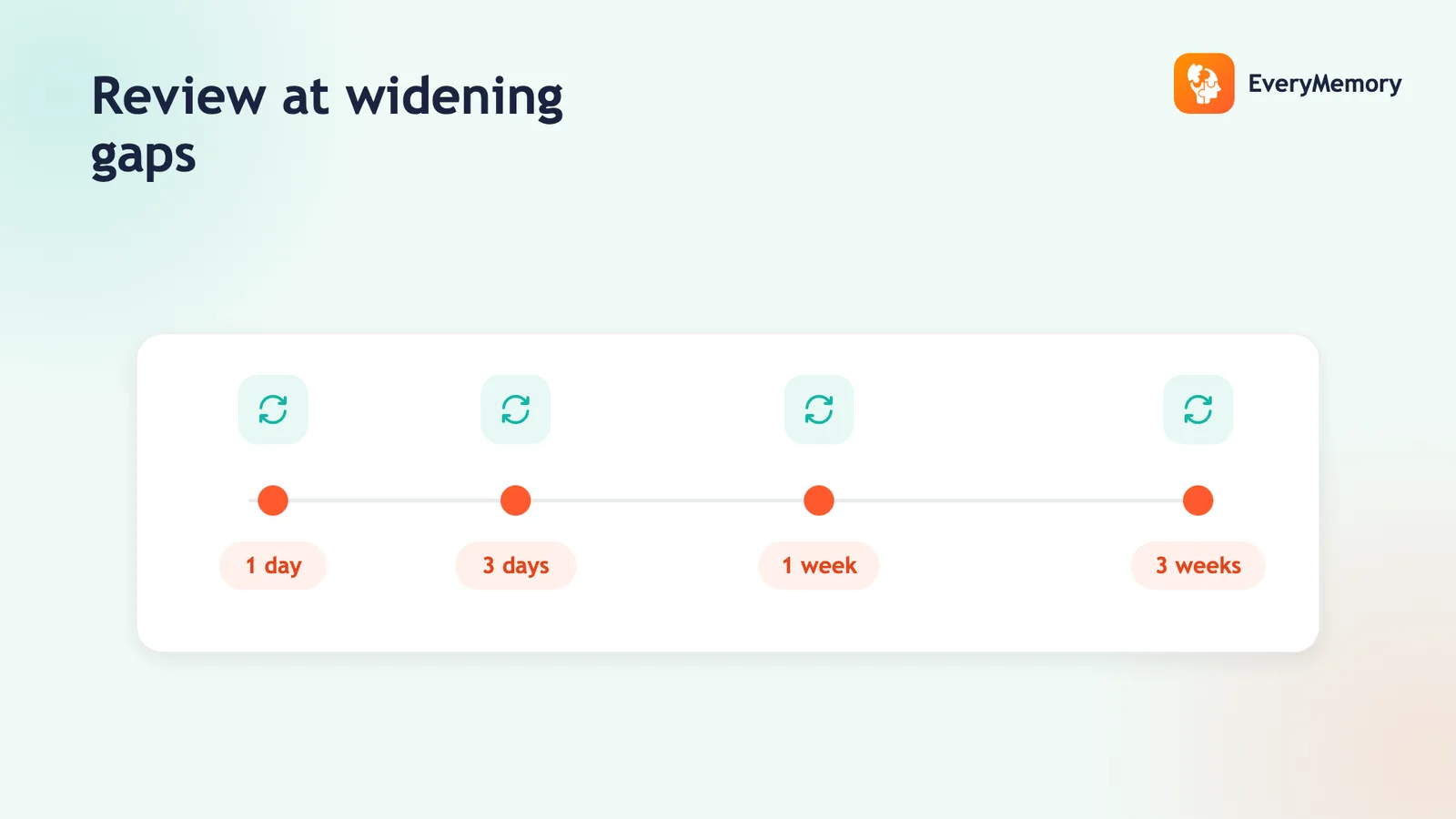
A second mechanism is that interleaving produces spaced practice as a side effect. Because you move away from topic A to work on B and C before returning to A, there is a natural gap between each exposure. That gap forces retrieval rather than recognition - your brain has to reconstruct the information rather than simply confirm it is still warm. This is the same principle behind spaced repetition, and interleaving captures it even within a single session. The two methods compound each other when used together.
A third factor is encoding variability. When you return to a topic after a detour through something else, you are almost certainly in a slightly different mental context. Cognitive science suggests that varied encoding - storing the same information under multiple retrieval conditions - makes that information accessible from more angles, which is what transfer (applying knowledge to new problems) actually requires.
A Concrete Worked Example: Telling Artists Apart
Visual category learning is one of the clearest demonstrations of interleaving. Suppose you are learning to identify ten species of wading birds. In a blocked approach you study all ten images of the dunlin, then all ten of the knot, then all ten of the sanderling. Each bird is easy to identify by the end of its block because you are essentially just matching to the last image you saw. In an interleaved approach the images are shuffled: dunlin, knot, sanderling, knot, dunlin, sanderling - each one a fresh discrimination challenge.
Researchers Nate Kornell and Robert Bjork ran exactly this kind of study using paintings and artist styles. Participants who studied paintings in interleaved order - Monet, Cezanne, Braque, Monet, Cezanne - were significantly better at correctly attributing new paintings they had never seen to the right artist, compared with participants who studied all six Monets, then all six Cezannes, and so on. The blocked group had seen just as many paintings. The interleaved group had been forced to notice what makes a Monet a Monet rather than just accumulating Monet images. That distinction - between features and exemplars - is precisely what real-world classification requires.
Where Interleaving Helps Most (and Where to Hold Off)
Interleaving is most powerful when the things you are mixing are related but confusable - topics that share surface features but require different approaches. Grammar rules in a foreign language, formula families in physics, chemical reaction types in organic chemistry, motor patterns in different sports strokes - all of these benefit because the discrimination between them is the actual learning goal. If you already know the difference intuitively, blocked practice on one weak area might be more efficient for that specific gap.
Where blocked practice still has a legitimate role is at the very beginning of learning something genuinely new. If you have never seen a partial derivative before, spending ten minutes exclusively on partial derivatives is reasonable - you need enough exposure to form even a rough mental model before contrast with other topics becomes meaningful. Think of it as a runway: a small amount of blocked practice to get airborne, then interleaving to build altitude. The research also suggests that interleaving works better for intermediate and advanced learners than for complete novices. Knowing when to switch methods is itself a skill worth developing.
Interleaving is also less helpful when the topics are so unrelated that there is nothing to contrast - mixing Spanish vocabulary with piano scales and tax law in the same session is just fragmentation, not productive interleaving. Aim for topics that live in the same domain or subject area, where confusing one with another is a real risk.
Stacking Interleaving With Spaced Repetition and Active Recall
Interleaving, spaced repetition, and active recall are three separate levers that all exploit the same underlying principle: retrieval effort strengthens memory. They combine naturally. A spaced-repetition system already spaces your reviews over days and weeks; interleaving adds within-session mixing so that even a single review session is not simply running through one deck category. When you do a flashcard review, resist sorting cards by topic before you start - let the mixed order stand. The mild discomfort of jumping between, say, Japanese vocabulary, historical dates, and chemistry definitions is productive friction, not a sign that something is wrong.
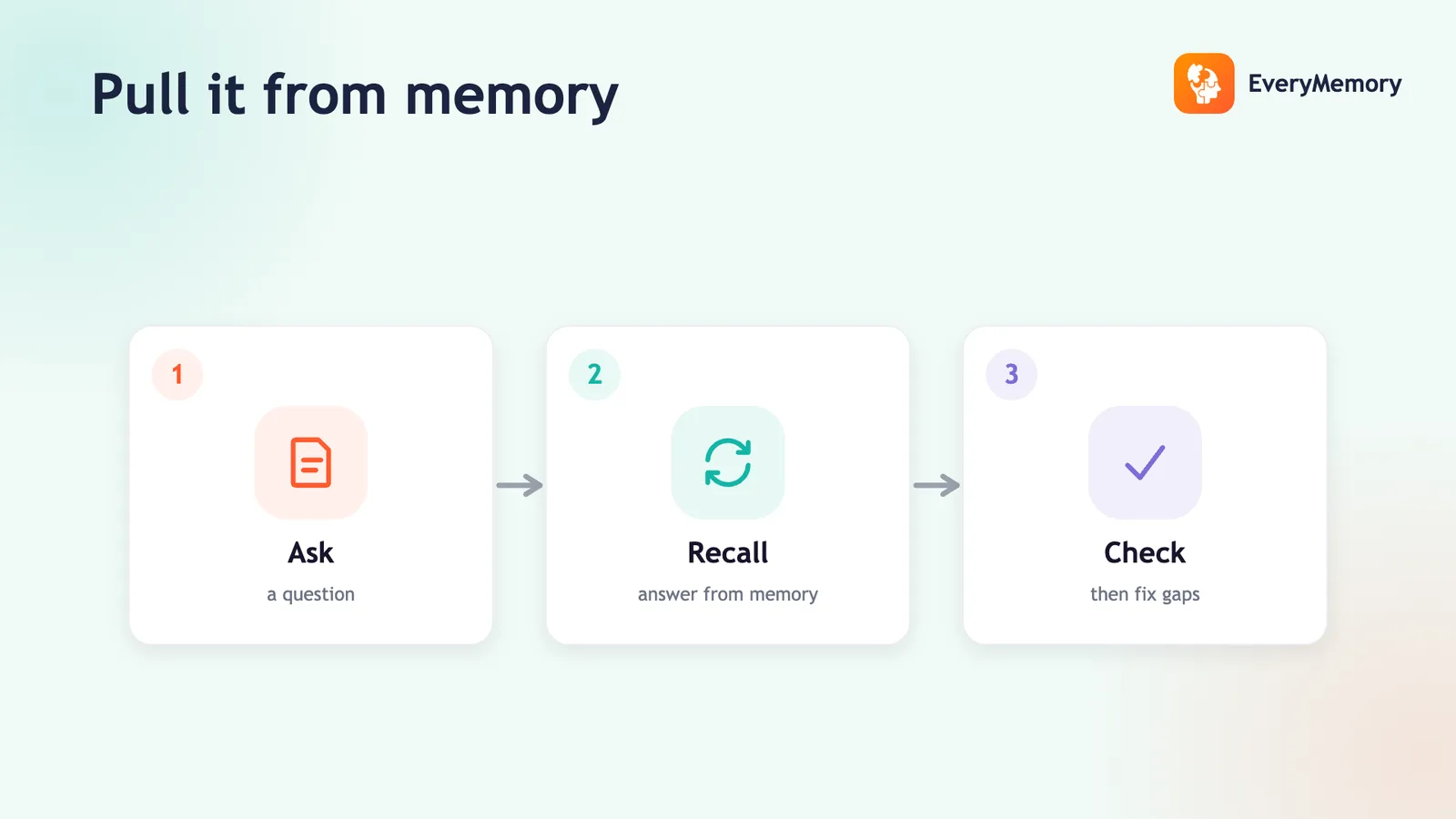
Active recall - retrieving information from memory rather than re-reading it - is the mechanism by which both spaced repetition and interleaving actually work. When you practice retrieval in an interleaved format, you get the discrimination benefit (selecting the right approach) on top of the retrieval benefit (strengthening the memory trace). A practical combination: after reading a chapter or completing a lesson, write down three to five key questions from different sections, then answer them in mixed order without looking back. That small ritual is interleaved active recall, and it costs less time than re-reading while delivering more durable retention. For a broader framework on combining these tools, see how to study effectively.
Practical Tips for Building Interleaved Sessions
The simplest way to start is to audit your current practice and ask: am I finishing all of one type before moving to the next? If yes, experiment with splitting each block in half and alternating. For a one-hour study session covering three topics, instead of twenty minutes on each, try switching at the completion of each individual problem or question rather than on a timer. Problem-by-problem interleaving tends to outperform block-by-block interleaving in the research, though any mixing is better than none.
Keep a simple log for four weeks. Note what you practiced, in what order, and then - critically - test yourself a week later. The delayed test is the only honest measure; your in-session feeling of fluency is a poor guide. Many learners who try interleaving for the first time feel so uncomfortable that they abandon it after one session, attributing the difficulty to the method rather than recognising it as the mechanism. Knowing in advance that it will feel harder, and that the feeling is the point, is the single most important mindset shift. Understanding why cramming fails gives useful context for why delayed testing matters.
- Mix within domains, not across them. Interleave problem types within mathematics, or grammar rules within one language - not mathematics with history.
- Use natural break points, not timers. Finish one problem or card, then switch topics. Timers mid-problem break concentration without adding discrimination benefit.
- Let the session feel hard. If it feels smooth and easy, you are probably in blocked mode. Mild friction is the signal that retrieval and discrimination are active.
- Test a week later. Rate your retention on the delayed test, not your fluency during the session.
- Start small. Interleave just two topics in your next session before expanding to three or four.
✅ Try this today - Restructure One Practice Session From Blocked to Interleaved
Pick a subject you are currently studying that has at least two or three distinct subtopics or problem types. You will need roughly forty-five minutes and a way to write or type your answers.
- List your subtopics and write two or three practice questions or problems for each. If you study maths, pick two or three formula types; if you study a language, pick two or three grammar patterns; if you study history, pick two or three eras or themes. You should end up with six to nine questions total.
- Shuffle the questions so no two consecutive questions are from the same subtopic - a simple card shuffle or random reorder works fine. Work through them in that order, answering each from memory before checking. Note which ones you had to retrieve with effort versus which felt automatic.
- One week later, without reviewing in between, write out the answers to the same questions from memory and compare your accuracy to your in-session performance. Most people find their delayed score is higher than they expected, and noticeably higher than they would have scored after a blocked session of the same length.
⚠ When to talk to a professional
This article describes non-medical study and practice techniques for general wellness; it is not a substitute for professional educational or psychological advice.