 EveryMemory
Journaling for a Clearer Mind and Better Memory
Writing things down does more than create a record - it actively frees up mental space, eases the pull of unfinished thoughts, and strengthens the way experiences are stored. A practical guide to journaling formats that genuinely work.
Part of the guide: How to Improve Your Memory: The Complete Beginner's Guide →
⚡ Quick answer
Journaling helps the mind in two complementary ways: offloading unfinished thoughts and worries onto the page frees up working memory so you can focus and absorb new information more easily; and writing about experiences deepens the way they are encoded, making them easier to recall later. Even five minutes a day, done consistently, produces a noticeable difference in mental clarity.
There is a particular kind of mental fog that builds across a busy day - not tiredness exactly, but a sense of too many open tabs. A reply you have not sent. A name you should follow up. A worry you have not quite resolved. These unfinished loops quietly consume mental bandwidth, crowding out the attention you want to give to what is right in front of you. Writing them down, even in the briefest form, has a way of clearing the air almost immediately.
The reason is not magic. When the brain registers that something has been captured in a reliable external place, it can release the low-level background effort of holding it in mind. That freed-up space in working memory makes it easier to focus, to think, and to retain new information. At the same time, the act of writing about an experience - what happened, how it felt, what it meant - deepens the way that experience is encoded and stored, which is why a well-kept journal can feel like a second memory you can actually search.
This article is a practical, evidence-informed guide to journaling for mental clarity and memory wellness. It covers five formats with concrete prompts and a five-minute evening routine you can start tonight. Journaling is framed here as a general wellness and reflection practice, not a clinical tool. If you are experiencing persistent low mood, anxiety, trauma responses, or any concern about your mental health, a qualified professional is the right support - no amount of journaling substitutes for that.
The Zeigarnik pull: why unfinished thoughts drain your mental energy
In the 1920s, psychologist Bluma Zeigarnik observed that people remember interrupted or incomplete tasks far better than completed ones. The brain, it turns out, keeps a background process running for anything it considers unfinished - a mental sticky note that stays active until the task is either done or delegated to a reliable system. This is sometimes called the Zeigarnik effect, and it explains why the half-composed email, the unresolved disagreement, or the appointment you keep meaning to book can occupy your thoughts so persistently even when you are trying to do something else entirely.
A journal entry acts as that reliable system. When you write a worry, a task, or an unresolved thought onto the page, you are effectively signalling to your brain that it no longer needs to maintain the background alert. Research by psychologist E. J. Masicampo and Roy Baumeister demonstrated this directly: people who made a specific plan for an unfinished task - even a brief written one - showed significantly less intrusive thinking about it afterwards. The writing does not have to solve the problem; it just has to capture it clearly enough that the brain trusts the record.
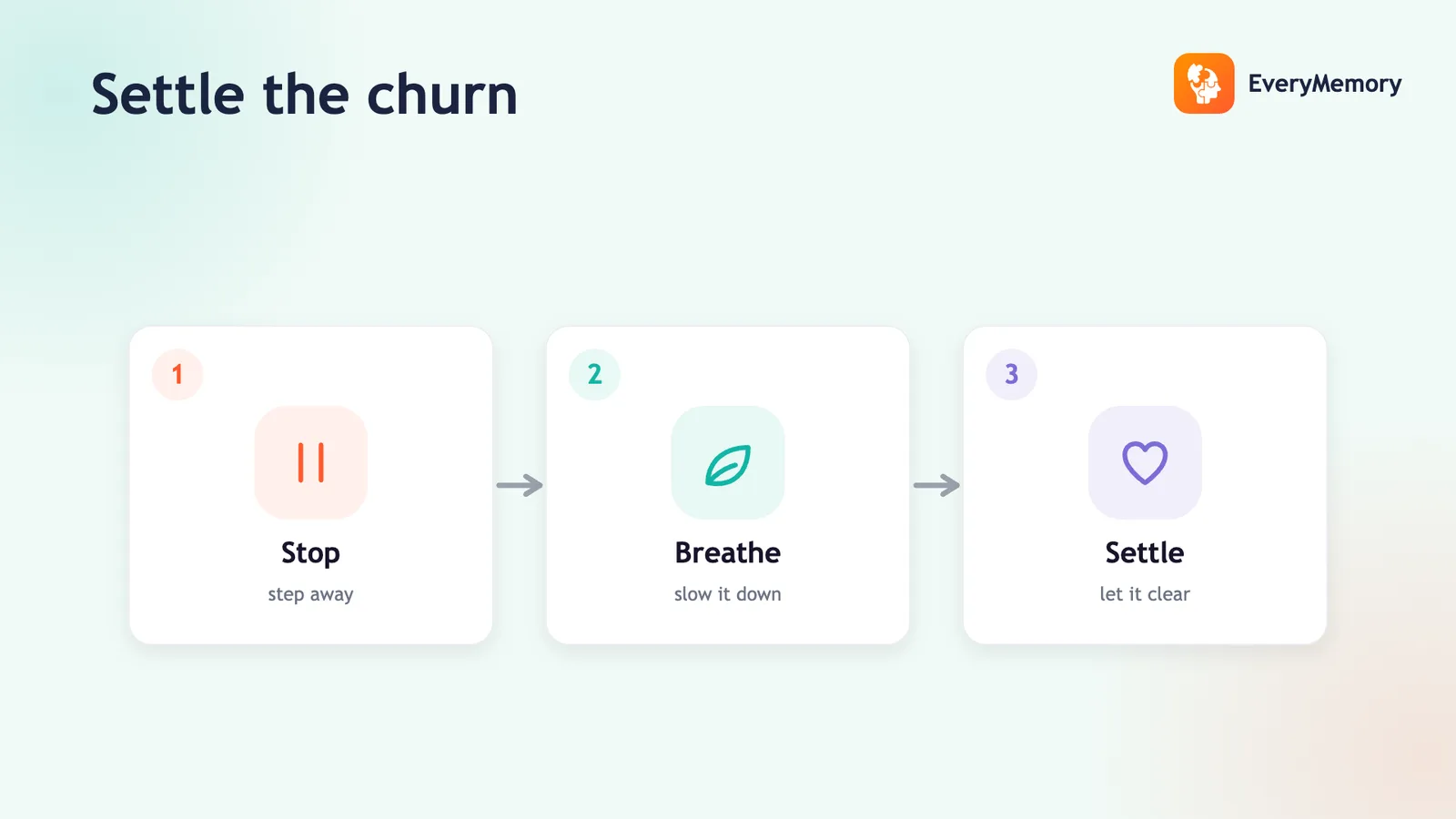
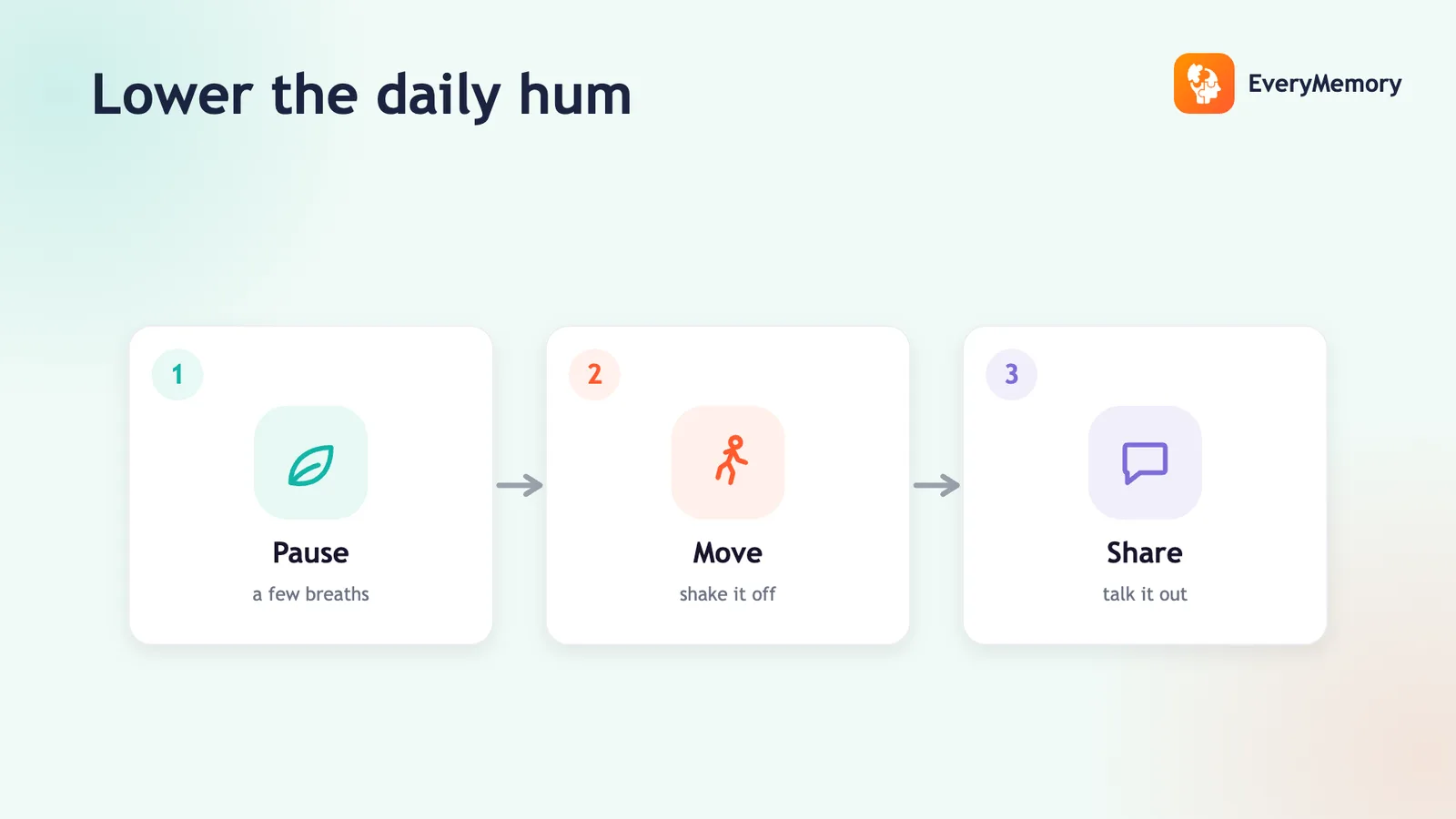
This is why a simple brain-dump before bed can be one of the most effective things you do for sleep quality and next-day mental clarity. Clearing the mind before rest is one of the most direct levers you have on how well you function the following day, and lowering the background hum of mental stress through capture and offloading is a key part of that.
How writing strengthens memory and creates an external record
Writing about an experience is not just a way to remember it later - it actively changes how well it is encoded in the first place. The process of translating an event into words requires you to select, organise, and sequence details, a form of effortful elaboration that is one of the most reliable ways to move information from short-term into longer-term memory. This is a different mechanism from the Zeigarnik offloading above: here the writing is doing encoding work, not clearing work.
Psychologist James Pennebaker, whose research on expressive writing spans more than four decades, found that writing about significant experiences - including difficult ones - is associated with a range of wellbeing outcomes. His work is often cited in clinical contexts, but his core insight has a more everyday application: when you write about what happened and what it meant to you, you are processing the experience more deeply than passive recall alone allows. That processing leaves a stronger, more organised memory trace.
A journal also becomes a searchable external record of autobiographical memory - the story of your own life. Rereading entries from months or years ago surfaces experiences that would otherwise have faded entirely. Systematic capture habits like this extend your effective memory well beyond what unaided biological recall can hold, without requiring any special technology.
Five journaling formats and when to use each
1. Brain-dump or worry list. Write every open loop, task, or worry on the page without editing or organising. The goal is completeness, not elegance. Do this at the end of the day or before bed. It is particularly effective for people who lie awake running mental lists, because the page becomes the list-holder and the mind can let go. It connects directly to why good sleep consolidates memory - a calmer mind at bedtime means the overnight consolidation process is less interrupted.
2. Gratitude journaling. Write two or three specific things you noticed or appreciated during the day. Specificity matters far more than length - "the way the afternoon light came through the kitchen window" lands differently in memory than "had a good day". Research on gratitude practices suggests they shift attentional habits over time, gradually making the mind more likely to notice and encode positive events as they happen.
3. One line a day. A single sentence capturing the most memorable moment or feeling from the day. This format has almost no barrier to entry and is the easiest to sustain over months and years. The constraint of one line also forces a useful decision: what actually mattered today? That selection process is itself a form of memory consolidation.
4. Reflective journaling with prompts. A slightly longer entry, usually ten to fifteen minutes, guided by a question. Prompts to try: What is one thing I learned or noticed today that I want to hold onto? Or: What felt difficult, and what might I do differently? Or: What am I still holding from this week that I need to put down? Reflective journaling is where deeper processing happens most naturally - give yourself permission to follow the thought wherever it leads.
5. Notes and memory journal. A dedicated section or notebook where you record things you specifically want to remember: a book recommendation, a name from a conversation, a phrase that struck you, a recipe, the name of the restaurant. This functions as a personal external memory and is worth reviewing occasionally to surface what has drifted out of active recall.
Making it stick: the habits that matter more than the format
The most effective journaling practice is the one that happens consistently, which means the biggest design question is how to reduce friction to near zero. Paper or app both work fine - the key variable is not the medium but the same-time, same-place pairing that makes the habit automatic. Linking journaling to an existing anchor - after the last cup of tea, before turning off the bedside lamp, immediately after the school run - is far more reliable than scheduling it as a standalone event.
Length and grammar are completely irrelevant. Three sentences and a few bullet points, written quickly and imperfectly, will outperform a beautifully structured two-page entry that only happens occasionally. The brain cares about regularity of practice, not literary quality. Give yourself explicit permission to write badly, incompletely, and without editing. The value is in the doing, not the product.
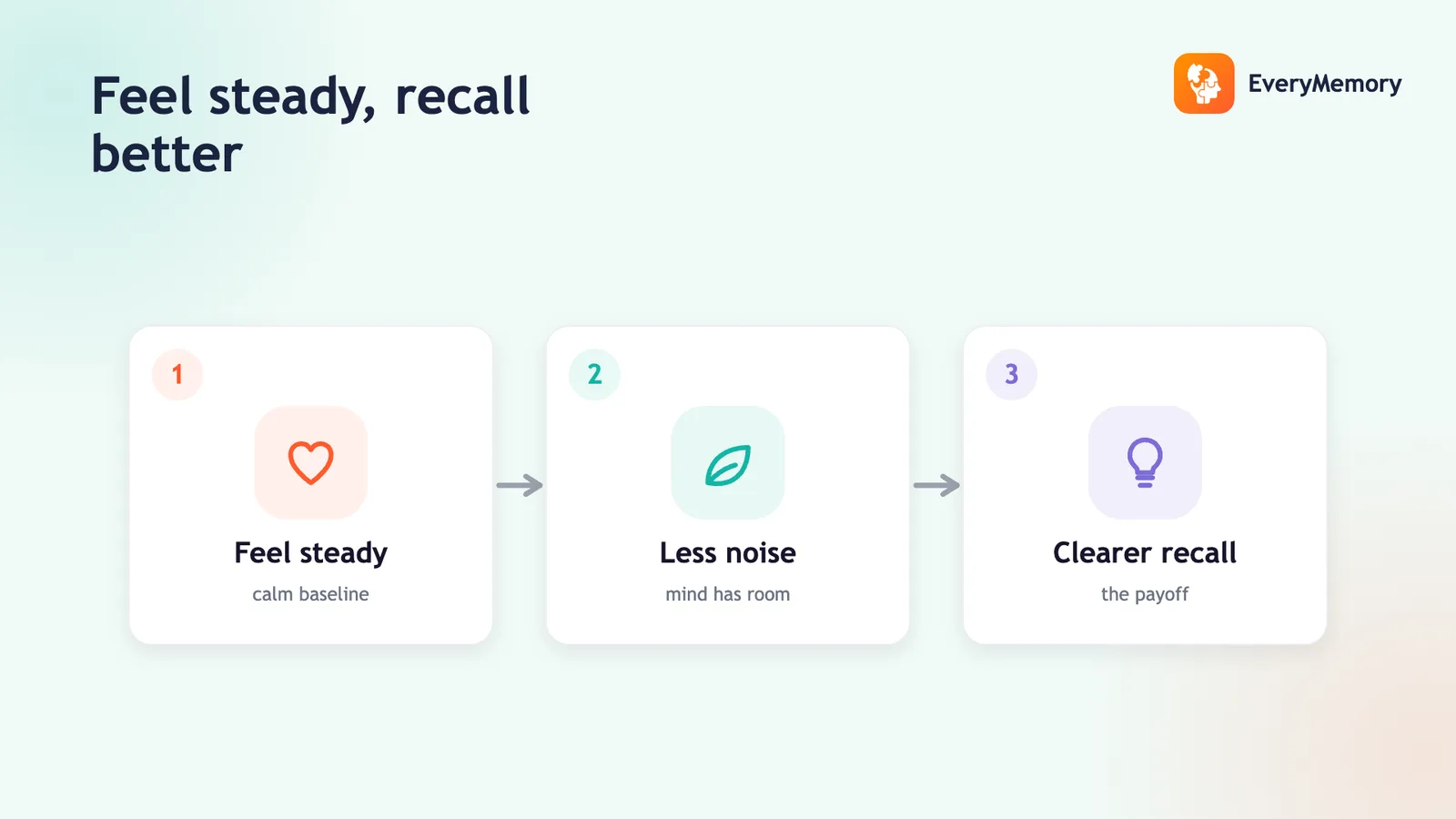
Start smaller than you think you need to. Five minutes is genuinely enough to capture a brain-dump, write a one-liner, or answer a single prompt. The common trap is setting an ambitious journaling goal on day one, missing two days in a row, and abandoning the practice entirely. A tiny consistent habit beats an aspirational inconsistent one every time. Emotional steadiness and memory are closely linked - and the regularity of a small daily practice does more for both than occasional intense sessions.
A worked example: four prompts for one evening entry
Here is what a five-minute reflective entry might look like in practice. You do not need to answer all four prompts every night - pick one or two and move on.
- What is one thing I want to remember from today? (A specific moment, conversation, or observation - as concrete as possible.)
- What open loops am I carrying? (Tasks, worries, or things left unresolved - write them out so the page holds them.)
- What drained me, and what restored me? (A two-line inventory of where your energy went. Useful for spotting patterns over weeks.)
- What am I looking forward to, or what do I want to approach differently tomorrow? (Brief and specific - one sentence is enough.)
A concrete example. "Today: had a surprisingly good conversation with my colleague about the project direction - want to remember the idea she had about sequencing the steps differently. Open loops: still need to call the dentist, and I said I would send that link to Maria. Drained by the 4pm meeting that went nowhere; restored by the walk home. Tomorrow: I want to slow down in the morning instead of checking the phone immediately." That entry took under five minutes and has done real capture work: a memory worth encoding, tasks offloaded from working memory, and a brief emotional inventory. That is the full mechanism in action.
✅ Try this today - A 5-minute end-of-day journaling routine
Set a five-minute timer just before bed or after dinner. Open your journal - paper, notes app, or a dedicated app - and work through these three steps without editing yourself.
- Write your open loops first: two or three tasks, worries, or unfinished thoughts that are still occupying mental space. Once they are on the page, they no longer need to be held in your head overnight.
- Write one thing you want to remember from the day - a moment, a name, a detail, an idea. Be as specific as you can. Specificity is what makes the memory stick.
- Answer one closing prompt: either "What am I putting down for tonight?" (to ease mental load before sleep) or "What do I want to carry forward?" (to set intention for tomorrow). One sentence is enough.
⚠ When to talk to a professional
Journaling is a general wellness and reflection practice - if you are experiencing persistent low mood, anxiety, intrusive thoughts, or the effects of trauma, please seek support from a qualified mental health professional.