 EveryMemory
Short-Term Memory Exercise for Beginners
Gentle working-memory drills for beginners - simple, screen-free exercises that build recall confidence from the ground up with clear starting points and easy progressions.
Part of the guide: Brain Exercises for Seniors: The Complete Guide →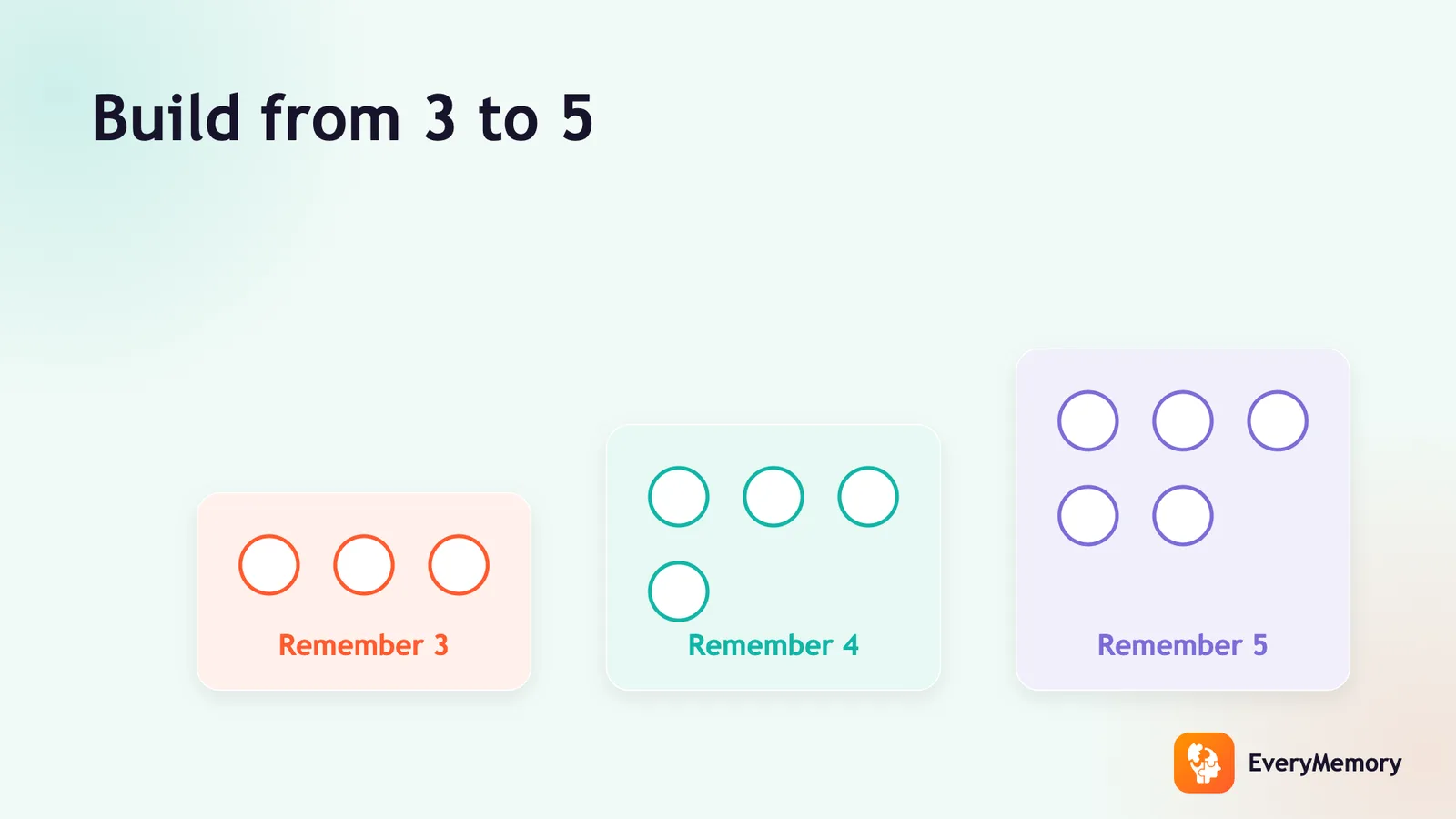
⚡ Quick answer
Short-term memory exercises for beginners involve holding a small amount of information in mind for a brief period, then using or recalling it. Starting with very short lists, brief study times, and immediate recall builds the basic encoding and retrieval habits before adding difficulty. Even very modest starting drills produce real improvements in working memory with consistent practice.
Key takeaways
- Beginner drills start with as few as three items and a sixty-second delay - genuinely simple starting points produce real improvements, not just warm-ups.
- Working memory responds to practice at any age, so starting in your sixties, seventies, or beyond is not too late.
- Aiming to succeed on roughly seventy to eighty percent of items produces the best learning - below that is too easy, above it causes overload.
- Writing down list length and score after each session makes fast early progress visible, which is one of the most effective motivators to keep going.
Starting memory exercises feels straightforward - until you try a drill that is clearly designed for someone who has been practising for months. The items are too many, the pace is too fast, and within a few attempts frustration replaces motivation. That is not a sign that memory training does not work. It is a sign that the starting point was wrong.
This guide is designed specifically for beginners. Every drill here starts small and simple - genuinely simple, not just labelled that way. You will find out what short-term and working memory actually are, why these gentle starting exercises are effective and not just "easy versions" of real training, and exactly how to progress from here at your own pace.
Short-term vs. working memory - a quick, practical distinction
Short-term memory is the temporary holding area for information you have just encountered - roughly the last few seconds to a minute. Working memory is slightly different: it is short-term memory in active use, while you are also doing something with the information. Remembering a phone number long enough to dial it is short-term memory. Remembering the number while also looking up the area code is working memory.
Most everyday memory difficulties involve working memory: holding a thought while doing something else, following multi-step instructions, or keeping track of where you were in a task after an interruption. If you have read our article on short-term memory problems, you will recognise these as the most common and most frustrating daily complaints.
The good news is that both short-term and working memory respond well to deliberate practice. The exercises in this guide train both.
Why gentle drills are genuinely effective
A common misconception is that easy exercises are a warm-up for real training, not training itself. In fact, the mechanisms at work in a very simple drill are the same as in a complex one: you are encoding, maintaining, and retrieving information. The difference is only in the load. For someone new to deliberate memory practice, a low-load drill is exactly the right level of challenge.
Working at a level where you succeed roughly 70 to 80 percent of the time produces the best learning. Below that, you are not stretching the system. Above it, frustration and cognitive overload reduce the quality of encoding. Simple drills are not lesser - they are calibrated for exactly where you are starting from.
Five beginner drills to start this week
Each drill below takes two to four minutes. Do one or two per session, three to four times a week. None require any materials beyond a pen and paper.
- 3-item list recall. Write three unrelated words (apple, lamp, river). Read them once, put the paper face down, wait 60 seconds, then write them from memory. When you can do this reliably, extend to 4 items, then 5.
- Room scan recall. Sit in a familiar room and pick a corner. Study it for 30 seconds, then close your eyes and list everything you remember seeing - out loud or on paper. Check, note what you missed, and try the same corner tomorrow.
- Delayed word retrieval. Before you start a task (making tea, getting dressed), say one word out loud that you will try to recall when you finish. When the task is done, recall the word. This mimics real working-memory demands in a low-pressure way.
- Number span practice. Have a helper read a string of three digits slowly (or write and cover them yourself). Repeat them back immediately. If correct, move to four digits. This directly trains digit span - the same skill used to hold a PIN or phone number.
- Grocery list recall. Before your next shopping trip, study five items from your list for 60 seconds, then put it in your pocket. In the shop, recall the five before checking. This converts a real-life task into a practice opportunity.
Easier and harder variations for each drill
If any drill above still feels overwhelming, here are reliable ways to reduce the load without abandoning the exercise entirely. If the standard version feels too easy after two weeks, here is how to progress.
- Easier: reduce lists to 2 items; allow yourself to glance at the paper once during the delay; use familiar category words (colours, fruits) rather than random words.
- Easier: for number span, start with 2 digits and use only numbers 1 to 5 to reduce interference.
- Harder: extend the delay period (from 60 seconds to 3 minutes, then 10 minutes).
- Harder: add a mild distraction task during the delay - count backwards from 20, or describe the room you are in.
- Harder: increase list length by one item every time you achieve 80 percent accuracy across three sessions.
Progressing too fast is a common beginner mistake. If you are getting fewer than half the items right, it is a signal to step back, not push harder. The goal at this stage is to build confidence and the encoding habit, not to max out difficulty.
Tracking progress and keeping the habit
For beginners especially, tracking is motivating. When you start from a genuinely simple baseline, progress is fast - and you will miss it entirely if you do not measure it. Write down your list length and accuracy after every session. After two weeks, look back at week one. The improvement is often larger than you expect.
Use the printable memory tracker for older adults to log this simply. A single row per session (date, drill, items attempted, items correct) is all you need.
For habit-building, the most effective strategy is pairing the drill with something you already do reliably - morning coffee, lunch, or the few minutes before an evening activity. Our guide on how to build a memory training habit walks through exactly how to set this up so it becomes automatic rather than a daily decision.
Once you are regularly scoring above 80 percent on your chosen list length, the daily brain training routine is a natural next step, as is the 7-day memory training plan for beginners.
✅ Try this today - Start with the 3-item recall drill
This takes less than 3 minutes and gives you an immediate baseline:
- Write three unrelated words on a piece of paper - for example: candle, bridge, sparrow.
- Read them once, turn the paper over, and set a timer for 90 seconds. Do something else during that time - make a cup of tea, look out the window.
- When the timer rings, write the three words from memory. Check your paper and note your score. That is your Day 1 baseline. Repeat tomorrow with three new words.


