 EveryMemory
How to Remember What People Tell You
Forgetting what someone just told you is not a memory problem - it is usually an attention problem. Here is how to actually capture and keep what people say.
Part of the guide: How to Improve Your Memory: The Complete Beginner's Guide →
⚡ Quick answer
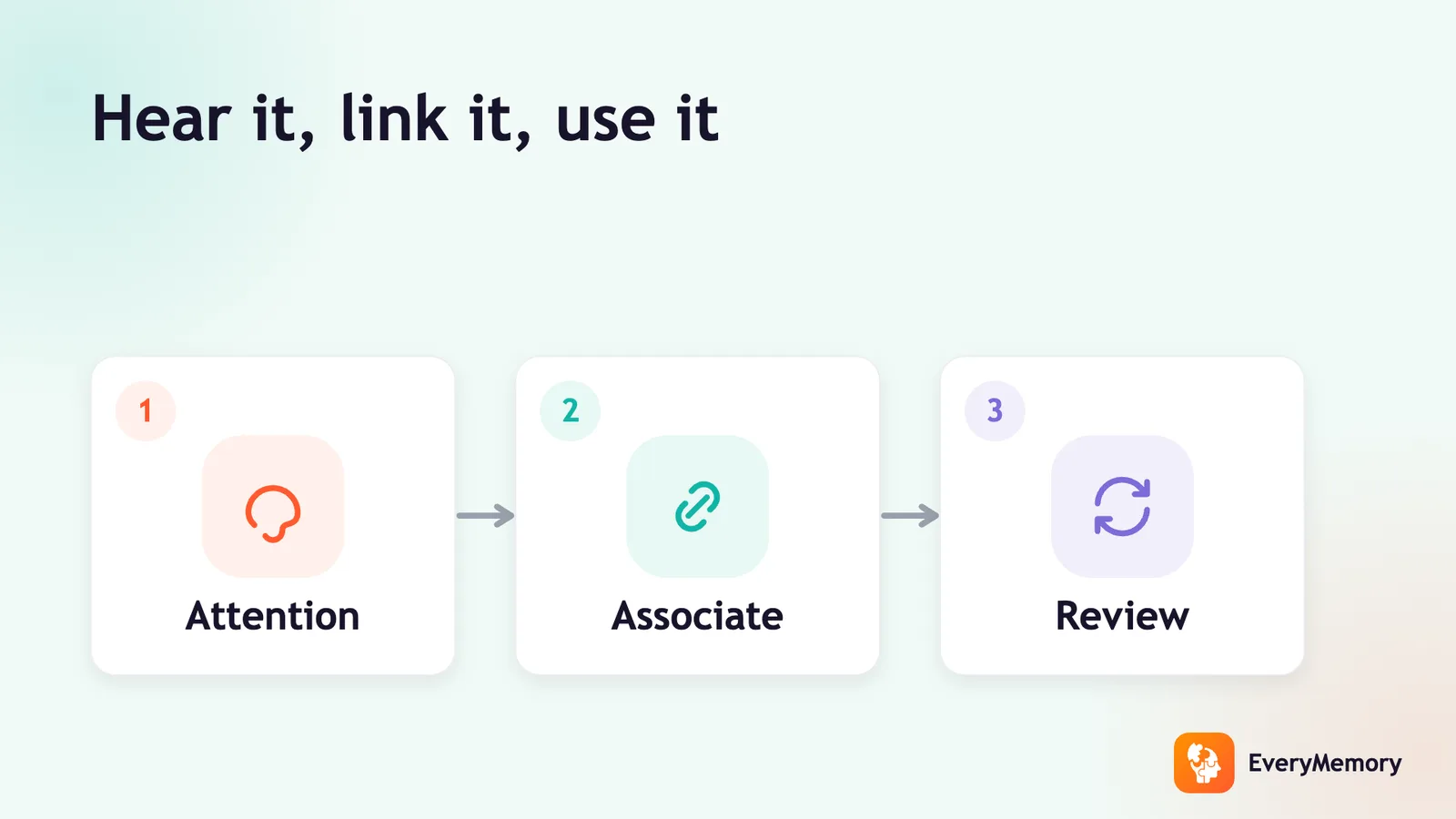
The most reliable way to remember what people tell you is to give your full attention when they are speaking, no phone, no rehearsing your reply, then briefly repeat the key point back, link it to something you already know, and recall the gist within a minute of the conversation ending. Each of these steps gives the information a much stronger chance of sticking.
You leave a conversation and cannot remember the key detail someone just shared. Maybe it was a request from your manager, an address a friend gave you, or something important a family member said they needed. The information went in one ear and out the other, and you are left piecing it back together from fragments.
The frustrating truth is that this rarely has anything to do with your memory being "bad." In most cases, the information simply never got encoded properly in the first place. You were present in body but not fully in mind, planning your next sentence, glancing at your phone, or half-thinking about something else entirely.
The good news is that remembering what people tell you is a learnable skill. It is built from a handful of habits you can start practising in your very next conversation. This guide walks through each one, from the moment someone starts speaking all the way to a quick review afterwards.
Why you forget: it was never properly encoded
Memory works in stages. Information has to enter your awareness, get held briefly in working memory, and then be processed deeply enough to transfer into longer-term storage. If any of those steps is interrupted, the information simply does not stick, no matter how sharp your memory is in other situations.
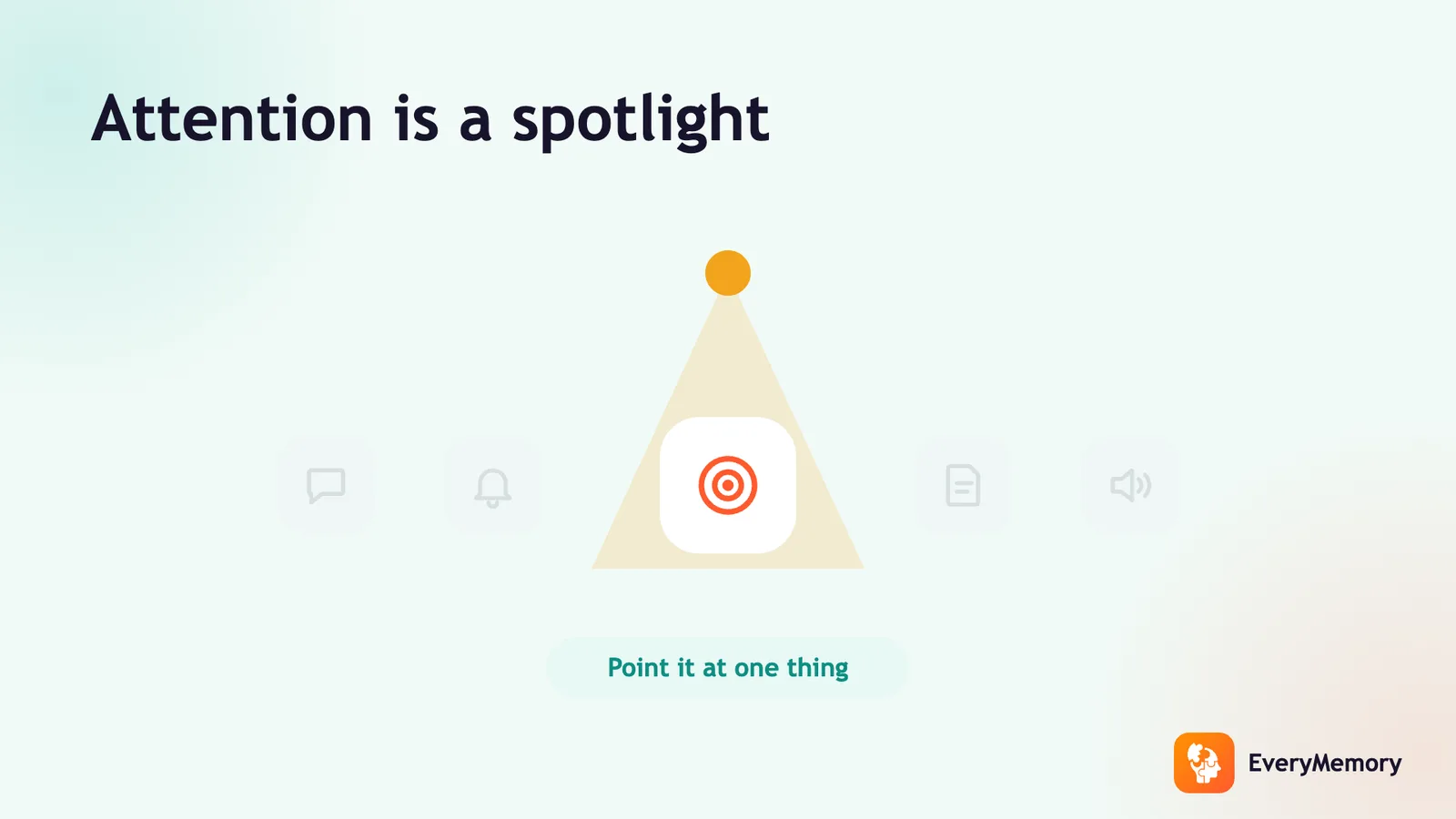
The most common culprit is divided attention. How attention works matters here: the brain has a limited capacity for conscious processing, and when that capacity is split, between a conversation and a nearby screen, or between listening and mentally drafting your reply, less of what the other person says gets encoded at all.
Research on multitasking and memory consistently shows that trying to do two things at once degrades recall for both. If part of your mind is somewhere else while someone is talking, you are not dividing your attention equally, you are reducing the quality of both tasks. The conversation is almost always the one that loses.
Active listening: the foundation everything else rests on
Before any technique can help, you need to actually be present. Active listening sounds simple but it asks something real of you: put the phone face-down or out of reach, turn your body toward the person, and make a conscious choice to hear what they are saying rather than preparing what you will say next.
That last part, resisting the urge to rehearse your response, is where most people slip up. The moment your inner voice starts composing your next sentence, you stop processing incoming words. You catch the gist but miss the details, and details are exactly what you will need later.
A useful cue: tell yourself you are going to summarise what the person says before you respond. That small commitment keeps your attention anchored to their words, because you know you will need to reproduce them. It also tends to make you a noticeably better conversationalist, which people remember too.
In-the-moment techniques that lock information in
Active listening opens the door; these techniques push the information through it. The simplest is a brief verbal repeat: when someone gives you a number, a name, or an instruction, say it back immediately. "So that is Tuesday at three, at the city-centre office" does two things at once, it confirms you heard correctly, and the act of saying it aloud creates a second encoding pass.
Asking a clarifying question serves a similar function. It forces you to process what was just said well enough to form a question about it, which deepens encoding. Even something like "Can you tell me a bit more about what you need?" keeps your attention fully engaged and fills in the gaps that shallow listening leaves behind.
Mental imagery is one of the most powerful in-the-moment tools. If someone tells you they need the report by Friday morning, picture yourself at your desk on Friday morning, the file open, sending it off. The more concrete and personal the image, the stronger the memory trace. Linking new information to something you already know through association works on the same principle, the new detail hooks onto an existing memory and becomes far easier to retrieve.
Making it stick: the minute right after
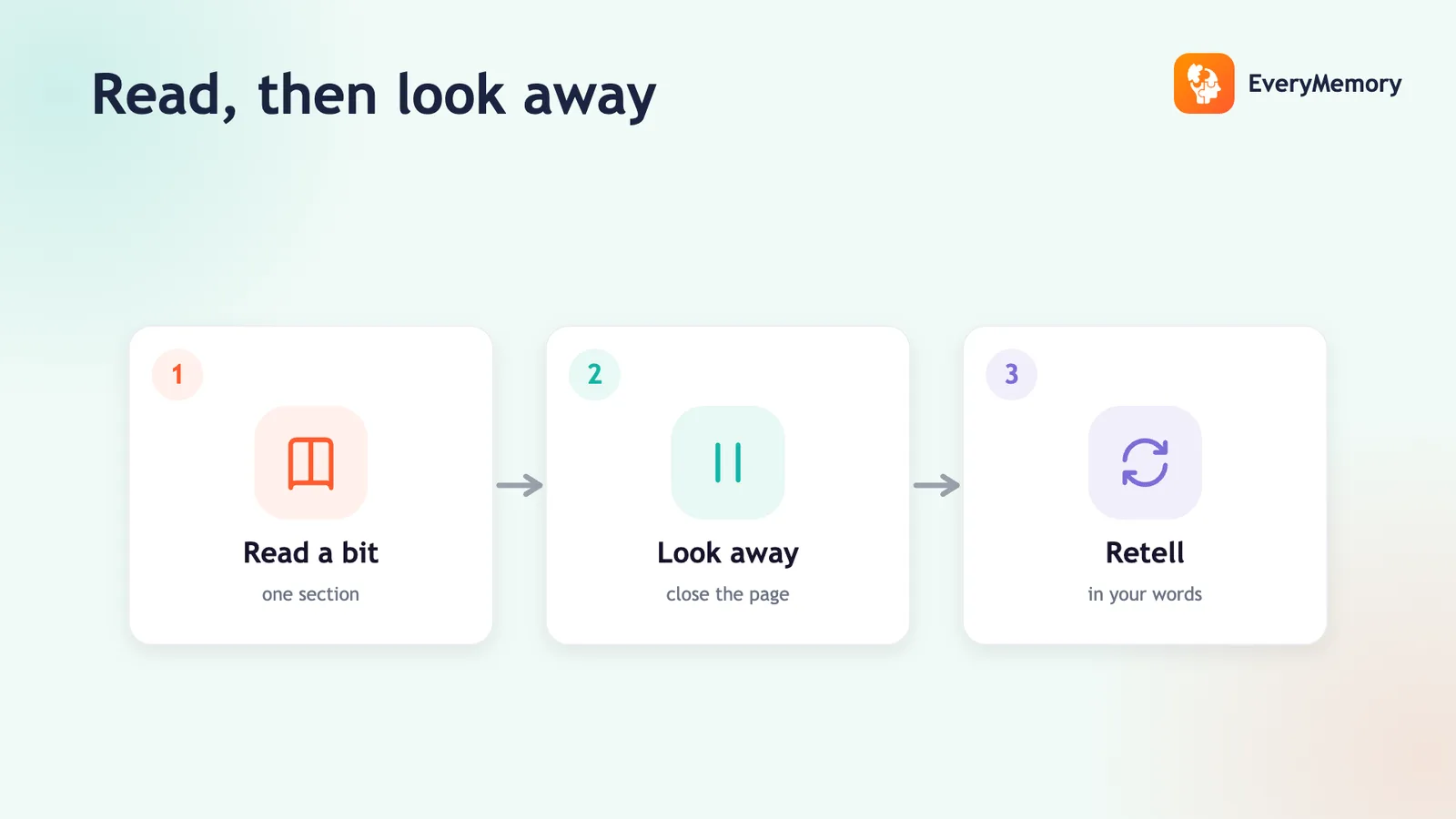
The conversation has just ended and you have a narrow window. Within about a minute, mentally replay the key points, not word for word, but the essential gist. What did they need? What did you agree to? What was the one thing you most want to hold on to? This is the same principle behind active recall: retrieving information shortly after you encounter it dramatically increases how well it is retained.
If you can, jot a two-word note. Not a full transcript, just a quick anchor: "Tuesday 3pm", "blue folder", "call Sarah first." The act of writing fixes the information in a second modality, and the note itself becomes a safety net. You are not relying on the note to remember; you are using the act of writing to deepen the original memory.
For particularly important conversations, a detailed set of instructions, a significant personal disclosure, try a brief mental summary a few hours later as well. Ask yourself: what did that person tell me? Work to retrieve the answer rather than checking your note immediately. Each retrieval attempt strengthens the memory independently of how the original encoding went.
A note on names and personal details
Names deserve their own mention because they are among the hardest things to remember from a conversation, and among the most socially costly to forget. They tend to slip because they carry no inherent meaning; a name is an arbitrary sound attached to a face, which gives your brain little to grip onto.
The fix is the same principle applied specifically: use the name once or twice in the conversation itself ("Good to meet you, Marcus, how long have you been in this role?"), create a quick mental image linking the name to a feature of the person, or link it to someone you already know with the same name. There is much more detail on this in the guide to remembering names and faces, but the core idea is to give the name something to attach to rather than letting it float free.
The same logic applies to any personal detail someone shares, where they live, their children's names, what they mentioned worrying about last time you spoke. When you visibly remember those things, people feel heard. That is what good conversational memory ultimately delivers: not just practical accuracy, but genuine connection.
✅ Try this today - Listen, Reflect, Recall - a 3-step practice for your next conversation
Choose one important conversation today, a meeting, a phone call, or a catch-up with a friend, and run through these three steps.
- Listen fully: put your phone away, do not rehearse your reply, and tell yourself you will summarise what the person says before you respond. Notice how much more you absorb when your whole attention is available.
- Reflect in the moment: before you reply, briefly restate the key point back, "so what you are saying is..." or simply ask one clarifying question. This creates a second encoding pass without interrupting the natural flow.
- Recall within a minute: as soon as the conversation ends, replay the main points in your head before you do anything else. Jot a two-word anchor if it was important. Do not look at notes first, retrieve, then check.
⚠ When to talk to a professional
This article is for general memory-wellness interest only and is not medical advice; if you are concerned about significant or sudden changes in your memory, please speak with a qualified healthcare professional.