 EveryMemory
Mind Mapping for Memory and Study
Mind mapping organises information the way your brain actually stores it - as a web of connected ideas, not a list. Here is how to build maps that make material stick.
Part of the guide: How to Improve Your Memory: The Complete Beginner's Guide →
⚡ Quick answer
A mind map places a central topic in the middle of a page, then radiates branches outward for each main idea, with sub-branches for details. You use short keywords (not sentences), colour, and simple icons. To lock information in memory, build the map once while studying, then close it and redraw it from scratch the next day.
Most notes are written as lists or flowing sentences that follow the order in which information was presented, not the order in which your brain naturally connects it. You transcribe a lecture point by point, close the notebook, and hours later find the material has not settled into anything coherent. The problem is not effort - it is format. Linear text forces a sequence onto ideas that your memory actually stores as a mesh of associations.
Mind mapping is a note-taking and thinking method that maps ideas outward from a central concept, exactly the way associative memory works. A finished map looks like a diagram with the core topic in the middle, main branches radiating outward for key themes, and sub-branches extending from those for supporting details. Because you see relationships spatially and add colour and small images alongside keywords, you engage more of your cognitive machinery than plain writing does.
This guide covers what a mind map is, why it fits memory well, how to build one that is genuinely useful rather than just decorative, and how to use redrawing from memory as a recall tool. There is also a concrete worked example - mind-mapping the causes of the First World War branch by branch - so the method stays practical and not abstract.
What a Mind Map Actually Is
A mind map is a diagram, not an outline. The central topic - a chapter title, a question, a project name - sits in the middle of the page, usually inside a shape or written in bold. From that centre, thick branches radiate outward, one for each major theme or category. Each branch carries a single keyword or short phrase, never a full sentence. From each main branch, thinner sub-branches extend with supporting detail, examples, or sub-topics. The whole structure fans out in every direction, filling the page organically rather than marching down it in rows.
Two elements separate a good map from a wall of text rearranged into bubbles. The first is hierarchy: branch thickness, font size, and distance from the centre all signal importance at a glance. The second is dual coding - pairing words with something visual. Colour each main branch differently. Add a tiny icon where it helps: a clock on a timeline branch, a coin on an economics branch, a person silhouette on a branch about leadership. You do not need artistic skill; a rough sketch activates visual memory in ways that text alone cannot.
Why Mind Mapping Suits How Memory Works
Memory is associative. When you recall one fact, related facts become more accessible because they are stored in overlapping neural networks, not in separate filing cabinets. A linear list fights that structure by presenting isolated items in a fixed sequence. A mind map works with it: every branch is already connected to the centre and to its neighbours, so retrieving one node primes the others around it.
Mind mapping also recruits multiple cognitive channels at once. You process the words semantically, the spatial layout (which idea is near which), and the colour and imagery visually. Research on dual coding - documented in depth on our mnemonics overview - shows that pairing verbal and visual encoding strengthens retrieval compared to either channel alone. A map does this automatically.
Perhaps most importantly, building a map forces active organisation. To place a fact on a branch, you must decide what category it belongs to and how it relates to adjacent facts. That decision-making is the cognitive work that drives encoding. Passive re-reading leaves that work undone. Actively processing what you read - deciding, connecting, ranking - is what converts reading into memory, and mapping makes that active processing unavoidable.
How to Build a Map That Actually Works
Start with a blank, unlined page turned landscape. Write the central topic in the middle and circle it. Landscape orientation matters: it gives more horizontal space for branches and signals to your brain that this is not an ordinary page of notes.
Generate your main branches first before adding any detail. Think of them as chapter headings or major categories. Draw a thick curved line from the centre outward for each one and write a single keyword on it. Five or six main branches is usually the right range - too few collapses the hierarchy, too many overwhelms the page. Choose a distinct colour for each main branch and use that colour for all its sub-branches too.
Add sub-branches one level at a time. Each sub-branch gets one keyword or a very short phrase - three words maximum. If you need more than three words to capture something, that is a signal to break the idea into two sub-branches. Once you have two or three levels of detail, look across the map for cross-connections: ideas on different branches that relate to each other. Draw a thin curved arrow between them. These cross-links are where a map becomes genuinely more useful than an outline - they surface relationships that linear notes hide.
- Start centre, work outward. Never start at a corner and work inward.
- One keyword per branch. Keywords trigger full thoughts; sentences crowd them out.
- Curve your lines. Straight lines feel mechanical and are harder to distinguish; curved ones are easier to track.
- Add a tiny icon per main branch. Even a simple sketch doubles recall of that branch.
- Cross-link after the main structure is done. Adding arrows mid-build interrupts the generative flow.
Concrete Uses: When to Reach for a Map
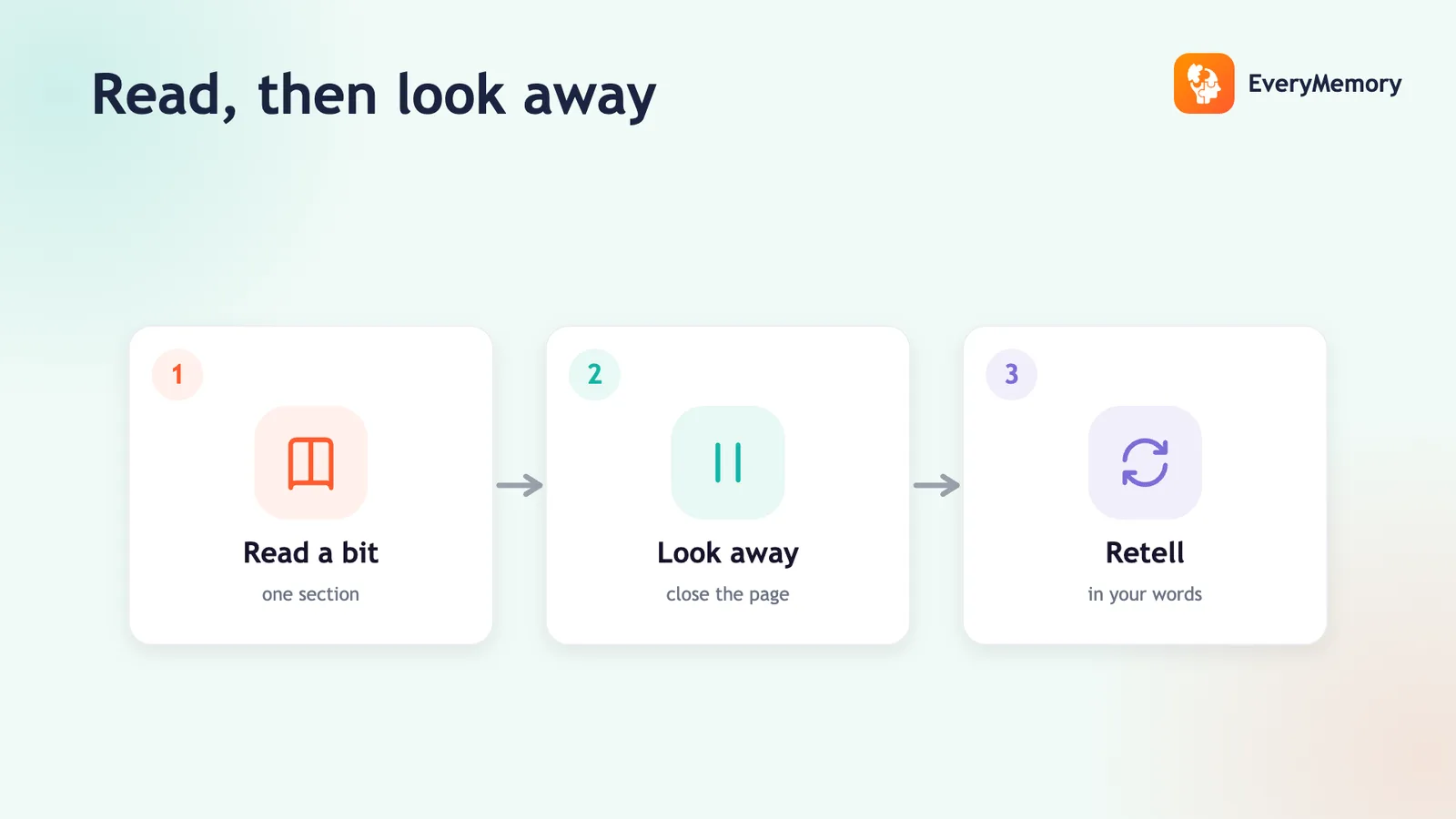
Summarising a chapter. Read the chapter once, close the book, and build the map from what you can recall. Then open the book and add only what you missed. This approach combines mapping with retrieval practice, which is one of the most effective study methods available - see the full breakdown in our guide on how to study effectively.
Planning an essay or talk. Put your argument or central message in the middle. Main branches become your sections. Sub-branches hold evidence, examples, and counter-arguments. The visual layout makes it immediately obvious if one section has three layers of evidence and another has none.
Brainstorming. Mind mapping with no hierarchy rules applied - just radiate every idea freely from the centre without judging. Sort and prune afterwards. The spatial layout helps you spot clusters and gaps faster than a list does.
Revising a topic before an exam. Build a map from memory first. Every blank spot on the map is a gap to close. Then compare with your source material and fill in what is missing. This is more diagnostic than re-reading because it shows you exactly where the gaps are.
Meeting or lecture notes. Draw the agenda topic in the centre before the meeting begins. As points arise, branch them outward. Because you are placing information into a structure rather than transcribing, you are forced to listen for meaning, not just words. Better note-taking consistently improves retention hours and days later, and real-time mapping is one of the faster ways to improve note quality.
Worked Example: The Causes of World War One
Here is how to build a map on a specific, moderately complex topic. Write Causes of WWI in the centre. Draw four main branches using four colours: MAIN (militarism), ALLIANCE (alliance systems), IMP (imperialism), NAT (nationalism) - the MAIN acronym is itself a mnemonic, covered in more depth in our article on using association to remember more.
From the red MILITARISM branch, add sub-branches: arms race, naval rivalry, conscription, war plans (with a tiny sub-branch for Schlieffen Plan). From the blue ALLIANCE branch: Triple Entente (sub-branches: France, Russia, Britain) and Triple Alliance (sub-branches: Germany, Austria-Hungary, Italy). From the green IMPERIALISM branch: colonial competition, Morocco crises, economic rivalry. From the orange NATIONALISM branch: pan-Slavism, Balkan tensions, assassination (sub-branch: Franz Ferdinand, 1914).
Now add cross-links. Draw a thin arrow from pan-Slavism (nationalism) to Austria-Hungary (alliances) because Austro-Hungarian suppression of Slav nationalism is what made the alliance system snap into motion after the assassination. Draw another from arms race (militarism) to colonial competition (imperialism) to show how the arms build-up and colonial scramble fed each other. Add a small explosion icon on the assassination sub-branch. The whole map fits on one landscape A4 sheet and shows, at a glance, both the four categories and the causal threads between them - something a three-page essay outline does not.
Honest Limits, Digital vs Paper, and Using Redrawing as Recall Practice
Mind mapping is not the right tool for everything. Step-by-step procedures - a recipe, a mathematical derivation, a legal process with mandatory sequence - are naturally linear, and forcing them onto a radial map obscures the order that matters most. Heavy verbatim text, such as legal definitions or exact quotations, also resists mapping because the precise wording cannot be reduced to a keyword without losing meaning. For those cases, use structured linear notes and reserve mapping for the conceptual architecture around them.
Messy maps lose their value quickly. A map where every branch has a slightly different colour logic, sub-branches drift off at inconsistent angles, and cross-links form a tangle is harder to read than a list. Legibility is not a cosmetic concern - a map you cannot parse at a glance does not trigger the fast associative recall it was built for. If a paper map grows messy, start a fresh one. Digital tools (Miro, XMind, Obsidian Canvas, even Keynote) make restructuring effortless and are better for collaborative maps or ones you will share. Paper is faster for first-draft thinking because there is no menu friction between thought and page; switch to digital when the map needs to be maintained over time.
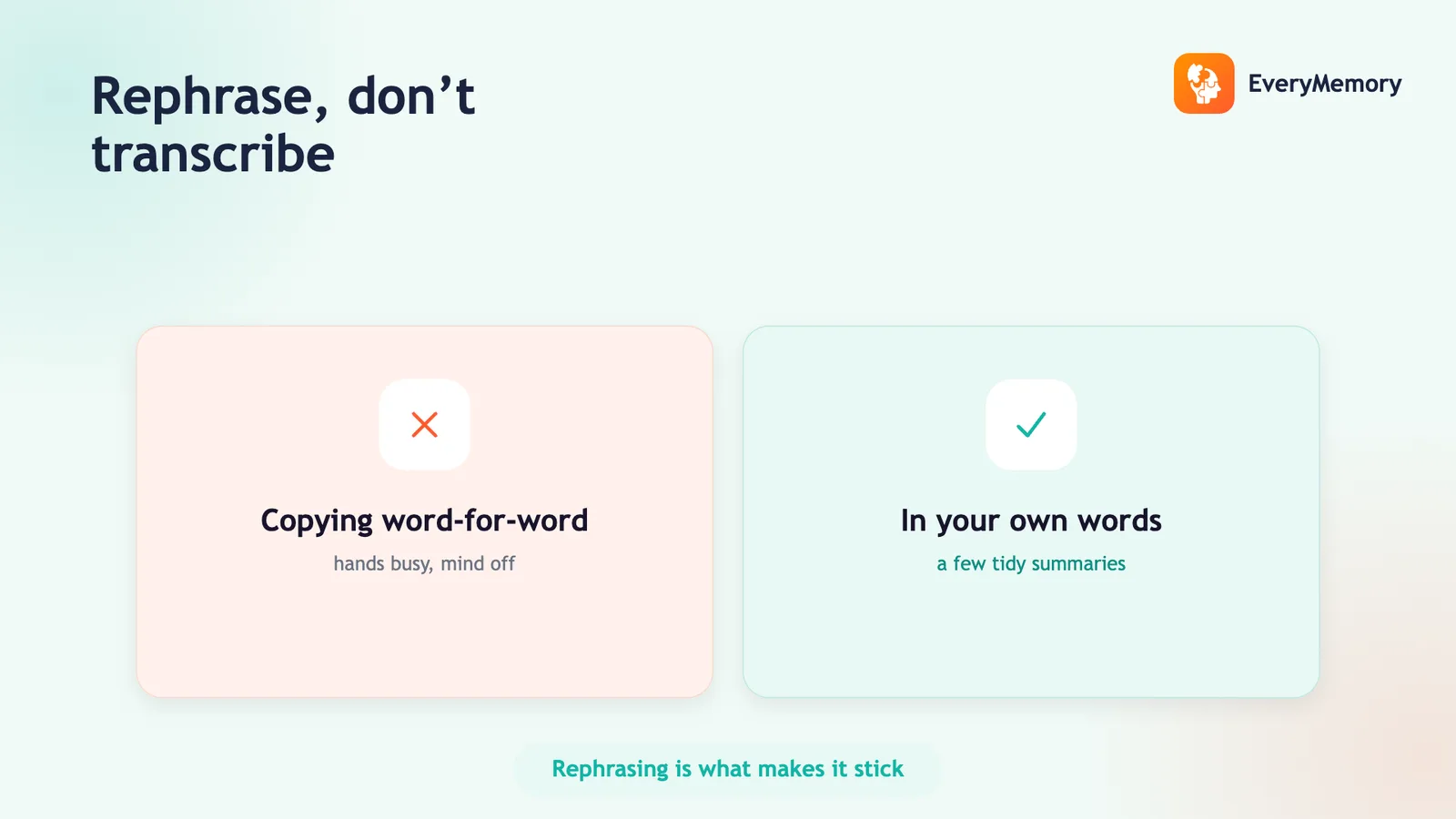
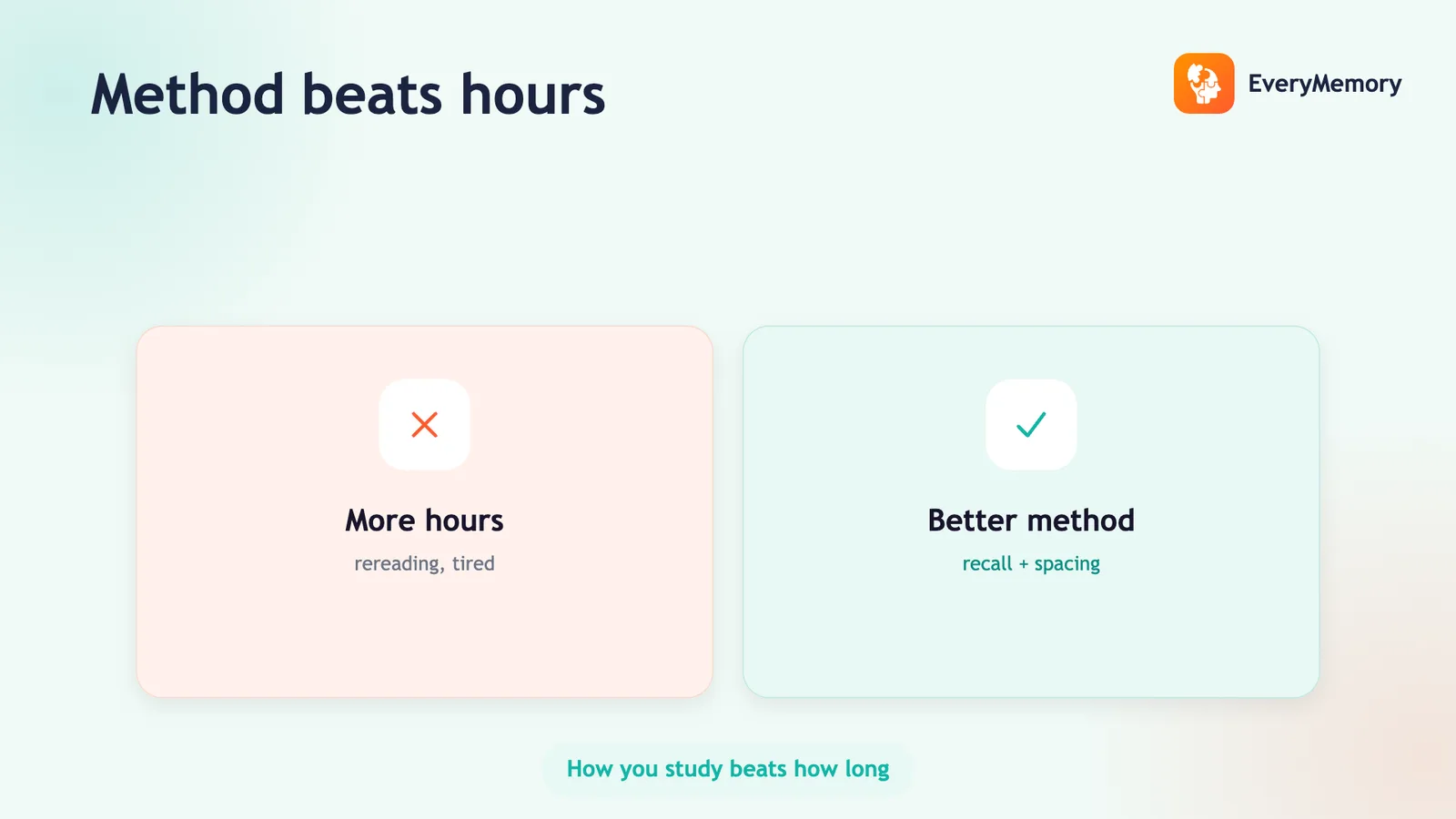
The highest-leverage use of any map is redrawing it from memory. After building your map, set it aside for at least a few hours or overnight. Then take a blank page and reconstruct the map entirely from recall - no peeking. Every branch you cannot reproduce marks a gap. Every connection you place correctly strengthens the underlying network. Compare your redrawn map with the original, note what is missing, and review only those sections. This single practice - build, wait, redraw - combines spaced repetition, retrieval practice, and elaborative encoding into a ten-minute habit that reliably outperforms re-reading the same material three times. It is also the approach described in our broader guide on how to learn and remember anything.
✅ Try this today - 10-Minute Map and Redraw
Pick one chapter, lecture, or topic you need to remember. You will map it once, then redraw it from memory. The whole cycle takes about 20 minutes across two sessions.
- Read or review the material once. Then close it and spend 10 minutes building a mind map on a blank landscape page: central topic in the middle, five or six main branches with distinct colours, two or three sub-branches each, one keyword per branch, and a small icon on each main branch.
- Set the map face-down and do something else for at least two hours - ideally sleep on it overnight. Do not re-read the material or peek at the map during this gap.
- Take a fresh blank page and redraw the entire map from memory. Do not look at the original. Include all branches, sub-branches, cross-links, and icons you can recall. Spend up to 10 minutes.
- Flip over your original map and compare. Circle every branch or connection missing from your redrawn version. Read only those sections of the source material again, then close it and add the missing branches to your redrawn map without looking.
⚠ When to talk to a professional
Mind mapping is a non-medical study and organisation tool; if you have concerns about memory or cognitive function, please speak with a qualified healthcare professional.