 EveryMemory
The Forgetting Curve: Why You Forget and How to Beat It
Hermann Ebbinghaus mapped exactly how fast memories fade - and the curve he discovered explains why cramming fails and how a simple review schedule can make almost anything stick.
Part of the guide: How to Improve Your Memory: The Complete Beginner's Guide →
⚡ Quick answer
The forgetting curve describes the rate at which newly learned information fades from memory over time. Without any review, people typically retain only a fraction of new material within 24 hours of learning it, with the steepest drop happening in the first few hours. The curve flattens with each correctly timed review session, meaning the single most effective counter-strategy is spaced repetition - revisiting material at increasing intervals rather than studying it all at once.
You read a chapter, attend a lecture, or meet someone new at a conference - and within 24 hours a large portion of what you took in is simply gone. This is not a personal flaw. It is a predictable pattern that a German psychologist named Hermann Ebbinghaus documented with scientific precision back in 1885, using only himself as a subject.
Ebbinghaus spent years memorizing lists of nonsense syllables - meaningless combinations like "DAX" and "BUP" - then testing himself at precise intervals to measure how much he retained. The result was a mathematical description of forgetting: steep at first, then gradually leveling off into a long, slow decline. He called it the forgetting curve, and more than a century of follow-up research has confirmed its basic shape holds across languages, subjects, and age groups.
Understanding why the curve drops so sharply - and what reliably flattens it - gives you a practical toolkit for retaining almost anything you want to learn. This article walks through the science, the mechanics, and a concrete schedule you can apply starting today.
Ebbinghaus and His Nonsense Syllables
Hermann Ebbinghaus was methodical to a fault. To eliminate the influence of prior knowledge, he invented nonsense syllables - 2,300 of them - and memorized lists of these meaningless strings before testing his own recall at intervals ranging from 20 minutes to 31 days. His key metric was "savings": how much less time it took to relearn a list compared to learning it the first time. A savings score of 50% meant he needed half the original study time on the second pass, suggesting roughly half the memory trace had survived.
What he found was a curve with a distinctive shape: forgetting was fastest immediately after learning, then progressively slower as time went on. The first hour was brutal. A day later, recall had dropped sharply. But the rate of loss then slowed, so that the gap between "one week later" and "one month later" was much smaller than the gap between "one hour later" and "one day later." This non-linear decay is the defining feature of the forgetting curve, and it has been replicated in studies using real educational content, foreign vocabulary, and factual knowledge - not just nonsense syllables.
The Actual Shape (and the Honest Caveat About Numbers)
You will often see the forgetting curve illustrated with specific percentages: "you forget 50% after 1 hour" or "only 20% remains after a week." These numbers come from Ebbinghaus's original data on nonsense syllables and should be treated as illustrative benchmarks, not universal laws. Meaningful material - a story, a concept tied to something you already know, an emotionally resonant fact - decays much more slowly. Dry, isolated facts with no context decay faster. The person, the material, and the conditions all shift where exactly the curve lands.
What is consistent across studies is the shape: exponential-style decay that is steepest in the first hours and days, then levels into a much flatter slope. Think of it visually as a steep ski run that transitions into a gentle green slope. If you do nothing after a single exposure, a substantial portion of the detail is gone within 24 hours. After that, you are mostly losing the finer points rather than the whole structure - but without review, even that residue fades over weeks. For more on the underlying mechanisms, see why we forget.
Why Forgetting Happens: Decay, Interference, and Retrieval Failure
Decay is the oldest explanation: memory traces physically weaken if they are not reactivated. There is neurological support for this - synaptic connections that go unused can be pruned - but decay alone does not explain everything. You can sometimes recall something years later if the right cue appears, which suggests the trace never fully disappeared; it just became harder to reach.
Interference is often the bigger culprit in everyday forgetting. Retroactive interference occurs when new learning scrambles earlier memories - studying Spanish vocabulary right after French vocabulary muddles both. Proactive interference runs the other direction: old habits compete with new learning. If you spent years driving an automatic and then switch to a manual, the old motor pattern actively interferes with the new one.
Retrieval failure may be the most common everyday experience of forgetting. The memory exists but the pathway to it is blocked - you cannot find the mental thread that leads back to the information. This is why cues help so much: a smell, a location, a related concept can suddenly unlock something you thought was gone. Understanding these three causes matters for practice because different counter-strategies target different mechanisms. Spaced repetition fights decay by reactivating traces before they degrade. Interleaving subjects reduces interference. Active retrieval practice rebuilds the retrieval pathway itself.
What Flattens the Curve
Meaningfulness is the most powerful single factor. Ebbinghaus himself noted that meaningful poetry was retained far better than his nonsense syllables. When new information connects to something you already know - a mental hook or schema - the brain has more pathways leading to it, making retrieval easier and decay slower. This is why understanding a concept deeply, rather than memorizing its surface form, produces dramatically better long-term retention. For a deeper look at how this consolidation process works, see how memory works.
Prior knowledge amplifies this effect. Experts in a domain forget new domain information much more slowly than novices because they have a rich network of existing knowledge to attach it to. A chess master studying a new opening retains it faster and longer than a beginner seeing the same moves.
Sleep is when memory consolidation does most of its heavy lifting. During slow-wave and REM sleep, the brain replays the day's learning and transfers it from fragile short-term traces into more stable long-term storage. Studying something and then sleeping on it is measurably better than staying up to study more. Emotional salience also slows the curve: the amygdala flags emotionally significant experiences for priority consolidation, which is why you remember where you were during a dramatic life event far better than what you had for lunch that same day.
The Single Most Important Lever: Spaced Repetition
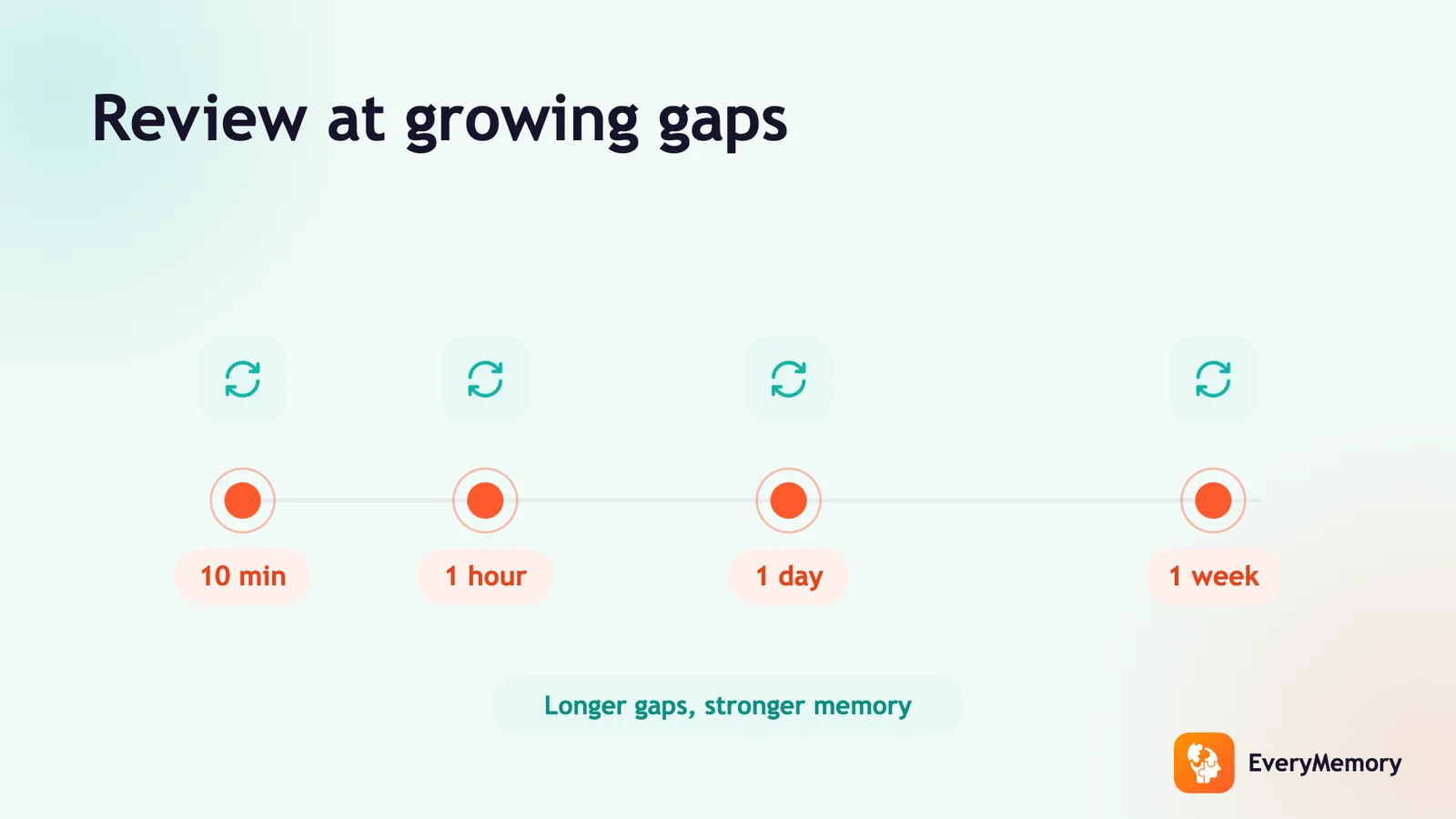
Ebbinghaus discovered not just the forgetting curve but also its mirror image: the spacing effect. Reviewing material at spaced intervals is dramatically more efficient than massing the same total study time into a single block. Each correctly timed review session resets the forgetting curve and - critically - flattens it. The trace becomes more resistant to decay after each retrieval, so the interval before the next review can stretch progressively longer.
A practical review schedule for a single piece of information might look like this: first exposure on Day 0, then review on Day 1, Day 4, Day 11, Day 25, and Day 60. Each session takes only a minute or two - you are not re-studying exhaustively, just actively retrieving the information. By the final interval, the memory is robust enough that it may need only occasional maintenance. For a detailed guide on building this kind of schedule into daily life, see spaced repetition for everyday memory, and for applying it to formal study, see spaced repetition for studying.
Spaced repetition apps (Anki is the most widely used) automate the interval calculation using an algorithm that adjusts based on how confidently you recalled each item. But a paper-based system works just as well: three index-card boxes labeled "review tomorrow," "review in a week," and "review in a month" capture the same logic without any software.
Why Active Recall Beats Rereading - and a Worked Example
The way you review matters as much as the timing. Rereading notes or highlighting text feels productive but produces a well-documented illusion of competence - the material looks familiar, but familiarity is not the same as retrievability. Active recall - closing the book and retrieving the information from scratch, or answering a question before checking the answer - forces the brain to actually rebuild the retrieval pathway rather than passively recognize the surface form. Studies comparing students who rereread against students who tested themselves on the same material consistently show the self-testing group retains more, even with equal total study time. For a full breakdown of this technique, see the active recall study method.
Here is what this looks like in practice. Say you want to remember that the capital of Kazakhstan is Astana, not Almaty (the largest city - a common confusion). Day 0: You encounter the fact, look away immediately, and write "capital of Kazakhstan = ?" on a flash card, then confirm the answer. Day 1: Before opening any notes, you quiz yourself. After a moment's effort: Astana. The card moves to the "4-day" pile. Day 5: It comes quickly. Move to the "10-day" pile. Day 15: Still solid. Move to the "3-week" pile. Day 36: One brief hesitation, then Astana surfaces cleanly - at this point the memory is robust and may need only one more check in two months.
The total active review time across five sessions is under five minutes. Compare that to the outcome of reading the fact once and never returning to it: by Day 5, the capital of Kazakhstan is almost certainly gone. This is the forgetting curve in practice - and this is why spacing combined with retrieval is so disproportionately powerful. To apply the same principles to reading non-fiction books, see how to remember more of what you read.
✅ Try this today - Run a Mini Spaced Schedule This Week
Pick one fact, name, or concept you want to remember - a person's name from a recent meeting, a word from a language you are learning, or a statistic you want ready to cite. Follow this three-step pattern over the next seven days.
- Right after first learning it, look away and write it down from memory on a slip of paper. Check your answer. If wrong, look it up and try again immediately. This first active retrieval, done within minutes of learning, has an outsized effect on how well the item survives the next 24 hours.
- The next morning, before opening any notes, try to recall the item. Give yourself 10-15 seconds of genuine effort before checking. If you get it right, the item graduates to a 4-day interval. If you draw a blank, reset to tomorrow and try again - struggling and then finding the answer still strengthens the trace.
- On Day 4 (or Day 2 if you reset), retrieve it once more and note how much less effort it takes compared to Day 1. Set a calendar reminder for Day 11 to do one final check before considering it consolidated in long-term memory.
⚠ When to talk to a professional
This article is for general memory-wellness education only and is not medical advice - if you have concerns about memory changes, consult a qualified healthcare professional.