 EveryMemory
30-Day Memory Challenge
A structured 30-day memory challenge for adults 55+. Four weekly phases, clear daily tasks, and a built-in system for tracking progress and staying on track.
Part of the guide: How to Improve Your Memory: The Complete Beginner's Guide →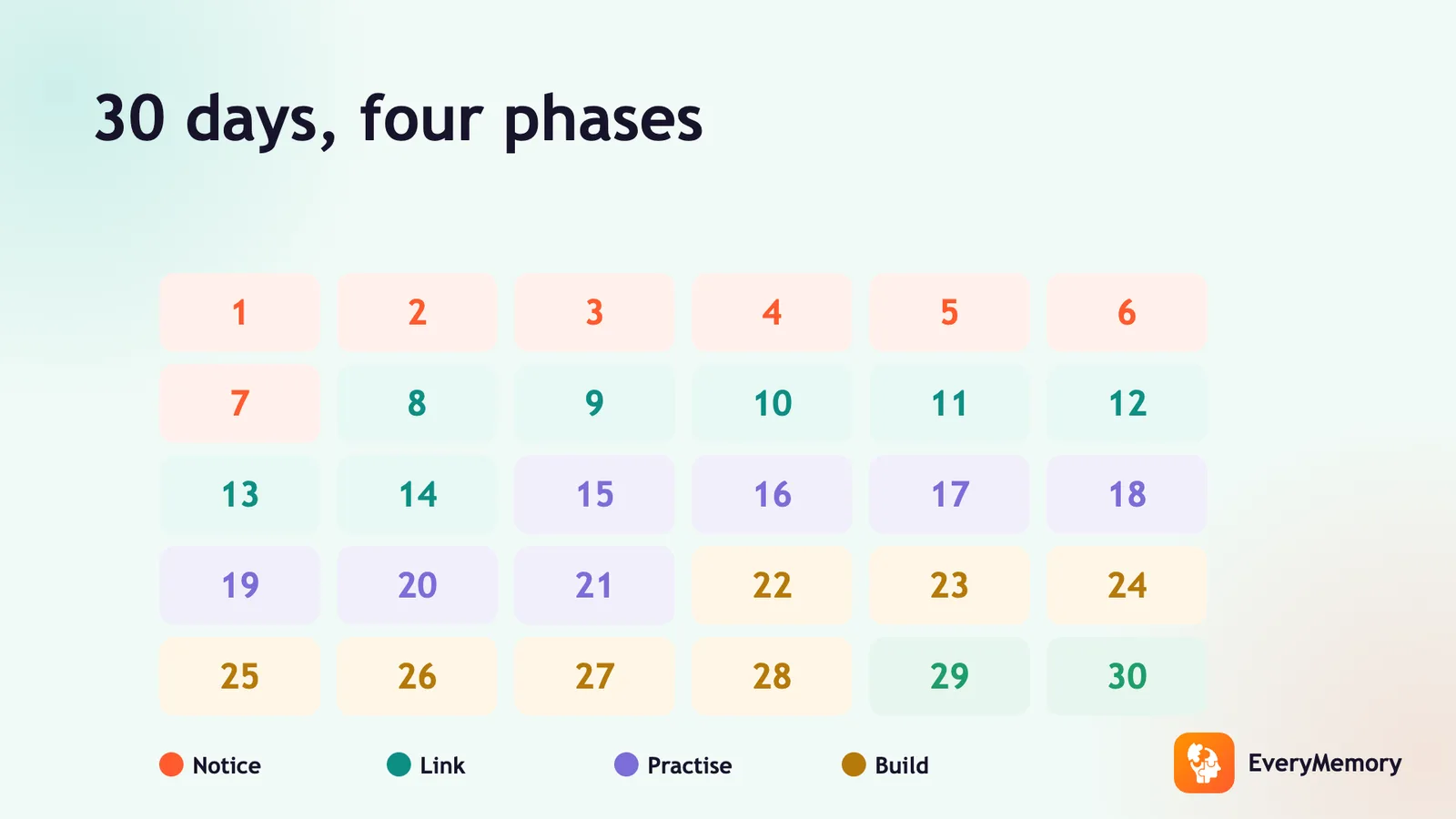
⚡ Quick answer
The 30-day memory challenge runs in four weekly phases: Week 1 builds the habit anchor with one simple exercise, Week 2 expands to a rotating exercise menu, Week 3 adds challenge and tracking, and Week 4 consolidates everything into a routine you can sustain indefinitely. Daily commitment is 10 to 15 minutes.
Key takeaways
- The challenge runs in four phases: build the anchor habit, expand exercise variety, add challenge, then consolidate into a lasting routine.
- Week one uses the same single exercise every day to build the anchor habit before introducing variety in week two.
- If you miss 3 or more days, slide back one week rather than restarting from day one.
- On day 30, writing a one-paragraph description of your routine going forward turns the challenge into a permanent habit.
A 30-day challenge works for memory training in a way that an open-ended "I should practise more" intention never quite does. A fixed endpoint makes it concrete, a weekly structure makes it manageable, and a built-in progression keeps it from getting stale before you reach the finish line.
This challenge is designed for adults 55 and older who want to build a lasting recall and focus habit - not just check off 30 boxes. Each week introduces a new layer: first the habit, then the range of exercises, then the depth, then the consolidation. By the end of the month, the practice is designed to feel like a natural part of your morning.
Before you start: two things to set up
Set up your environment before day one so that friction does not stop you in the first week.
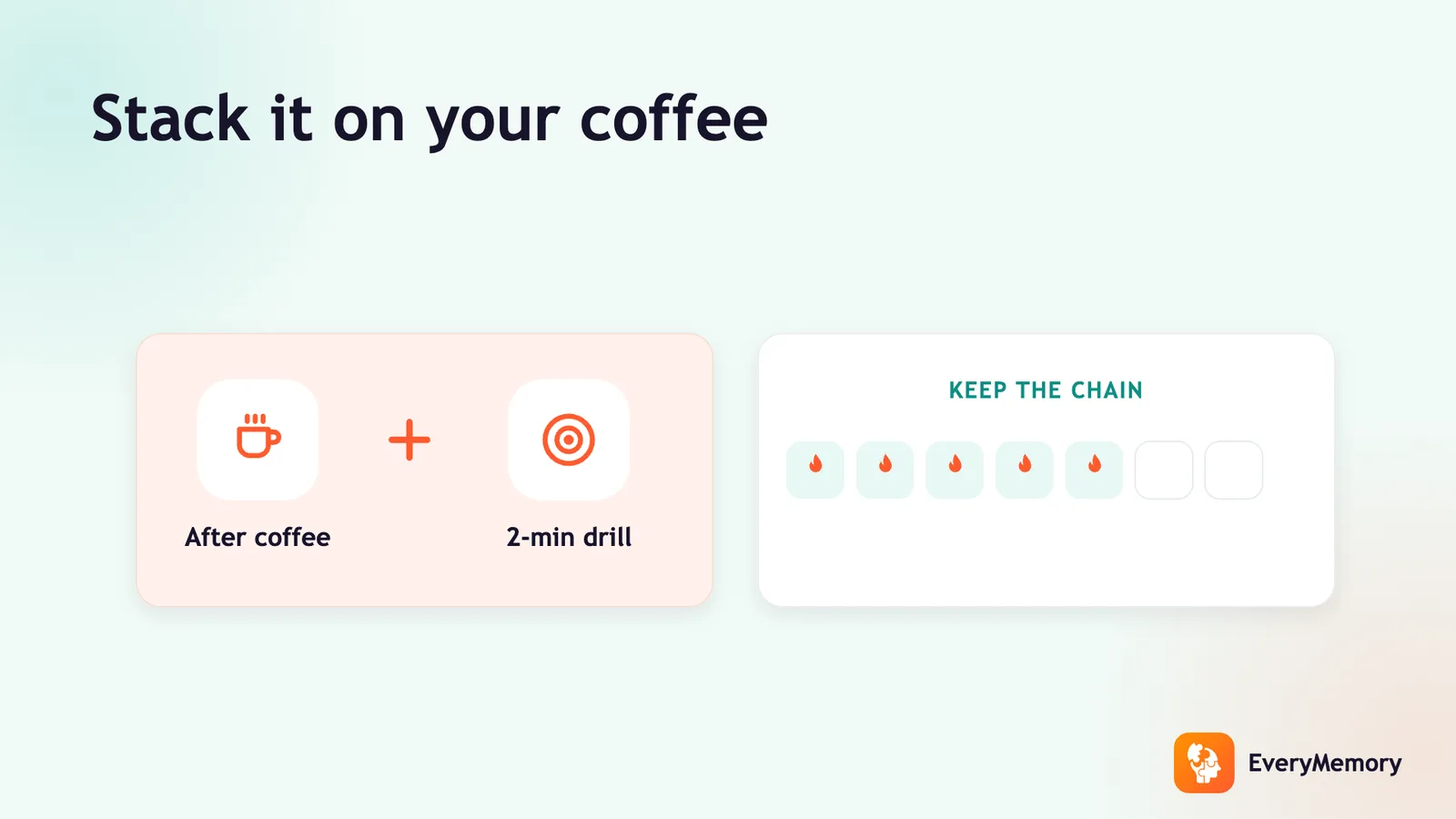
- Choose your anchor. Pick the existing morning habit you will attach your practice to: making coffee, sitting down for breakfast, or brushing your teeth. Write it down in the exact format: "After [anchor], I will spend 10 minutes on my memory challenge."
- Gather your materials. A small notebook, a pen, and this article printed or bookmarked. That is genuinely all you need. Keep the notebook in your anchor spot.
If you have not done any structured memory practice before, the 10-minute memory workout for beginners is a useful warm-up to do in the week before the challenge starts.
Week 1 (Days 1-7): Build the anchor
The goal of week one is not impressive recall performance. The goal is to show up every day. Use the same exercise every day - this reduces decisions and builds the anchor habit quickly.
Daily task (10 minutes): Read a list of 10 words slowly, cover them, write as many as you recall, then check. Note the number correct. That is the entire session.
- Day 1-3: Do not worry about the score. Focus only on completing the session.
- Day 4-5: Start noticing which types of words stick - concrete nouns, action words, or emotional words tend to hold better than abstract ones.
- Day 6-7: Compare your day 7 recall score to day 1. Most people recall one to three more words by day 7 without trying - the repetition itself is doing work.
Weekly check-in (Sunday, 5 minutes): Answer the five questions from the weekly memory check-in template and note your baseline scores for recall quality and focus.
Week 2 (Days 8-14): Expand the menu
The anchor habit is forming. Now introduce variety so different memory systems get regular practice. Rotate through five exercise types across the week:
- Monday - Names and faces: Practise linking names to faces using the names and faces exercise guide.
- Tuesday - Visual pattern recall: Study a simple image for 30 seconds, then draw it from memory. Three rounds.
- Wednesday - Word recall: Return to the word list exercise with a new list. Try to beat your week-one average.
- Thursday - Focus drill: Count backward by threes from 100 for two minutes, then two rounds from focus and attention brain workout.
- Friday - Story recall: Read a short article once, close it, write down everything you remember. Aim for five specific details.
- Weekend: One rest day and one free-choice day - repeat whichever exercise felt hardest.
Week 3 (Days 15-21): Add challenge and tracking
By week three the routine feels familiar - this is the moment to gently increase the challenge so practice stays genuinely engaging rather than automatic.
- Word recall: Increase to 15 words with a 90-second recall limit.
- Names and faces: Use new faces. Try to recall them again 24 hours after study.
- Story recall: Recall the article in a different order - start from the middle, fill in the rest.
- Focus drill: Extend sustained attention tasks from 2 to 4 minutes.
After each session this week, rate your engagement on a 1-3 scale. If you score 1 on three consecutive days, the exercise is too easy - step it up. Also complete your second weekly check-in and compare scores with week one.
Week 4 (Days 22-30): Consolidate and carry forward
Week four is the integration phase. The goal is to settle the routine into a form you will still be doing in month two - not a challenge version, but a sustainable daily practice.
- Days 22-25: Run your personalised rotation - the three exercise types you found most valuable across weeks two and three. Keep sessions at 10 to 12 minutes.
- Day 26: Repeat day one's word-recall exercise. Compare your score directly with day one. This is your month-one benchmark.
- Days 27-28: Go back to whichever exercise felt hardest in week one. Spend both days on it. Most people find it noticeably easier now.
- Day 29: Complete your month-end check-in: compare all four weekly check-in records side by side. Note what has shifted.
- Day 30: Write a one-paragraph description of your routine going forward - the anchor, the exercises you will rotate, and the weekly check-in day. This is your post-challenge plan.
Day 30 is not an endpoint. It is the moment the challenge becomes a habit. The memory training habit guide walks you through sustaining what you have built here.
What to do if you fall behind
Missing days is normal. The protocol is simple: miss one day, resume tomorrow without catch-up. Miss three or more in a row, slide back to the most recent completed week and repeat it before moving forward. Do not restart from day one unless you have missed more than ten days.
Keeping your notebook visible - on the kitchen table, on the bathroom counter - is the most effective recovery tool. Seeing it acts as a cue even on low-motivation mornings.
Tracking progress across the month
Three tracking tools to use across the 30 days:
- Daily log: After each session, write the date, exercise type, and one word to describe how it felt (sharp, steady, scattered, easy, hard). Takes 20 seconds.
- Weekly check-in: The five-question review from the weekly memory check-in template, done every Sunday.
- Benchmark scores: Your word-recall scores on days 1, 10, 20, and 30. These give you a direct before-and-after comparison on a consistent measure.
At the end of the month, the combination of daily logs, weekly check-ins, and benchmark scores gives you a genuinely rich picture of how your practice evolved. That picture is worth more than any single number.
✅ Try this today - Day one: start tonight
You do not need to wait until the first of the month. Start tomorrow morning with this:
- Tonight, write your anchor sentence on a sticky note and put it on your coffee maker or wherever your morning anchor happens: "After [anchor], I will spend 10 minutes on my memory challenge."
- Set out a notebook and pen next to the coffee maker (or your anchor spot). Write "Day 1" on the first page.
- Tomorrow morning, after your anchor, read a list of 10 words slowly, close the list, write the ones you recall. Check and write your score. That is day one done.